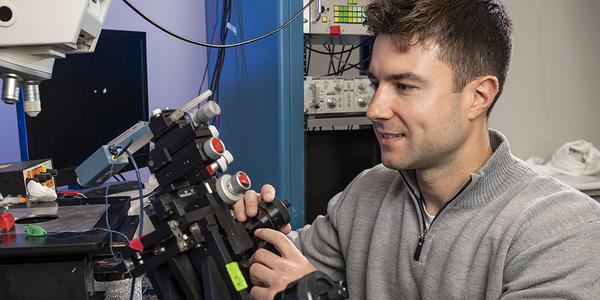

George Huang, director of the Center of Excellence in Micro Air Vehicle Research, describes military and civilian applications for the micro air vehicle.

Center of Excellence in Micro Air Vehicle Research Video Transcript
“The future warfare, as far as I’m concerned or even our country is concerned, is really with terrorists. We are dealing with the terrorists for the future; it’s not a really conventional army or such. Now, when we deal with terrorists, we talk about urban environment, we talk about the indoors. So, it would be nice if we could have an airplane, we could go into a city, search around the city, walk around the building and then get, even, into the building and go into each room to do the surveillance and the some intelligent operations. The small size is important because a lot of areas that we are going to enter are very small, tiny spaces and especially when, for example; let’s talk about non-military application: say we have a disaster, earthquake somewhere—people burning, buried underneath a building, we don’t even know if they will survive or if they’re alive or dead. But we have to spend quite a lot of money to dig the hole. Now, if we have an actually insect-size of micro air vehicle, we can actually send it in—get contact with the people, even take pictures or even take videotape, audio tape of the situation inside and it will tell us what we should do next.
“The Air Force actually has a mission to have micro air vehicle, bird-sized micro vehicle by 2015, then insect-size of micro air vehicle by 2030. Ideally, we would like to have this insect or bird-sized micro air vehicle can do autonomous flight. Basically, what we can tell them is that we say “go to that position and take a video tape or do some operation and bring back information back to me.” Right now there’s no, as far as Air Force is concerned, they have no resolution in terms of what type of shapes it’s going to be. But, if you look at nature, nature doesn’t create propeller, nature doesn’t even have jet engine in the air or in the sea. Nature, what nature created, is actually a propeller prop in the wind. And why is that? Because, actually when it comes to the smaller size, that’s probably the most efficient way of flying because you can do any prop motion, you can stop, you can make a turn, the actual ability of the vehicle is actually better than fixed wing. So, I would see it, I would say that for the future, the micro air vehicle probably would be a flapping wing vehicle.
“We are really at the center of all the activity, aerospace activity. We have Wright-Patterson next to us; we have a lot of emerging companies right around here. If you put any university right here, it would be very much like Stanford in a city camaraderie, and I see Wright State. If we can take advantage of this environment, we can make Wright State as good as Stanford University at city camaraderie. And one thing when I came over here, one mission I wanted to do was to be able to build an area of excellence, not only a center of excellence for UAV and MAV, because I know this is going to be the next generation of revolution for Dayton.”