
« Return to home page

Micro Air Research -Soaring to new heights

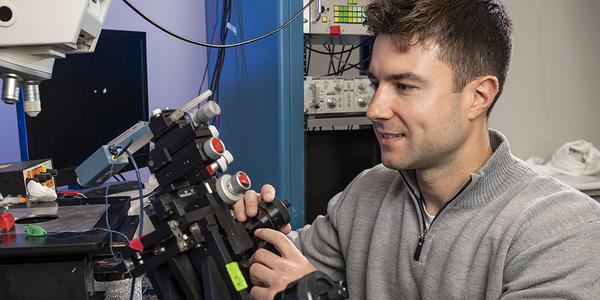
George Huang, director of the Center of Excellence for Micro Air Vehicle Research, hopes the Dayton region will become the Silicon Valley for micro air vehicles.

George Huang, director of the Center of Excellence for Micro Air Vehicle Research, hopes the Dayton region will become the Silicon Valley for micro air vehicles.

“This was my passion. Having a small-size airplane that looks like a fly is a dream,” explained George Huang, chair of Wright State’s Department of Mechanical and Materials Engineering and director of the new Center of Excellence for Micro Air Vehicle Research.

Director: George Huang, Ph.D.
(937) 775-5040
george.huang@wright.edu
http://www.wright.edu/mav

Using nature for inspiration, Huang and his team of researchers have created a micro air vehicle (MAV) modeled after the dragonfly. The MAV has a seven-and-a-half-inch wingspan and weighs 10 grams—the weight of two nickels.

According to Huang, there are many military and non-military advantages of having a plane this size, including rescue missions and spying on enemies in urban areas.

“Terrorists are in buildings, not open fields. You need to go in and see what the enemies are doing, find out where radioactive materials are located. That can only be done with a smaller object that can maneuver like a fly, not an airplane,” Huang explained.

To develop the MAV, Huang and his team studied the dragonfly and how it can sense the flow direction, going up or gliding down as needed to conserve energy. While the MAV is currently radio controlled, Huang hopes to develop sensors for the body of the MAV so it can determine flow direction and react accordingly.

4483-373Learn how graduate student Jaderic Dawson develops wings for micro air vehicles.
Read Jaderic Dawson’s Profile →

“There are different types of engineering working together to get to that stage,” said Huang. “It’s an interdisciplinary approach covering a broad range of knowledge from electrical engineering to computer science to human factors.”

Huang and his students also tapped into the expertise of local companies, including Mound Laser & Photonics Center, Inc., in Miamisburg. According to president and CEO Larry Dosser, his team used laser micromachining to create parts for the MAV and laser welded them together. “MAV work is ideal for us. We took a wing from a fly, scanned it and converted it for the lasers to replicate,” Dosser explained. “The MAV is a classic example of how we can apply our technology to develop something that the Air Force and Department of Defense can use. A lot of this technology has defense or sensing applications, but there are also very similar applications in the medical device fields.”

As the design of the MAV continues to evolve, Huang is looking for other partners and funding to support the project. “We see the opportunities to work with the Amicroair_calloutir Force and local companies to develop a micro air vehicle,” said Huang, who cites the Air Force’s goals of releasing a palm-sized MAV by 2015 and an insect-sized MAV by 2030.

“Just as the Wright brothers created the first airplane and changed the world, Wright State can be a leader in this new type of aircraft—the micro air vehicle. This cutting-edge technology could change the future of both military and civilian operations, ranging from rescue missions to gathering information. By creating partnerships with Wright-Patterson Air Force Base and local aerospace companies, the Dayton region can once again lead the world in flight,” said Bor Jang, dean of Wright State’s College of Engineering and Computer Science.

“This is the new industry of the 21st century. The Dayton region can evolve from making cars to creating micro air vehicles that you can hold in your hand,” said Dosser. “The collaboration between Wright State and our company will help all of us stay on the leading edge of this technology.”

Huang hopes the Dayton region will become the Silicon Valley for micro air vehicles. “Companies will come here and this will become a center for micro air vehicle technology,” said Huang.

Center of Excellence in Micro Air Vehicle Research Video

George Huang, director of the Center of Excellence in Micro Air Vehicle Research, describes military and civilian applications for the micro air vehicle.

YouTube Preview Image

Comments are closed.


3640 Colonel Glenn Highway - Dayton, Ohio - 45435
WSU Official Biplane Logo
Copyright Information © 2009 | Accessibility Information
Please send comments to: webmaster@wright.edu