<?xml version="1.0" encoding="UTF-8"?>
<rss version="2.0"
	xmlns:content="http://purl.org/rss/1.0/modules/content/"
	xmlns:wfw="http://wellformedweb.org/CommentAPI/"
	xmlns:dc="http://purl.org/dc/elements/1.1/"
	xmlns:atom="http://www.w3.org/2005/Atom"
	xmlns:sy="http://purl.org/rss/1.0/modules/syndication/"
	xmlns:slash="http://purl.org/rss/1.0/modules/slash/"
	xmlns:wsud="http://webapp2.wright.edu/web1/community/wp-content/themes/wsu-community/wsudrupal.xsd.xml">

<channel>
	<title>Wright State University Magazine</title>
	<atom:link href="http://webapp2.wright.edu/web1/community/feed/" rel="self" type="application/rss+xml" />
	<link>http://webapp2.wright.edu/web1/community</link>
	<description></description>
	<lastBuildDate>Fri, 07 Jun 2013 14:08:27 +0000</lastBuildDate>
	<language>en</language>
	<sy:updatePeriod>hourly</sy:updatePeriod>
	<sy:updateFrequency>1</sy:updateFrequency>
	<generator>http://wordpress.org/?v=3.3.1</generator>
<xhtml:meta xmlns:xhtml="http://www.w3.org/1999/xhtml" name="robots" content="noindex" />
		<item>
		<title>Unlocking Memories</title>
		<link>http://webapp2.wright.edu/web1/community/2013/unlocking-memories/</link>
		<comments>http://webapp2.wright.edu/web1/community/2013/unlocking-memories/#comments</comments>
		<pubDate>Mon, 13 May 2013 19:58:10 +0000</pubDate>
		<dc:creator>Jim Hannah</dc:creator>
				<category><![CDATA[Academics]]></category>
		<category><![CDATA[Article]]></category>
		<category><![CDATA[Science & Math]]></category>

		<guid isPermaLink="false">http://webapp2.wright.edu/web1/community/?p=3082</guid>
		<description><![CDATA[Golf tournaments, Italian music, the late Julia Childs’ cooking shows, and family photos—lots of family photos. These are among the contents of “memory boxes,” part of a revolutionary program called Behavior-Based Ergonomics Therapy, or BBET, for dementia patients being pioneered &#8230; <a href="http://webapp2.wright.edu/web1/community/2013/unlocking-memories/" class="morelink">Continue reading <span class="meta-nav">&#8594;</span></a>]]></description>
			<content:encoded><![CDATA[<p><a href="http://webapp2.wright.edu/web1/community/?attachment_id=3085" rel="attachment wp-att-3085"><img class="aligncenter size-large wp-image-3085" src="http://webapp2.wright.edu/web1/community/files/2013/05/UnlockingMemories1-640x488.jpg" alt="" width="640" height="488" /></a></p>
<p>Golf tournaments, Italian music, the late Julia Childs’ cooking shows, and family photos—lots of family photos. These are among the contents of “memory boxes,” part of a revolutionary program called Behavior-Based Ergonomics Therapy, or BBET, for dementia patients being pioneered by a Wright State University biomedical engineering adjunct professor.</p>
<p>Govind Bharwani, Ph.D., developed the program for Alzheimer’s patients at the St. Leonard Franciscan Living Community in Centerville, Ohio. The program is spreading quickly. It is now being used at more than a dozen institutions in Ohio, Kentucky, and Kansas. And there is a six-month waiting list for those who want to implement some form of it.</p>
<p>“We are getting calls from around the world,” said Bharwani. “This is changing the way Alzheimer’s care will be done.”</p>
<p>Alzheimer’s disease is the most common form of dementia. Symptoms include memory loss, confusion, irritability, aggression, and withdrawal. The disease gets worse as it progresses, eventually leads to death, and there is no known cure. An estimated 5.4 million Americans are living with Alzheimer’s, which is the sixth-leading cause of death in the United States, according to the Alzheimer’s Association.</p>
<p>Alzheimer’s can place a great burden on caregivers. St. Leonard turned to Wright State and the College of Nursing and Health’s Nursing Institute of West Central Ohio for help with the physical wear on its staff and with Alzheimer’s patients, who would sometimes fall and injure themselves.</p>
<div id="attachment_3088" class="wp-caption alignleft" style="width: 310px"><a href="http://webapp2.wright.edu/web1/community/?attachment_id=3088" rel="attachment wp-att-3088"><img class="size-medium wp-image-3088" src="http://webapp2.wright.edu/web1/community/files/2013/05/UnlockingMemoriesBlue-300x200.jpg" alt="" width="300" height="200" /></a><p class="wp-caption-text">A therapy room at the St. Leonard facility</p></div>
<p>“The staff on the Alzheimer’s unit were always fighting fires; there was always a crisis; there was always somebody upset. Then it snowballs to other people,” said Bharwani’s daughter, Meena, who helps implement the therapy program and train the staff. “It’s hard to get control of the unit when everyone’s got so much stress.”</p>
<p>Enter her father, an ergonomics expert with 30 years’ experience. Ergonomics is the science of reducing physical and mental stress, which can afflict Alzheimer’s patients. Their loss of memory can make them agitated and combative, leading to behavior problems and the use of anti-psychotic medication.</p>
<p>“Our research has shown that boredom and disengagement in a long-term care facility can lead to these types of behaviors,” Bharwani said. “If they’re not engaged in a meaningful way, they run into emotional problems; that eventually leads to behavior problems and also causes a lot of stress on the caregivers.”</p>
<p>The question became how best to engage them.</p>
<p>Bharwani formed a team from Wright State, the Alzheimer’s Association, and St. Leonard’s—members with a total of 90 years’ practical experience. He also toured retirement and nursing facilities around the state that focused on Alzheimer’s care.</p>
<p>He found that Alzheimer’s residents are often put into group activities and sessions, which can engage some of them but not others. He also discovered that an array of different therapies was being used with the residents—from music therapy to aroma therapy to pet therapy. However, the therapies often called for specialists, which was expensive and impractical for the institutions and didn’t work for every resident.</p>
<p>So Bharwani decided to focus on the most effective therapies and then create therapy programs customized for each resident. He developed personality profiles through family histories and cognitive assessments. A computer software program would then spit out a therapy prescription that could be easily implemented by the nursing staff. It is believed to be the first non-pharmacological customized therapy program for Alzheimer’s patients in the nation.</p>
<p>The therapies include a music library of CDs that features hymns, oldies, television theme songs, Lawrence Welk, and other soothing sounds. Then there are videos of sports, travel, music sing-alongs, hobbies, comedies, cooking, and gardening. Called “comforting” libraries, these two therapies are designed to reduce cognitive stress.</p>
<p>A third therapy stimulates the brain through the use of games and puzzles. And the use of individual memory boxes constitutes the fourth leg of the program by providing reminiscent therapy. The residents’ families supply sentimental items in the memory boxes such as old photos and stuffed animals.</p>
<p>“These customized therapies in combination can reduce resident stress and prevent difficult behaviors,” Bharwani said.</p>
<p>The memory boxes are a crucial component of the therapy. Dementia patients often cannot remember recent events, but retain pleasant experiences from the distant past and even remember details that an average person would likely have long forgotten.</p>
<div id="attachment_3089" class="wp-caption alignright" style="width: 310px"><a href="http://webapp2.wright.edu/web1/community/?attachment_id=3089" rel="attachment wp-att-3089"><img class="size-medium wp-image-3089" src="http://webapp2.wright.edu/web1/community/files/2013/05/UnlockingMemoriesGreen-300x204.jpg" alt="" width="300" height="204" /></a><p class="wp-caption-text">Another therapy room at the St. Leonard facility</p></div>
<p>“As the disease progresses, they begin to enjoy what they were many years ago,” Bharwani said. “You can put them in front of a mirror, and they would not recognize who the person is. But you give them a picture of what they were 20 or 30 years ago, and they’ll know exactly who it is.”</p>
<p>The therapy items are housed in a small room on the unit called the BBET Resource Center, which is open around the clock. The caregivers on the unit use an individualized<br />
therapy action plan and often add to the items themselves if they see the need. One nurse once went out and bought a model train for a resident.</p>
<p>Laura Spain, a nursing assistant who has worked on the unit for 14 years, said the therapy items are  especially helpful in the middle of the night, when some residents get anxious and begin pacing. A 30- to 60-minute BBET therapy session is usually sufficient to keep a resident calm for up to four hours and they eat, sleep, and bathe in a relaxed manner.</p>
<p>“It just stops the behavior and stops the anxiety so they’re not hurting,” she said.</p>
<p>Nurses and other workers on the unit were initially skeptical of the therapy program and concerned it would add to their already-heavy workload. It was tested on five of the 18 residents during the pilot.</p>
<p>“In the first week, they saw such a change in their behavior that the staff was absolutely blown away,” Bharwani said.</p>
<p>When the Bharwanis’ program was implemented unit-wide, the moods and behaviors of residents dramatically improved. Within six months, resident falls had decreased by 40 percent and the use of behavior medicines—including anti-psychotic medication—had been reduced by up to 70 percent. Bharwani found himself presenting the results at conferences around the country.</p>
<p>“It’s all about individual engagement as opposed to medication,” said Tim Dressman, executive director of St. Leonard. “We’ve had tons of tours and attention from the outside, internationally. You use it, it works. I can’t say enough.”</p>
<p>Eric VanVlymen, executive director of the Alzheimer’s Association, Miami Valley Chapter, said the Bharwani program empowers the staff to help residents with dementia in an engineered and systematic way.</p>
<p>“That’s the beauty of it,” VanVlymen said. “I have seen a lot of different programs, and what makes this special is it thinks about the staff and how to reduce their stress and it thinks about people with dementia and how to reduce their stress through<br />
those therapies. What I have really come to appreciate is Dr. Bharwani’s engineering mind, which addresses the problem from a different perspective.”</p>
<p>Since the first BBET Resource Center at St. Leonard was established in 2010, the program has expanded into their new memory support facility with a resource center in each of four wings. In late 2012, St. Leonard opened yet another center<br />
to benefit the community—this one to help early-stage dementia patients who are being cared for in their homes, often by their children.</p>
<p>“It gives the caregivers a respite,” Bharwani said. “They are struggling. For them, it is a tremendous amount of stress.”</p>
<p>The BBET program has been honored with five national awards, including the 2011 Dorland Health Silver Crown Award for Alzheimer’s Care and the 2011 American Medical Directors Association Foundation Quality Improvement Award.</p>
<p>Bharwani grew up in New Delhi, India. His neighbors encouraged him to pursue engineering at a nearby engineering college, the Birla Institute of Technology &amp; Science.</p>
<p>He obtained his mechanical engineering degree in India, master’s degrees in industrial engineering and business administration from Lehigh University in Pennsylvania, and his Ph.D. from Wright State in biomedical engineering.</p>
<p>Bharwani has now begun working on a book that—based on his research and experience—will serve as a practical guide to caring for people with dementia.</p>
<p>He said he initially approached the St. Leonard’s project like the engineer he is, focusing dispassionately on the results. Later it became an emotional experience, with Bharwani often getting hugs from grateful family members.</p>
<p>“They say, ‘You’ve given my mother a new life’ or ‘You’ve given my father a new life,’” he said. “Improving the quality of life for people with Alzheimer’s disease is what this program is all about.”</p>
]]></content:encoded>
			<wfw:commentRss>http://webapp2.wright.edu/web1/community/2013/unlocking-memories/feed/</wfw:commentRss>
		<slash:comments>0</slash:comments>
	<wsud:featured-image>http://webapp2.wright.edu/web1/community/files/2013/05/UnlockingMemories1.jpg</wsud:featured-image><wsud:excerpt><![CDATA[Golf tournaments, Italian music, the late Julia Childs’ cooking shows, and family photos—lots of family photos. These are among the contents of “memory boxes,” part of a revolutionary program called Behavior-Based Ergonomics Therapy, or BBET, for dementia patients being pioneered &hellip; <a href="http://webapp2.wright.edu/web1/community/2013/unlocking-memories/" class="morelink">Continue reading <span class="meta-nav">&rarr;</span></a>]]></wsud:excerpt>	</item>
		<item>
		<title>Engineering Marvel</title>
		<link>http://webapp2.wright.edu/web1/community/2013/engineering-marvel/</link>
		<comments>http://webapp2.wright.edu/web1/community/2013/engineering-marvel/#comments</comments>
		<pubDate>Mon, 13 May 2013 19:58:09 +0000</pubDate>
		<dc:creator>Jim Hannah</dc:creator>
				<category><![CDATA[Article]]></category>

		<guid isPermaLink="false">http://webapp2.wright.edu/web1/community/?p=3096</guid>
		<description><![CDATA[He arrived in this country from his native India clutching two suitcases and carrying $200 in his pocket. Just 48 years old, Sundaram Narayanan is the new provost of Wright State, assuming his duties as the university’s chief operating officer &#8230; <a href="http://webapp2.wright.edu/web1/community/2013/engineering-marvel/" class="morelink">Continue reading <span class="meta-nav">&#8594;</span></a>]]></description>
			<content:encoded><![CDATA[<p>He arrived in this country from his native India clutching two suitcases and carrying $200 in his pocket.</p>
<p><a href="http://webapp2.wright.edu/web1/community/2013/engineering-marvel/engineeringmarvelc-2/" rel="attachment wp-att-3257"><img class="alignright size-medium wp-image-3257" src="http://webapp2.wright.edu/web1/community/files/2013/05/EngineeringMarvelC1-287x300.jpg" alt="" width="287" height="300" /></a>Just 48 years old, Sundaram Narayanan is the new provost of Wright State, assuming his duties as the university’s chief operating officer and chief academic officer on March 18. Previously, he was dean of the College of Engineering and Computer Science and helped create and lead the Wright State Research Institute.</p>
<p>“The provost position is a tremendous opportunity to help Wright State grow even further,” Narayanan said. “It’s important that we continue to grow and support the innovations and the entrepreneurial spirit that exists at the university.”</p>
<p>Narayanan grew up in Bangalore in southern India, well known as a hub for India’s information technology sector. His parents, both of whom worked for the telephone company, couldn’t afford to go to college. But they encouraged Narayanan and his sister to do so.</p>
<p>“The value of education was something that was preached to us,” said Narayanan, who obtained his bachelor’s degree in mechanical engineering at India’s National Institute of Technology, followed by his master’s degree from the University of Alabama and doctoral degree from the Georgia Institute of Technology in industrial and systems engineering.</p>
<p>After obtaining the graduate engineering degrees, Narayanan’s journey took him to Wright State, where he first taught as an assistant professor, later chaired the Department of Biomedical, Industrial, and Human Factors Engineering, and then led the Wright State Research Institute and the College of Engineering and Computer Science as dean.</p>
<p>Narayanan, who remains active playing cricket with Wright State students and competes against teams at other universities, says being a first-generation college student gives him a special perspective as provost.</p>
<p>“Wright State’s mission of providing the opportunity of high-value education to everyone is close to my heart,” he said. “We will strive to help students from all backgrounds come to Wright State and become high achievers.”</p>
<p>Wright State President David R. Hopkins said Narayanan’s 18-year career at the university has proven him to be an outstanding teacher, department chair, and dean. And, said Hopkins, he has a tremendous ability to see how everything fits together.</p>
<p>“While the campus genuinely respects and admires his distinguished career, it is what he will help to lead us to do in the future that has our faculty, staff, and students truly excited,” Hopkins said. “It’s what sets him apart and positions him to lead.”</p>
<p>Narayanan’s leadership philosophy is to recruit top talent, give them the tools and resources for success, provide strong mentorship, promote high performers in key positions, set ambitious targets, and break down barriers that limit results.</p>
<p>Narayanan says his goals as provost include continuing to improve academic quality so that students succeed and maintaining the strength and institutional knowledge of faculty and staff in the face of impending retirements. He also wants to make the university more prominent.</p>
<p>“We’ve got to be known as a market leader,” he said. “We have to get the word out in terms of what our professors are doing, what our students are doing—national competitions, publishing in top-quality journals.”</p>
<p>Under Narayanan’s tenure as dean, the engineering and computer science college experienced its highest enrollment in its history; the school’s research funding grew by 67 percent from $9 million in 2009 to $15 million in 2012; and the college created Ohio’s only master’s degree program in cyber security.</p>
<p>Narayanan was also instrumental in creating and directing the Wright State Research Institute, which in five years has grown to more than 75 employees with annual research awards of more than $20 million.</p>
<p>Narayanan has directed research programs in computer modeling and simulation of complex systems in which the human operator plays a major role. These efforts resulted in nearly $20 million in extramural funding from federal, state, and industry and helped produce over 100 technical articles and two books.</p>
<p>Narayanan says his engineering background has taught him to take a systems approach in decision making.</p>
<p>“It’s the whole notion of seeing the bigger picture, the different elements fitting together,” he said. “You’ve got multiple stakeholders, and you need to have a sense of balance between all of the different stakeholders involved.”</p>
<p>He also believes in empowering people and encouraging them to express their perspectives and opinions.</p>
<p>“Then you want to be able to put them together in a manner that will constantly focus on what is best for them and for the organization,” he said.</p>
<p>Narayanan was named provost following a nationwide search that resulted in six finalists for the position. He succeeds Steven Angle as the university’s permanent provost. Angle was named chancellor at the University of Tennessee at Chattanooga in March.</p>
<p>Narayanan and his wife, Viji, reside in Centerville, Ohio, with their three children.</p>
]]></content:encoded>
			<wfw:commentRss>http://webapp2.wright.edu/web1/community/2013/engineering-marvel/feed/</wfw:commentRss>
		<slash:comments>0</slash:comments>
	<wsud:featured-image>http://webapp2.wright.edu/web1/community/files/2013/05/EngineeringMarvelC.jpg</wsud:featured-image><wsud:excerpt><![CDATA[He arrived in this country from his native India clutching two suitcases and carrying $200 in his pocket. Just 48 years old, Sundaram Narayanan is the new provost of Wright State, assuming his duties as the university’s chief operating officer &hellip; <a href="http://webapp2.wright.edu/web1/community/2013/engineering-marvel/" class="morelink">Continue reading <span class="meta-nav">&rarr;</span></a>]]></wsud:excerpt>	</item>
		<item>
		<title>Reel Respect</title>
		<link>http://webapp2.wright.edu/web1/community/2013/reel-respect/</link>
		<comments>http://webapp2.wright.edu/web1/community/2013/reel-respect/#comments</comments>
		<pubDate>Mon, 13 May 2013 16:20:25 +0000</pubDate>
		<dc:creator>Cory MacPherson</dc:creator>
				<category><![CDATA[Article]]></category>

		<guid isPermaLink="false">http://webapp2.wright.edu/web1/community/?p=3047</guid>
		<description><![CDATA[Quick: name your favorite movie. Can you imagine how you would feel if that movie were lost, never to be watched again by you or anyone else? Now, what do The Matrix, Citizen Kane, This Is Spinal Tap, To Kill &#8230; <a href="http://webapp2.wright.edu/web1/community/2013/reel-respect/" class="morelink">Continue reading <span class="meta-nav">&#8594;</span></a>]]></description>
			<content:encoded><![CDATA[<div id="attachment_3049" class="wp-caption aligncenter" style="width: 650px"><a href="http://webapp2.wright.edu/web1/community/2013/reel-respect/reelrespect/" rel="attachment wp-att-3049"><img class="size-large wp-image-3049" src="http://webapp2.wright.edu/web1/community/files/2013/05/ReelRespect-640x446.jpg" alt="" width="640" height="446" /></a><p class="wp-caption-text">Photo: Gravitas Docufilms</p></div>
<p style="text-align: center">Quick: name your favorite movie. Can you imagine how you would feel if that movie were lost, never to be watched again by you or anyone else?</p>
<p>Now, what do <em>The Matrix, Citizen Kane, This Is Spinal Tap, To Kill a Mockingbird,</em> and <em>Singin’ in the Rain</em> have in common? The answer is that they’re all included on the National Film Registry, a list of the most important American movies.</p>
<p><em>These Amazing Shadows</em>, a new documentary by filmmakers Paul Mariano and Kurt Norton, chronicles the history of the National Film Registry and explores the impact of its films on American culture, as well as what is being done to protect our film heritage for future generations. One of the film’s stars is George Willeman,<br />
a 1988 graduate of Wright State’s motion pictures program and the nitrate film vault manager for the Library of Congress.</p>
<p>Since 1989, the Librarian of Congress has announced 25 titles each year to be added to the National Film Registry for preservation. To be selected, films must be at least 10 years old and be deemed “culturally, historically, or aesthetically significant” by the Librarian of Congress, based on recommendations by the National Film Preservation Board.</p>
<p>The Registry represents a diverse array of American films. In addition to features and documentaries, it also includes newsreels and home movies. In 2009, Michael Jackson’s <em>Thriller</em> became the first music video listed on the Registry.</p>
<p>“It’s saying to America and to the world: these films matter,” said film critic and historian Leonard Maltin in <em>These Amazing Shadows</em>. “It’s saying that your film has stood the test of time.”</p>
<p>Inclusion on the National Film Registry does more than simply certify a work’s importance; it also ensures that a film’s original materials will be conserved by the Library of Congress. If need be, the Library will also oversee that it is physically preserved, often with painstaking care.</p>
<p>“For a variety of reasons—neglect or basic deterioration especially—many of our early films, and actually some more recent ones, are lost forever. There’s nothing left,” said Willeman. “I know of one Academy Award–winning film called <em>The Patriot</em>. All that survives from it are a few trailers and stills.”</p>
<p>Preservation is particularly important for the nitrate films that Willeman is responsible for overseeing. Though nitrate film was used extensively from the late 1800s up until the 1950s, the product is highly flammable and must be kept in climate-controlled vaults. “It’s the plastic version of gunpowder,” said Willeman. With many of the early 20th century’s most beloved films in danger of literally “going up in flames,” it’s up to Willeman to rescue and safeguard these movies for future generations.</p>
<p>Growing up in Springfield, Ohio, Willeman was bitten by the film bug at a young age. He started by bringing movies home from the library and then moved on to collecting silent 8mm reels from Blackhawk Films. Eventually, he saved up enough paper route money to buy a print of the 1927 futuristic classic <em>Metropolis</em>. Willeman still remembers watching it in his basement with friends.</p>
<p>That love of movies led Willeman to enroll in Wright State’s motion pictures program. “It was like living in a hippie commune of filmmakers and it was so wonderful,” he said of his time spent in the department’s film labs, located then in Millett Hall. “We’d be there all hours of the day. There were so many talented people in the program and we had this great time.”</p>
<p>He had thought that he’d become a filmmaker, perhaps focusing on comedy or horror features. But fate had other plans.</p>
<p>At that time, the Library of Congress’ film preservation laboratory and nitrate film vaults were housed at Wright-Patterson Air Force Base in Dayton. Willeman took a part-time student job there as a collections attendant. He inspected cans of the hightly flammable nitrate film for four hours a day. “You have to love film to work there,” he said. “Otherwise it’s just nasty cans of rotting plastic that could catch on fire and do<br />
horrible damage.”</p>
<p>Willeman stayed with the Library of Congress even after graduation. He became a nitrate film specialist, identifying and classifying each individual film that came in. When the nitrate collection was moved to the new Library of Congress Packard Campus for Audio-Visual Conservation in Culpeper, Virginia, Willeman relocated as well. Today, he’s the nitrate film vault manager, responsible for the more than 150,000 cans of nitrate film in the Library’s collection.</p>
<p>One of the most exciting aspects of Willeman’s job is discovering pieces of film history previously thought to be lost forever. “When I started at the nitrate vault, I was one of the few who had any kind of education in film,” he said. “So I started finding things that had been there, but nobody knew what they were.”</p>
<p>Willeman identified the original negative of Edwin S. Porter’s 1903 western <em>The Great Train Robbery</em>. He also discovered the original, <em>uncensored</em> negative of the notorious 1933 film <em>Baby Face</em>, starring Barbara Stanwyck as an attractive woman who uses her sexuality to get ahead. “It had all the naughty bits still in it,” said Willeman. “That was just the find of a lifetime.”</p>
<p>His <em>Baby Face</em> discovery is just one of the many stories Willeman tells in <em>These Amazing Shadows</em>. When filmmakers Mariano and Norton approached him about appearing in the documentary, Willeman never imagined that he’d share the screen with Hollywood legends like George Takei, Rob Reiner, John Waters, and Debbie Reynolds. Nor did he think that the experience would take him to Sundance and other prestigious film festivals. “I couldn’t believe it when they told me that I have the most screen time in the film, especially with some of the other folks in it,” he said. “And I gave the film its title. That’s pretty exciting.”</p>
<p>Yet even after the excitement of appearing in a film himself, Willeman describes himself as “blessed” to have his day-to-day job: “It’s really nerdy, but I just love being around these reels of film and being a part of making sure that they’re preserved so that people can see them later on.”<br />
To learn more, please visit the <a href="http://www.youtube.com/user/TheseAmazingShadows">YouTube channel</a> for These Amazing Shadows</p>
]]></content:encoded>
			<wfw:commentRss>http://webapp2.wright.edu/web1/community/2013/reel-respect/feed/</wfw:commentRss>
		<slash:comments>0</slash:comments>
	<wsud:featured-image>http://webapp2.wright.edu/web1/community/files/2013/05/ReelRespect.jpg</wsud:featured-image><wsud:excerpt><![CDATA[Quick: name your favorite movie. Can you imagine how you would feel if that movie were lost, never to be watched again by you or anyone else? Now, what do The Matrix, Citizen Kane, This Is Spinal Tap, To Kill &hellip; <a href="http://webapp2.wright.edu/web1/community/2013/reel-respect/" class="morelink">Continue reading <span class="meta-nav">&rarr;</span></a>]]></wsud:excerpt>	</item>
		<item>
		<title>On the Road to Civil Rights</title>
		<link>http://webapp2.wright.edu/web1/community/2013/on-the-road-to-civil-rights/</link>
		<comments>http://webapp2.wright.edu/web1/community/2013/on-the-road-to-civil-rights/#comments</comments>
		<pubDate>Mon, 13 May 2013 16:20:24 +0000</pubDate>
		<dc:creator>Wright State Media Team</dc:creator>
				<category><![CDATA[Article]]></category>

		<guid isPermaLink="false">http://webapp2.wright.edu/web1/community/?p=3066</guid>
		<description><![CDATA[Since the civil rights movement began sweeping through the South 50 years ago, the winds of change have carried away some its most notorious locations and enshrined others as monuments to courage. On March 1, 2013, more than 250 people, including &#8230; <a href="http://webapp2.wright.edu/web1/community/2013/on-the-road-to-civil-rights/" class="morelink">Continue reading <span class="meta-nav">&#8594;</span></a>]]></description>
			<content:encoded><![CDATA[<div id="attachment_3070" class="wp-caption aligncenter" style="width: 650px"><a href="http://webapp2.wright.edu/web1/community/2013/on-the-road-to-civil-rights/roadtocivilrights/" rel="attachment wp-att-3070"><img class="size-large wp-image-3070 " src="http://webapp2.wright.edu/web1/community/files/2013/05/RoadToCivilRights-640x454.jpg" alt="" width="640" height="454" /></a><p class="wp-caption-text">Left to right: Jamal Russell, Chad Lovins, Brooke Moore, Lukas Schweikert, Christopher Jones, Andrianna Milton, Michael Tyler II, Phillip Logan, and Amaha Selassie. (Photo: Tracy Snife)</p></div>
<p>Since the civil rights movement began sweeping through the South 50 years ago, the winds of change have carried away some its most notorious locations and enshrined others as monuments to courage.</p>
<p>On March 1, 2013, more than 250 people, including 33 members of Congress, nine Wright State students, and faculty member Tracy Snipe, Ph.D., gathered to begin the 13th Congressional Civil Rights Pilgrimage to Alabama. On the first day, they stood on the steps of the University of Alabama campus building where Governor George Wallace blocked the entrance to bar black students from enrolling, as two students stood up to segregation in 1963.</p>
<p>The pilgrimage, sponsored by the Faith and Politics Institute in Washington, D.C., is a three-day event aimed at fostering understanding of civil rights issues, past and present. For the second year, Wright State students participated as part of a seminar class led by Snipe, associate professor of political science, with financial support from the College of Liberal Arts and the Division of Multicultural Affairs &amp; Community Engagement, among other units. They were among 35 people from high school to age 30 selected for the Students and Stewards program of the pilgrimage.</p>
<p>“Our hope is that as young people travel on the pilgrimage, they understand the history and how it impacts the future,” said Rev. Joseph A. C. Smith, who oversees the Students and Stewards program for the Faith and Politics Institute. “This year, we are looking at the concept of non-violence, asking them to reflect on where violence is present in their lives and what non-violent responses might be.”</p>
<p>After visiting Tuscaloosa, Alabama, the pilgrimage group traveled to Birmingham, Alabama, for a visit to the Civil Rights Institute, Kelly Ingram Park, where police turned dogs and fire hoses on peaceful protestors, and the 16th Street Baptist Church, where four young girls were killed by a bomb while in Sunday school. The 1963 church bombing turned public sympathies toward the civil rights movement, and the survivors of the bombing are the subjects of Snipe’s academic research.</p>
<p>The second day was spent in Montgomery, Alabama, the capital city where Rosa Parks refused to sit at the back of the bus, Martin Luther King, Jr., preached, and the Freedom Riders met with brutal resistance.</p>
<p>“After going to places like Alabama, you have a greater appreciation for the degree of courage it took to be a pacifist,” observed Snipe. The proximity of the protest sites to the state capital building, for example, put them “a stone’s throw away from danger.”</p>
<p>As important as seeing the sites of the civil rights movement was the opportunity to meet its heroes, together with current political leaders.</p>
<p>Congressional representatives on the pilgrimage crossed the political aisle, from John Lewis, Democratic representative from Atlanta, Georgia, to Eric Cantor, Republican House Majority leader from Richmond, Virginia. Surgeon General Regina Benjamin and Attorney General Eric Holder were among those representing the Executive Branch.</p>
<p>Rep. Lewis has been a civil rights activist since the 1960s. He was a young leader of the Student Nonviolent Coordinating Committee and a Freedom Rider. Along with Hosea Williams, he led a non-violent protest march that began on the Edmund Pettus Bridge in Selma, Alabama; it turned into “Bloody Sunday” on March 7, 1965, when state and local police attacked. This year’s Congressional Pilgrimage concluded in Selma with a worship service at the Brown Chapel and the annual commemoration of Bloody Sunday, as 5,000 people recreated the walk over the bridge, led this year by Vice President Joe Biden.</p>
<p>The Wright State students were impressed with the approachability of the leaders on the pilgrimage and inspired by talks by such civil rights legends as Rev. Bernard LaFayette, who heads the Center for Nonviolence and Peace Studies at the University of Rhode Island, and Ruby Bridges, who, at the age of 6, was the first African American child to integrate an all-white school in New Orleans.</p>
<p>“The experience was something that will live with you forever,” said Andrianna Milton, who is majoring in African American Studies and plans a teaching career. Her own family history is tied to Alabama, where her paternal great-grandmother died on a plantation. When she met Rep. Lewis, she was struck by the fact that he was college age when he joined the civil rights movement. Of his non-violent approach to change, she said, “We can carry that on today.”</p>
<p>“The biggest thing they taught was that you can’t understand how to move forward until you understand where you’ve been,” said Michael Tyler, who researches the civil rights movement as part of his Wright State Master of Humanities program. “You look at the struggles that others went through, people who died so that people they never knew could vote. It’s the power of one—what one person can do.”</p>
<p>The desire to influence social justice issues during their careers was the impetus for many of the Wright State students to join the pilgrimage. They found government and private-sector leaders enthusiastic about helping them through networking and internship opportunities.</p>
<p>The in-depth stories of the pilgrimage are yet to be written by the Wright State students. Brooke Moore, who plans to go into health administration, spoke with a senior vice president of Pfizer. Christopher Jones talked with Rep. Lewis’ chief of staff about a possible internship. Chad Lovins plans to get a master’s degree in international relations. Jamal Russell is a senior in English literature and has written on his experiences visiting civil rights sites. Amaha Selassie is working on ways to build trust among diverse students on campus and will participate in the Caux Scholars Program on peace building in Switzerland this summer.</p>
<p>Selassie thinks a lot of work needs to be done to achieve the goals of the civil rights movement: “The struggle is still going on right now. There are a lot of underlying issues that haven’t been dealt with. We need to heal past wounds on both sides.”</p>
<p><strong>Legacy of Hope and Fear</strong></p>
<p><a href="http://webapp2.wright.edu/web1/community/2013/on-the-road-to-civil-rights/roadtocivilrights2/" rel="attachment wp-att-3073"><img class="alignright size-medium wp-image-3073" src="http://webapp2.wright.edu/web1/community/files/2013/05/RoadToCivilRights2-300x229.jpg" alt="" width="300" height="229" /></a>The Wright State contingent planned its own tour of important civil rights sites beginning at the Freedom Riders Museum in Montgomery, followed by stops at the Tuskegee Airmen National Historic Site and Tuskegee University in Tuskegee, Alabama. Selassie, Milton, and Moore created a video blog at the museum. Their video, which focused on the current generation’s views about the struggle for civil rights, is on display in the museum for visitors to view.</p>
<p>The group also went to Jackson, Mississippi, to see the home where civil rights leader Medgar Evers was slain. The tour was expertly conducted by curator Minnie Watson. Later, local historian Dr. Dewey Knight led students on a tour of the University of Mississippi in Oxford. James Meredith was the first known African American to integrate this institution, leading to violent protests in 1963.</p>
<p>After darkness had fallen on a long day of traveling, the Wright State group arrived in rural Money, Mississippi. They came to view the haunting remains of the grocery store visited by Emmett Till, a 14-year-old boy whose brutal murder in 1955 for alleged slights to a white woman touched off the national civil rights movement. The students described the desolate spot as a chilling reminder of what it must have been like to be an African American citizen in the South so many years ago, living in fear of being carried off and killed. In fact, they said the unease was palpable at that site still today.</p>
]]></content:encoded>
			<wfw:commentRss>http://webapp2.wright.edu/web1/community/2013/on-the-road-to-civil-rights/feed/</wfw:commentRss>
		<slash:comments>0</slash:comments>
	<wsud:featured-image>http://webapp2.wright.edu/web1/community/files/2013/05/RoadToCivilRights.jpg</wsud:featured-image><wsud:excerpt><![CDATA[Since the civil rights movement began sweeping through the South 50 years ago, the winds of change have carried away some its most notorious locations and enshrined others as monuments to courage. On March 1, 2013, more than 250 people, including &hellip; <a href="http://webapp2.wright.edu/web1/community/2013/on-the-road-to-civil-rights/" class="morelink">Continue reading <span class="meta-nav">&rarr;</span></a>]]></wsud:excerpt>	</item>
		<item>
		<title>From the President&#8217;s Desk</title>
		<link>http://webapp2.wright.edu/web1/community/2013/from-the-presidents-desk-2/</link>
		<comments>http://webapp2.wright.edu/web1/community/2013/from-the-presidents-desk-2/#comments</comments>
		<pubDate>Mon, 13 May 2013 15:27:30 +0000</pubDate>
		<dc:creator>Wright State Media Team</dc:creator>
				<category><![CDATA[From the President's Desk]]></category>

		<guid isPermaLink="false">http://webapp2.wright.edu/web1/community/?p=2997</guid>
		<description><![CDATA[Welcome to this issue of  Wright State University Magazine. On May 17 and 18, Wright State University will host the Science Olympiad National Tournament, where nearly 2,000 of America’s best and brightest middle and high school students will compete for &#8230; <a href="http://webapp2.wright.edu/web1/community/2013/from-the-presidents-desk-2/" class="morelink">Continue reading <span class="meta-nav">&#8594;</span></a>]]></description>
			<content:encoded><![CDATA[<p><a href="http://webapp2.wright.edu/web1/community/2013/from-the-presidents-desk-2/hopkinsb/" rel="attachment wp-att-3260"><img class="alignright size-medium wp-image-3260" src="http://webapp2.wright.edu/web1/community/files/2013/05/HopkinsB-300x238.jpg" alt="" width="300" height="238" /></a>Welcome to this issue of  <em>Wright State University Magazine.</em></p>
<p>On May 17 and 18, Wright State University will host the Science Olympiad National Tournament, where nearly 2,000 of America’s best and brightest middle and high school students will compete for top honors. If you ever competed in the Science Olympiad or if you are the parent of a Science Olympian, you’ll want to read our story about the upcoming tournament. It will bring back memories of all of the hours of hard work that goes into preparing for this competition.</p>
<p>Of course, we are thrilled to welcome all of these talented students and their teachers and families to campus. But what I find most exhilarating about the Science Olympiad is seeing these great young minds at work. We have already hosted two regional competitions, and I have been amazed at the ingenuity, innovation, and sheer brilliance of these students. It makes me very feel positive about the future of this country when I see such genius in the next generation.</p>
<p>Watching the Science Olympians in action reminds me of our students at Wright State, especially those who are so active in undergraduate research. As many of you know, at Wright State, students have the opportunity to engage in hands-on research. This is not always the case at other universities, where students may not get to participate in research until they’re in graduate school. In this issue, we’ll delve into some of the fascinating research that’s being produced by our students.</p>
<p>Here’s wishing you a wonderful spring and summer. And if you’re in town on May 17 and 18, please stop by and see the Science Olympians in action.</p>
<p><strong>Warmest regards from campus,</strong></p>
<p><a href="http://webapp2.wright.edu/web1/community/2011/from%e2%80%af-the-%e2%80%afpresident%e2%80%99s%e2%80%af-desk/hopkins_sig/" rel="attachment wp-att-1091"><img class="alignnone size-full wp-image-1091" src="http://webapp2.wright.edu/web1/community/files/2011/04/hopkins_sig.jpg" alt="" width="144" height="41" /></a></p>
<p>David R. Hopkins</p>
<p>President</p>
<p>Wright State University</p>
]]></content:encoded>
			<wfw:commentRss>http://webapp2.wright.edu/web1/community/2013/from-the-presidents-desk-2/feed/</wfw:commentRss>
		<slash:comments>0</slash:comments>
	<wsud:featured-image>http://webapp2.wright.edu/web1/community/files/2013/05/HopkinsB.jpg</wsud:featured-image><wsud:excerpt><![CDATA[Welcome to this issue of  Wright State University Magazine. On May 17 and 18, Wright State University will host the Science Olympiad National Tournament, where nearly 2,000 of America’s best and brightest middle and high school students will compete for &hellip; <a href="http://webapp2.wright.edu/web1/community/2013/from-the-presidents-desk-2/" class="morelink">Continue reading <span class="meta-nav">&rarr;</span></a>]]></wsud:excerpt>	</item>
		<item>
		<title>The Great Dayton Flood</title>
		<link>http://webapp2.wright.edu/web1/community/2013/the-great-dayton-flood/</link>
		<comments>http://webapp2.wright.edu/web1/community/2013/the-great-dayton-flood/#comments</comments>
		<pubDate>Sun, 12 May 2013 19:58:10 +0000</pubDate>
		<dc:creator>Wright State Media Team</dc:creator>
				<category><![CDATA[Article]]></category>

		<guid isPermaLink="false">http://webapp2.wright.edu/web1/community/?p=3101</guid>
		<description><![CDATA[Dayton, Ohio, suffered the worst natural disaster in its history in March 1913. These are just a few of the historical flood images from the Dayton Daily News Collection and the Miami Valley Conservancy District Records that are housed in &#8230; <a href="http://webapp2.wright.edu/web1/community/2013/the-great-dayton-flood/" class="morelink">Continue reading <span class="meta-nav">&#8594;</span></a>]]></description>
			<content:encoded><![CDATA[<p>Dayton, Ohio, suffered the worst natural disaster in its history in March 1913. These are just a few of the historical flood images from the Dayton Daily News Collection and the Miami Valley Conservancy District Records that are housed in Special Collections and Archives in the Wright State University Libraries.</p>
<p><strong>Click images to enlarge</strong></p>

<a href='http://webapp2.wright.edu/web1/community/2013/the-great-dayton-flood/floodgallery1/' title='FloodGallery1'><img width="150" height="150" src="http://webapp2.wright.edu/web1/community/files/2013/05/FloodGallery1-150x150.jpg" class="attachment-thumbnail" alt="The Dayton Journal attempted a morning “extra” edition; however, fewer than 10 percent of the papers could be delivered due to the dangerous floodwaters." title="FloodGallery1" /></a>
<a href='http://webapp2.wright.edu/web1/community/2013/the-great-dayton-flood/floodgallery10/' title='FloodGallery10'><img width="150" height="150" src="http://webapp2.wright.edu/web1/community/files/2013/05/FloodGallery10-150x150.jpg" class="attachment-thumbnail" alt="Two homeowners stand on their roof on Fourth St." title="FloodGallery10" /></a>
<a href='http://webapp2.wright.edu/web1/community/2013/the-great-dayton-flood/floodgallery2/' title='FloodGallery2'><img width="150" height="150" src="http://webapp2.wright.edu/web1/community/files/2013/05/FloodGallery2-150x150.jpg" class="attachment-thumbnail" alt="Delco employees use a rope and bucket pulley system to share supplies and information with survivors trapped in neighboring buildings." title="FloodGallery2" /></a>
<a href='http://webapp2.wright.edu/web1/community/2013/the-great-dayton-flood/floodgallery3/' title='FloodGallery3'><img width="150" height="150" src="http://webapp2.wright.edu/web1/community/files/2013/05/FloodGallery3-150x150.jpg" class="attachment-thumbnail" alt="A house sits in the middle of a city street, having been carried there by the flood." title="FloodGallery3" /></a>
<a href='http://webapp2.wright.edu/web1/community/2013/the-great-dayton-flood/floodgallery4/' title='FloodGallery4'><img width="150" height="150" src="http://webapp2.wright.edu/web1/community/files/2013/05/FloodGallery4-150x150.jpg" class="attachment-thumbnail" alt="This was the view of Fourth Street looking east from the Arcade building." title="FloodGallery4" /></a>
<a href='http://webapp2.wright.edu/web1/community/2013/the-great-dayton-flood/floodgallery5/' title='FloodGallery5'><img width="150" height="150" src="http://webapp2.wright.edu/web1/community/files/2013/05/FloodGallery5-150x150.jpg" class="attachment-thumbnail" alt="Many businesses were quick to open after the waters receded." title="FloodGallery5" /></a>
<a href='http://webapp2.wright.edu/web1/community/2013/the-great-dayton-flood/floodgallery6/' title='FloodGallery6'><img width="150" height="150" src="http://webapp2.wright.edu/web1/community/files/2013/05/FloodGallery6-150x150.jpg" class="attachment-thumbnail" alt="A giant cash register at the downtown courthouse encouraged pledges for the future Miami Valley Conservancy District." title="FloodGallery6" /></a>
<a href='http://webapp2.wright.edu/web1/community/2013/the-great-dayton-flood/floodgallery7/' title='FloodGallery7'><img width="150" height="150" src="http://webapp2.wright.edu/web1/community/files/2013/05/FloodGallery7-150x150.jpg" class="attachment-thumbnail" alt="NCR operated this soup and bread line to feed flood survivors." title="FloodGallery7" /></a>
<a href='http://webapp2.wright.edu/web1/community/2013/the-great-dayton-flood/floodgallery8/' title='FloodGallery8'><img width="150" height="150" src="http://webapp2.wright.edu/web1/community/files/2013/05/FloodGallery8-150x150.jpg" class="attachment-thumbnail" alt="NCR owner John H. Patterson surveys the flood damage." title="FloodGallery8" /></a>
<a href='http://webapp2.wright.edu/web1/community/2013/the-great-dayton-flood/floodgallery9/' title='FloodGallery9'><img width="150" height="150" src="http://webapp2.wright.edu/web1/community/files/2013/05/FloodGallery9-150x150.jpg" class="attachment-thumbnail" alt="An Ohio National Guardsman patrols a Dayton street corner." title="FloodGallery9" /></a>

<div></div>
]]></content:encoded>
			<wfw:commentRss>http://webapp2.wright.edu/web1/community/2013/the-great-dayton-flood/feed/</wfw:commentRss>
		<slash:comments>0</slash:comments>
	<wsud:featured-image>http://webapp2.wright.edu/web1/community/files/2013/05/FloodGallery10.jpg</wsud:featured-image><wsud:excerpt><![CDATA[Dayton, Ohio, suffered the worst natural disaster in its history in March 1913. These are just a few of the historical flood images from the Dayton Daily News Collection and the Miami Valley Conservancy District Records that are housed in &hellip; <a href="http://webapp2.wright.edu/web1/community/2013/the-great-dayton-flood/" class="morelink">Continue reading <span class="meta-nav">&rarr;</span></a>]]></wsud:excerpt>	</item>
		<item>
		<title>Demmings Proves to be Prolific Scorer</title>
		<link>http://webapp2.wright.edu/web1/community/2013/demmings-proves-to-be-prolific-scorer/</link>
		<comments>http://webapp2.wright.edu/web1/community/2013/demmings-proves-to-be-prolific-scorer/#comments</comments>
		<pubDate>Sun, 12 May 2013 19:58:09 +0000</pubDate>
		<dc:creator>Seth Bauguess</dc:creator>
				<category><![CDATA[Article]]></category>

		<guid isPermaLink="false">http://webapp2.wright.edu/web1/community/?p=3160</guid>
		<description><![CDATA[Wright State sophomore guard Kim Demmings has emerged. She led the Horizon League with 4.5 assists per game in the 2012–13 season and scored a robust 19.7 points per game, good for fourth in the conference. She was at times &#8230; <a href="http://webapp2.wright.edu/web1/community/2013/demmings-proves-to-be-prolific-scorer/" class="morelink">Continue reading <span class="meta-nav">&#8594;</span></a>]]></description>
			<content:encoded><![CDATA[<p><a href="http://webapp2.wright.edu/web1/community/2013/demmings-proves-to-be-prolific-scorer/demmings/" rel="attachment wp-att-3162"><img class="alignright size-medium wp-image-3162" src="http://webapp2.wright.edu/web1/community/files/2013/05/Demmings-238x300.jpg" alt="" width="238" height="300" /></a>Wright State sophomore guard Kim Demmings has emerged. She led the Horizon League with 4.5 assists per game in the 2012–13 season and scored a robust 19.7 points per game, good for fourth in the conference. She was at times unstoppable, as was the case at Milwaukee when she scored 35 points.</p>
<p>“Hard work, great teammates and coaches, dedication. I think that’s how it happened,” said Demmings, who was named to the All-Horizon League second team. “If you have the right mindset and a great attitude and determination, you can get good results.”</p>
<p>Demmings prefers to face defenders and blow past them by driving to the basket with sudden athleticism. Also a willing passer, Demmings proved her successful freshman year was no fluke and has emerged as an offensive force for the Raiders.</p>
<p>“She was asked to take on more this year and she responded very well,” said Mike Bradbury, head women’s basketball coach. “She’s led our team in scoring her first two years, and if our team can be successful, she could be the best player to ever play here.”</p>
<p>Though Raider greatness appears to be within her grasp, she presents a humble and polite demeanor in person, but has an undercurrent of confidence that is ever-present in the best competitors.</p>
<p>“I love scoring,” said Demmings. “I attack the rim, and when I get there I know I can pretty much always finish. Most of the time I’m in attack mode, but I know when to pass too.”</p>
<p>The 2012–13 season was challenging. A couple of key injuries crippled the Raiders from the onset and the team finished 12-18, but Demmings’ sophomore encore is encouraging. Considering the 2010–11 and 2011–12 seasons were the best the program has ever achieved, the future is bright for Demmings and Wright State next season.</p>
]]></content:encoded>
			<wfw:commentRss>http://webapp2.wright.edu/web1/community/2013/demmings-proves-to-be-prolific-scorer/feed/</wfw:commentRss>
		<slash:comments>0</slash:comments>
	<wsud:featured-image>http://webapp2.wright.edu/web1/community/files/2013/05/Demmings.jpg</wsud:featured-image><wsud:excerpt><![CDATA[Wright State sophomore guard Kim Demmings has emerged. She led the Horizon League with 4.5 assists per game in the 2012–13 season and scored a robust 19.7 points per game, good for fourth in the conference. She was at times &hellip; <a href="http://webapp2.wright.edu/web1/community/2013/demmings-proves-to-be-prolific-scorer/" class="morelink">Continue reading <span class="meta-nav">&rarr;</span></a>]]></wsud:excerpt>	</item>
		<item>
		<title>Building Another Baseball Force</title>
		<link>http://webapp2.wright.edu/web1/community/2013/building-another-baseball-force/</link>
		<comments>http://webapp2.wright.edu/web1/community/2013/building-another-baseball-force/#comments</comments>
		<pubDate>Sat, 11 May 2013 19:58:09 +0000</pubDate>
		<dc:creator>Jim Hannah</dc:creator>
				<category><![CDATA[Article]]></category>

		<guid isPermaLink="false">http://webapp2.wright.edu/web1/community/?p=3156</guid>
		<description><![CDATA[It’s a young tribe, but with a wise and experienced leader. With the loss of 11 seniors from last season’s squad, the Wright State baseball team is in a rebuilding mode this year. But they are coached by Rob Cooper, &#8230; <a href="http://webapp2.wright.edu/web1/community/2013/building-another-baseball-force/" class="morelink">Continue reading <span class="meta-nav">&#8594;</span></a>]]></description>
			<content:encoded><![CDATA[<p><a href="http://webapp2.wright.edu/web1/community/2013/building-another-baseball-force/baseballforce/" rel="attachment wp-att-3157"><img class="alignright size-medium wp-image-3157" src="http://webapp2.wright.edu/web1/community/files/2013/05/BaseballForce-203x300.jpg" alt="" width="203" height="300" /></a>It’s a young tribe, but with a wise and experienced leader.</p>
<p>With the loss of 11 seniors from last season’s squad, the Wright State baseball team is in a rebuilding mode this year. But they are coached by Rob Cooper, who has won three Horizon League Championships and led the Raiders to three NCAA Regional berths. And what the players lack in experience, they make up for in desire and intensity.</p>
<p>“The strength right now is that the guys are coachable, that they want to get better, that they do care about it,” he said. “Hopefully, with that attitude, we’ll be able to see some improvement as the year goes on.”</p>
<p>The Raiders are led by catcher Garrett Gray of Lewisburg and pitcher Casey Henn of Cincinnati, both fifth-year seniors who were part of two Horizon League Championship teams. Junior outfielder Keiston Greene of Decatur, Ill., has shown promise, being named Horizon League Batter of the Week in March. In a 25-0 win over Wilmington, Greene went 3-for-3 with two home runs, a double, three RBIs, four runs scored and a stolen base.</p>
<p>Cooper says teams to beat this year in the Horizon League include the University of Illinois at Chicago, Valparaiso and Milwaukee. But no one can be ruled out of a championship bid.</p>
<p>“I actually think this is the most balanced the league has been since I’ve been here,” said Cooper, who is in his ninth season.  “Whoever continues to get better and plays well at the end of the year is going to be the one to win it.”</p>
<p>Born at the U.S. Air Force Academy in Colorado Springs, where his father was stationed, Cooper grew up in Sacramento, Calif. He was introduced to baseball at age 5, played high school and junior college baseball in Sacramento and went on to play baseball and coach at the University of Miami.</p>
<p>Cooper came to Wright State after serving as an assistant coach at Oral Roberts, a national power. He has guided the Raiders to more than 250 victories, seven straight 30-plus win seasons, and watched 21 of his players sign professional contracts. He has twice joined Team USA as an assistant coach and this summer will take a team to Taiwan.</p>
<p>Cooper credits his success to the players, who have bought into the program.</p>
<p>“We always try to challenge our guys and put them in situations where they’re going to be tested and have to grow,” Cooper said. “The only way you’re going to learn from things is by getting outside your comfort zone. It’s just hard work.”</p>
]]></content:encoded>
			<wfw:commentRss>http://webapp2.wright.edu/web1/community/2013/building-another-baseball-force/feed/</wfw:commentRss>
		<slash:comments>0</slash:comments>
	<wsud:featured-image>http://webapp2.wright.edu/web1/community/files/2013/05/BaseballForce.jpg</wsud:featured-image><wsud:excerpt><![CDATA[It’s a young tribe, but with a wise and experienced leader. With the loss of 11 seniors from last season’s squad, the Wright State baseball team is in a rebuilding mode this year. But they are coached by Rob Cooper, &hellip; <a href="http://webapp2.wright.edu/web1/community/2013/building-another-baseball-force/" class="morelink">Continue reading <span class="meta-nav">&rarr;</span></a>]]></wsud:excerpt>	</item>
		<item>
		<title>AlumNotes</title>
		<link>http://webapp2.wright.edu/web1/community/2013/alumnotes-4/</link>
		<comments>http://webapp2.wright.edu/web1/community/2013/alumnotes-4/#comments</comments>
		<pubDate>Fri, 10 May 2013 20:04:47 +0000</pubDate>
		<dc:creator>Wright State Media Team</dc:creator>
				<category><![CDATA[AlumNotes]]></category>
		<category><![CDATA[Article]]></category>

		<guid isPermaLink="false">http://webapp2.wright.edu/web1/community/?p=3149</guid>
		<description><![CDATA[2012 Mercedes Bender (B.A.) was named associate producer at ABC 22/FOX 45 in Dayton, Ohio. Cindy Bevan (M.S.) joined Clinton Memorial Hospital Regional Health System in Wilmington, Ohio, as an advanced nurse practitioner. Her responsibilities include providing primary care to &#8230; <a href="http://webapp2.wright.edu/web1/community/2013/alumnotes-4/" class="morelink">Continue reading <span class="meta-nav">&#8594;</span></a>]]></description>
			<content:encoded><![CDATA[<h2>2012</h2>
<p><strong>Mercedes Bender</strong> (B.A.) was named associate producer at ABC 22/FOX 45 in Dayton, Ohio.</p>
<p><strong>Cindy Bevan</strong> (M.S.) joined Clinton Memorial Hospital Regional Health System in Wilmington, Ohio, as an advanced nurse practitioner. Her responsibilities include providing primary care to patients across the life span with a special interest in the treatment of diabetes and diabetic education.</p>
<p><strong>Ricardo Buenaventura</strong> (M.B.A.), a clinical associate professor of surgery and internal medicine, works in private practice in interventional pain management with Pain Relief of Dayton in Centerville, Ohio, and is on the medical staff at Kettering Medical Center.</p>
<p><strong>Brian L. Duke</strong> (B.S.) is employed by the Air Force at Wright-Patterson Air Force Base in Dayton, Ohio, after a 28-year military career.</p>
<p><strong>Alyssa Hogue</strong> (B.S.B.) was hired as marketing manager for Nexstep Commercial Products, a Springfield, Ohio-based manufacturer of cleaning tools.</p>
<p><strong>Joshua Lisec</strong> (B.A.) signed a contract with DonnaInk Publications of Orlando, Fla., to publish his novel, an adventure-thriller titled<em> The Phoenix Reich.</em></p>
<div id="attachment_3236" class="wp-caption alignright" style="width: 250px"><a href="http://webapp2.wright.edu/web1/community/2013/alumnotes-4/macklinaziza/" rel="attachment wp-att-3236"><img class="size-medium wp-image-3236" src="http://webapp2.wright.edu/web1/community/files/2013/05/MacklinAziza-240x300.jpg" alt="Aziza Macklin" width="240" height="300" /></a><p class="wp-caption-text">Aziza Macklin</p></div>
<p><strong>Aziza Macklin</strong> (B.F.A.) is acting with the Columbus Children’s Theatre (CCT) Professional Touring Company. Visiting more than 250 schools each year, Aziza is one of four actors who performs plays and conducts theatre workshops for K–5 audiences around Ohio.</p>
<p><strong>Michael Seesing</strong> (M.B.A.)<br />
was appointed accounting manager by Providence Medical Group, a Dayton, Ohio, health care provider organization, and sits on the organization’s finance, compensation and retirement committees.</p>
<p><strong>Maria Monserratre Surita</strong>, (B.S.) is serving as a production controller for the Ohio Army National Guard at a field main-tenance shop in Springfield, Ohio.</p>
<h2>2011</h2>
<p><strong>Darien Crago</strong> (B.F.A.) was on the Broadway National Tour of <em>White Christmas</em> over the holiday season.</p>
<p><strong>Tabitha Peters-Guidone</strong> (B.S.) has opened Decoy Art Boutique and Studio, a Beavercreek, Ohio, business that offers art classes for all age groups and levels with an emphasis on creativity and hands-on classes that encourage experimentation in many<br />
different mediums.</p>
<p><strong>Mark Phillips</strong> (M.Acc.), who provides tax, accounting, and<br />
audit services for Hoover and Roberts in West Alexandria, Ohio, earned his credential as a Certified Public Accountant.</p>
<p><strong>Amy Schoenlein</strong> (B.S.) became a Registered Tax Return Preparer with Moorman, Harting &amp; Co., a certified public accounting firm with offices in Coldwater and Celina, Ohio.</p>
<h2>2010</h2>
<p><strong>Tyler S. Barnes</strong> (B.A.), an Air National Guard Airman 1st Class, graduated from basic military training at Lackland Air Force Base in San Antonio, Texas.</p>
<h2>2009</h2>
<p><strong>Jeremy Gaston</strong> (B.F.A.) landed the leading role of Donkey in the Broadway road show <em>Shrek: The Musical.</em></p>
<p><em></em><strong>Andy Platt</strong> (B.S.B.) was appointed field director in the Dayton, Ohio, area for Northwestern Mutual-Miami Valley, an insurance and investment-services company.</p>
<p><strong>Ann Rotolante</strong> (B.F.A.) served as producer/editor in the film <em>True Nature,</em> a family drama and supernatural thriller that tells the story of a wealthy nuclear family whose perfect life is shattered by a series of unnerving events.</p>
<p><strong>Meredith Sullivan</strong> (M.D.), a pediatrician, has joined The Pediatric Group and the medical staff of the Upper Valley Medical Center in Troy, Ohio.</p>
<p><strong>Katherine Takayasu</strong> (M.D.)(M.B.A.), a family doctor, is completing a two-year fellowship at the University of Arizona and Stamford Hospital’s Center for Integrative Medicine &amp; Wellness in Stamford, Conn. Her interests include integrating complementary modalities such as acupuncture into women’s health areas like pregnancy, infertility, and menopause management.</p>
<h2>2008</h2>
<p><strong>Matthew Bockey</strong> (B.A.) graduated magna cum laude with a Juris Doctor degree from Capital University.</p>
<p><strong>Daniel Moore</strong> (B.S.B.), a former Ohio state trooper, was appointed Muscatine County (Iowa) fine collection coordinator, assisting people who are delinquent in fines or court costs.</p>
<h2>2007</h2>
<p><strong>Veronica Ford </strong>(B.S.) is working as an industrial engineer at Honeywell Federal Manufacturing &amp; Technology in Kansas City, MO.</p>
<p><strong>Morgan O’Brien</strong> (M.A.) has begun serving as vice consul in the U.S. Embassy in Brazzaville, Republic of the Congo.</p>
<h2>2006</h2>
<p><strong>Kenny Edwards</strong> (M.D.), an orthopaedic surgeon, joined the medical staff of the Columbus Orthopaedic Clinic in Columbus, Miss.</p>
<p><strong>Nathan Kearns</strong> (B.S.B.) was promoted to manager of marketing services at The Marketing Formula, a Dayton, Ohio-based company that creates marketing strategies and builds brands for businesses.</p>
<p><strong>Michael D. Riggenbach</strong> (M.D.), an orthpaedic surgeon specializing in surgery on the hands and upper extremities, joined Orlando Orthopaedic Center in Orlando, Fla.</p>
<h2>2005</h2>
<p><strong>Andrew “Drew” Higgins</strong> (B.A.) was hired as director of the Miami County (Ohio) Board of Elections.</p>
<p><strong>Avinash Konkani </strong>(M.S.), a graduate student in clinical engineering at Oakland University in Rochester, Mich., is the winner of the 2013 American College of Clinical Engineering’s “Student Paper Competition.” Konkani was also honored with the Student of the Month Award by the university’s International Students and Scholars Office.</p>
<p><strong>Scott Leverage</strong> (M.D.), an expert in a nonsurgical procedure that combines upper gastrointestinal endoscopy and X-rays to treat problems of the bile and pan-creatic ducts, has joined Tri-State Gastroenterology Associates in Crestview Hills, Ky.</p>
<p><strong>Matthew G. Shahady </strong>(M.B.A.) joined financial planning and investment firm Derse Morgen in Huntersville, N.C., as a financial advisor.</p>
<h2>2004</h2>
<p><strong>Lindsay Ackley </strong>(B.S.B.)(M.P.A.) was named by Dayton (Ohio) Children’s Medical Center as planned giving officer and member of the hospital’s development team.</p>
<p><strong>Randy Bridge</strong> (B.A.)(M.A.)(M.P.A.) was hired as the planning director for the City of New Carlisle, Ohio.</p>
<p><strong>Larry Hartlaub</strong> (B.S.B.) was named auditor for Ottawa County, Ohio.</p>
<h2>2003</h2>
<p><strong>Selena Burks</strong> (B.FA.) showed her documentary film <em>Saving Jackie </em>at the Sundance Film Festival in Park City, Utah.</p>
<p><strong>Brittany Lawrence</strong> (B.S.B.), tax manager and Certified Public Accountant for accounting firm Clark Schaefer Hackett, was named to the Women in Business Networking Advisory Board.</p>
<p><strong>Jessica Odorcic</strong> (B.A.) won the Subaru Buffalo 4 Mile Chase women’s title in the Buffalo, N.Y., race, finishing in 20:38.</p>
<p><strong>Lincoln Schreiber</strong> (B.A.)(M.A.), a poet and adjunct faculty member at Sinclair Community College, helped reactivate poetry slams in Dayton, Ohio, with an event at the University of Dayton’s Art Street Studio B.</p>
<h2>2002</h2>
<p><strong>Joseph Allen</strong> (M.D.), who is affiliated with the Department of Family Medicine at the Wright State University Boonshoft School of Medicine, was one of 13 physicians nationwide selected to receive the 2012 Pfizer Teacher Development Award. The award recognizes outstanding, new community-based physicians who combine clinical practice with part-time teaching of family medicine.</p>
<p><strong>Mindy Arnett </strong>(B.A.)(M.A.) had her first novel published, a young adult fantasy titled <em>The Nightmare Affair.</em></p>
<p><strong>Michael Brush</strong> (B.S.Ed.), an attorney with the Dayton, Ohio-based firm of Freund, Freeze &amp; Arnold, was named Direct Energy and the Dayton Daily News’ 2012 Dayton Volunteer Citizen of the Year. Brush has been involved in fundraising events for the American Cancer Society and the Children’s Organ Transplant Association. He has also done volunteer work and been a mentor for Big Brothers Big Sisters of the Greater Miami Valley.</p>
<p><strong>Dr. Kevin P. Kaufhold</strong> (B.S.), a family medicine physician at the Granger office of the South Bend (Ind.) Clinic, received the 2012 Pfizer Teaching Development Award from the American Academy of Family Physician Foundation. He was one of 12 physicians from 400 family medicine programs nationwide to be selected.</p>
<p><strong>Mindy Kremer</strong> (B.A.)(M.B.A.) was promoted to marketing coordinator for Mercer Health, a hospital in Coldwater, Ohio.</p>
<p><strong>Tarin Mink</strong> (B.A.)(M.S.W.), a mental health therapist at Samaritan Behavioral Health in Dayton, Ohio, co-authored the article “Using service-learning to teach a social work policy course” in the <em>Journal of Community Engagement and Scholarship</em>.</p>
<p><strong>Marianne Porter</strong> (B.F.A.) plays the leading role in the film <em>True Nature, </em>a family drama and supernatural thriller that tells the story of a wealthy nuclear family whose perfect life is shattered by a series of unnerving events.</p>
<h2>2001</h2>
<p><strong>Jenny Garringer</strong> (B.S.B.)(M.B.A.) was appointed Academic Admissions Advisor for the new regional location of Franklin University in Beavercreek, Ohio.</p>
<p><strong>Michael A. Policastro</strong> (M.D.), an emergency room physician for the Tri Health system that includes Bethesda North and Good Samaritan Hospitals in the Cincinnati, Ohio, area, was named chief medical officer for the Loveland-Symmes Fire Department.</p>
<p><strong>Tejdeep Singh Rattan</strong> (B.S.)(M.S.)(M.B.A.) became the first Sikh officer to serve in the U.S. Army in more than two decades.</p>
<p><strong>James Reis</strong> (M.D.), former medical director of the Golden Living Center Extended Care Facility in Richmond, Ind., became the newest internal medicine physician at Pardee Hospital in Hendersonville, N.C.</p>
<p><strong>Laura Skidmore</strong> (B.A.) was named executive director of the Dayton International School, a Spanish immersion school in Dayton, Ohio.</p>
<h2>2000</h2>
<p><strong>Elizabeth Conzo</strong> (B.S.B.) relocated to Tianjin, China, to work as a manager of order fulfillment for Chinese manufacturing facilities.</p>
<p><strong>Guosong Li </strong>(Ph.D.), a senior technical leader in research and advanced engineering for Ford Motor Company, received the SAE International Henry Ford II Distinguished Award for Excellence in Automotive Engineering.</p>
<p><strong>Jamal Smith</strong> (B.A.), Indiana’s senior advisor for Minority Affairs, was appointed executive director of the Civil Rights Commission by Indiana Governor-elect Mike Pence.</p>
<p><strong>David Turner</strong> (B.S.B.) was hired as director of marketing for Century Federal Credit Union in Cleveland. Century is one of the largest credit unions in northeast Ohio, with $330 million in assets, 28,000 members and seven branch locations.</p>
<h2>1999</h2>
<p><strong>Joe Bellar</strong> (B.M.) is playing lead guitar for the recently formed Ultimate Sin, an Ozzy Osbourne and Black Sabbath tribute band in the Chillicothe, Ohio, area.</p>
<p><strong>Robert Russell</strong> (B.S.B.), CEO of the Dayton, Ohio-based Russell &amp; Company Private Wealth Management, will be the subject of a documentary film by Emmy award- winning director Nick Nanton. His new book, <em>Retirement Held Hostage</em>, was released in September.</p>
<h2>1998</h2>
<p><strong>Sharon Galvin</strong> (M.D.), a family practitioner, has joined the medical staff of Tyrone Medical Associates in Tyrone, Penn.</p>
<h2>1997</h2>
<p><strong>David Bowman </strong>(B.A.), chief marketing strategist for The Ohlmann Group, was brought in as an adjunct marketing instructor by the Kettering, Ohio-based School of Advertising Art.</p>
<p><strong>Sheila L. Hiddleson</strong> (B.S.N.) was hired as health commissioner of the Delaware (Ohio) General Health District.</p>
<p><strong>Kristina McBride</strong> (B.S.Ed.)(M.Ed.) is an author whose novel <em>One Moment</em> was released in June. The novel centers on how lives can change dramatically and forever in one moment.</p>
<p><strong>Gary C. Norman</strong> (B.A.), recently appointed by the governor of Maryland as a commissioner on the Maryland Commission on Civil Rights, has co-founded Mid-Atlantic Lyceum, a nonprofit designed to bring leaders of diverse perspectives and political orientations together for improved dialogue, enhanced decision-making and the creation of consensus-driven public policy.</p>
<p><strong>Patrick Steele</strong> (B.F.A.) wrote, directed and produced the film <em>True Nature,</em> a family drama and supernatural thriller that tells the story of a wealthy nuclear family whose perfect life is shattered by a series of unnerving events.</p>
<h2>1996</h2>
<p><strong>Chuck Letner </strong>(Ph.D.), an Alpharetta, Ga., man who has had three kidney transplants and currently relies on dialysis, received the Fresenius Medical Care Pioneer in Excellence Award. The Fresenius Group provides products and services for dialysis.</p>
<p><strong>Linda Watson</strong> (B.S.B.) has joined the Richmond, Ind.-based accounting firm Adamson LLC as director of marketing and operations.</p>
<h2>1995</h2>
<p><strong>Barry Besecker </strong>(B.S.), co-founder of the Beavercreek, Ohio-based Marxent Labs, helped develop “augmented reality” mobile applications that superimpose computer-generated content such as animation or video over images in catalogs, advertisements, and other printed material.</p>
<p><strong>Todd Lawson</strong> (B.F.A.) co-created Red-Blooded, All-American Man, a rock musical that premiered in August at The Loft Theatre in Dayton, Ohio, as part of the fifth annual Festival of New Musicals.</p>
<p><strong>Stephen G. Lucas</strong> (M.B.A.) was named vice president of human resources at Hartzell Industries, Inc., a Piqua, Ohio-based manufacturer of industrial fans, hardwoods and face veneer.</p>
<h2>1994</h2>
<p><strong>Keith Klentz</strong> (B.S.E.E.) was appointed director, Visualization and Simulation Sales, Visual Environments for Christie Digital Systems, a Cypress, Calif.-based company that designs virtual reality, simulation systems, and control room environments.</p>
<h2>1993</h2>
<p><strong>Michele Dawn Kegley</strong> (M.S.), assistant professor of business and economics at the University of Cincinnati, obtained her Ph.D. in leadership and organizational change from Antioch University in Yellow Springs, Ohio.</p>
<p><strong>Kendra Rider</strong> (A.A.) joined Community Health Professionals as a medical social worker at the Van Wert (Ohio) Inpatient Hospice Center.</p>
<h2>1992</h2>
<p><strong>Burak Barmanbek</strong> (M.B.A.), co-founder and chairman of Istanbul, Turkey-based Momentum A.S., wrote and released the novel <em>Culpa Innata</em>, a futuristic thriller about a heroine navigating in an unsettling new world.</p>
<p><strong>Susi Ebersbach</strong> (M.B.A.) has joined the Gettysburg, Penn.-based Ability Prosthetics &amp; Orthotics, as an advanced billing and reimbursement specialist.</p>
<h2>1991</h2>
<p><strong>Susan Blackwell</strong> (B.F.A.), an actress who originated the role of Susan in the Broadway musical [title of show] worked with the teenage cast at Centerville (Ohio) High School for its upcoming production of the show.</p>
<p><strong>Mark Browne</strong> (M.D.) was named chief medical officer and senior vice president at Covenant Health, a Knoxville, Tenn.-based health system.</p>
<p><strong>Leanna Manuel</strong> (B.S.)(Psy.D.) , co-owner of the Beavercreek, Ohio-based CCA Companies, LLC, where she provides clinical psychology services, has written <em>Tap It Away: 10 Minutes to Freedom with EFT</em>, a book about the Emotional Freedom Technique.</p>
<p><strong>Matthew S. Miller</strong> (M.D.), a gastroenterologist with the Lexington (Ky.) Clinic, expanded his services to Bourbon County.</p>
<p><strong>Richard Smoot</strong> (Psy.D.), a clinical psychologist, was hired by innerQuest Psychiatry and Counseling, a psychiatrist practice located in Asheville, N.C.</p>
<h2>1990</h2>
<p><strong>Eric Jack</strong> (M.B.A.), associate professor in the University of Alabama at Birmingham’s Department of Management, Information Systems and Quantitative Methods and associate dean of the university’s School of Business since 2008, has been named the school’s interim dean, effective in October.</p>
<p><strong>Christopher K. Nagy</strong> (M.D.), an orthopedic surgeon and expert in age-management medicine, has joined Cenegenics as a clinical physician and chief medical officer at the company’s Charlotte, N.C., office.</p>
<h2>1989</h2>
<p><strong>Mark A. Erickson</strong> (M.D.), an orthopedic surgeon at the Children’s Hospital Colorado in Aurora, Colo., was named by Orthopedic &amp; Spine Review as among 20 spine surgeons and specialists who are leaders at children’s hospitals around<br />
the country.</p>
<p><strong>Rosalyn Lake</strong> (B.A.) was named director of development at Wilberforce University in Wilberforce, Ohio.</p>
<p><strong>Edwin Mayes</strong> (B.S.B.)(M.A.), former director of first-year experience at Wright State, was named director of first-year experience at Case Western Reserve University in Cleveland.</p>
<h2>1988</h2>
<p><strong>William McGlothlin</strong> (Ed.S.) was named superintendent of the Beavercreek (Ohio) Board of Education and won a three-year contract.</p>
<p><strong>Janet Watkins</strong> (B.S.B.) was named associate director of the NASA Glenn Research Center in Cleveland, responsible for the overall management of the center’s institutional operations. NASA Glenn designs technology for spaceflight and air travel.</p>
<p><strong>Ron White</strong> (B.F.A.), an artist and art teacher at Barberton (Ohio) High School, won the inaugural Akron (Ohio) Art Prize for a glazed ceramic/clay sculpture titled <em>Contemplative or Multitasker&#8230;Which one are you?</em></p>
<h2>1986</h2>
<p><strong>Stephan Bognar</strong> (B.F.A.) and fellow filmmaker Julia Reichert produced a documentary film that will air on PBS in February. <em>Sparkle </em>follows Dayton Contemporary Dance Company dancer Sheri “Sparkle” Williams as she recovers from a major injury. The film won the Audience Award for Best Short Documentary at the SilverDocs documentary film festival.</p>
<p><strong>Thomas Brunsman</strong> (M.D.), a physician with Jamestown (Ohio) Family Medicine, made a mission trip to Romania, where he and other physicians helped treat high blood pressure, diabetes, arthritis, and other conditions in farming communities in the foothills of the Carpathian Mountains.</p>
<p><strong>Kay Cartwright</strong> (M.S.), vice president and chief nursing officer at Reid Hospital &amp; Health Care Services in Richmond, Ind., received the Lifetime in Nursing Award from the Indiana University East School of Nursing.</p>
<p><strong>Deepak Sood</strong> (M.S.) was appointed vice president of global engineering at Kulicke &amp; Soffa Industries, a Singapore-based company that designs, manufactures and sells semi-conductor assembly equipment.</p>
<h2>1985</h2>
<p><strong>Kevan Buck</strong> (M.B.A.), executive vice president of the University of Tulsa, was authorized in September to manage the day-to-day operations of the university in the absence of President Geoffrey Orsak, who was granted a leave of absence to attend to a serious health matter of his father.</p>
<p><strong>G. Bradley Smith</strong> (M.D.) joined the Bloomington, Ill., office of  HeartCare Midwest, a group of cardiovascular physicians and staff.</p>
<h2>1984</h2>
<p><strong>Cathy Essinger</strong> (M.A.), who has written several books of poetry, had her Dark Flower poems produced as a play at Edison Community College in Piqua, Ohio.</p>
<h2>1983</h2>
<p><strong>Nannette Bernales</strong> (M.D.), associate medical director at Hospice of the Bluegrass in Northern Kentucky, was named Physician of the Year by the American Cancer Society.</p>
<h2>1982</h2>
<p><strong>Bruce Cromer</strong> (B.F.A.) will play Atticus Finch in the play <em>To Kill a Mockingbird </em>for the Cincinnati Shakespeare Company in September.</p>
<p><strong>Gary LeRoy</strong> (B.S.M.T.)(M.D.), associate professor of family medicine and associate dean of the Wright State Boonshoft School of Medicine’s Student Affairs and Admissions Department, was appointed to the Ohio Board of Regents Primary Care Medical Student Scholarship Selection Committee. The scholarships address the need for more primary care physicians in the state’s urban and rural areas.</p>
<p><strong>Rose Romanick Plummer</strong> (B.S.B.)(M.B.A.), chief financial officer for Projects Unlimited Inc. in Dayton, Ohio, was named Second Place Honoree in the <em>Dayton Business Journal</em>’s 2012 CFO of the Year Competition in the medium/large private company category.</p>
<p><strong>Mark J. Porter</strong> (B.S.B.), an agent New York Life Insurance Co.’s general office in Columbus, Ohio, was named to the 2012 Executive Council of New York Life Insurance. Members of the council are among the most successful of the company’s sales force of 11,900 licensed agents.</p>
<h2>1981</h2>
<p><strong>Michael C. Bridges</strong> (B.S.E.), president and CEO of the Fairborn, Ohio-based Peerless Technologies Corp., a military-focused research and consulting firm, was appointed to the Wright State University Board of Trustees.</p>
<p><strong>John R. Dimar II</strong> (M.D.), an orthopedic surgeon at Norton Leatherman Spine Care in Louisville, Ky., and chief pediatric orthopedic surgeon at Kosair Children’s Hospital, was named by Orthopedic &amp; Spine Review as among 20 spine surgeons and specialists who are leaders at children’s hospitals around<br />
the country.</p>
<p><strong>Barrie Kaufman</strong> (M.A.T.), an artist and art therapist, is the focus of the exhibit Curator’s Choice: Barrie Kaufman at the Huntington Museum of Art in Huntington, W.Va.</p>
<h2>1979</h2>
<p><strong>Mike Vall</strong> (M.B.A.), chief operating officer at Firestone Building Products Company in Carmel, Ind., has been elected board chair of the Carmel Chamber of Commerce.</p>
<h2>1978</h2>
<p><strong>Richard Juarez</strong> (M.B.A.), senior manager with Ball Aerospace &amp; Technologies Corp. in Dayton, Ohio, received the company’s Gabe Award for continuous outstanding professional service while producing an exemplary body of work.</p>
<h2>1976</h2>
<p><strong>Michele Bon-Durant</strong> (B.F.A.), a volunteer at the Dayton Visual Arts Center in Dayton, Ohio, was named 2011 Volunteer of the Year out of 200–250 volunteers.</p>
<p><strong>Sondi Kai</strong> (B.F.A.), an artist, is presenting<em> Reincarnated: The New Forever Life of Plastic</em> at the Yellow Springs Art Council Gallery in Yellow Springs, Ohio. The exhibit, which features colorful and bizarre looking “creatures” made up of post-consumer plastic trash, is designed to help promote environmental awareness.</p>
<p><strong>Ken Ward</strong> (B.S.Ed.) was hired as director of Your Human Resource Center, which provides treatment, prevention, and intervention services to residents of Wayne and Holmes counties in northern Ohio.</p>
<h2>1974</h2>
<p><strong>Dar Bagby</strong> (B.M.), a literary illustrator, helped produce <em>Hidden Earth</em>, a series of Christian fantasy books aimed at young audiences.</p>
<p><strong>Charlie Painter</strong> (M.Ed.), head tennis coach at Beavercreek (Ohio) High School, was nominated as the U.S. Professional Tennis Association National High School Coach of the Year.</p>
<p><strong>Charles W. “Chuck” Whitney</strong> (B.S.B.) joined the Tucker, Ga.-based Oglethorpe Power Corp., where his responsibilities include nuclear and fossil plant construction and operations both as a lawyer and a senior manager.</p>
<h2>1973</h2>
<p><strong>Cheri Crothers</strong> (B.A.), a founding member of Wright State’s first Model United Nations team, was the inaugural alumna of the new Wright State University Alumni Speaker Series.</p>
<h2>1972</h2>
<p><strong>Curtis Barnes Sr.</strong> (B.S.Ed.), art professor emeritus at Sinclair Community College in Dayton, Ohio, was the featured artist at the college’s Burnell R. Roberts Triangle Gallery.</p>
<p><strong>Raul Blanche</strong> (B.S.) received the Col. Anton D. Brees Lifetime Service Award from the Association of Old Crows, an international professional organization representing members engaged in electronic warfare, information operations, and related disciplines.</p>
<p><strong>Dave Corelli</strong> (B.S.) was appointed by PCB Piezotronics Inc. as president of the Vibration Institute, a Willowbrook, Ill.-based professional organization for machinery vibration analysts.</p>
<h2>1969</h2>
<p><strong>Gary Leasure</strong> (B.S.B.) will co-host the Transient Veterans Holiday Dinner at the Veterans Administration Center in Dayton, Ohio, on Dec. 31.</p>
<h2>1968</h2>
<p><strong>Sarah Deets</strong> (M.Ed.), a retired physical education and elementary school teacher, was mobbed during a recent trip to the Great Wall of China by the Chinese, who wanted their picture taken with the 95-year-old woman.</p>
]]></content:encoded>
			<wfw:commentRss>http://webapp2.wright.edu/web1/community/2013/alumnotes-4/feed/</wfw:commentRss>
		<slash:comments>0</slash:comments>
	<wsud:featured-image>http://webapp2.wright.edu/web1/community/files/2013/05/MacklinAziza.jpg</wsud:featured-image><wsud:excerpt><![CDATA[2012 Mercedes Bender (B.A.) was named associate producer at ABC 22/FOX 45 in Dayton, Ohio. Cindy Bevan (M.S.) joined Clinton Memorial Hospital Regional Health System in Wilmington, Ohio, as an advanced nurse practitioner. Her responsibilities include providing primary care to &hellip; <a href="http://webapp2.wright.edu/web1/community/2013/alumnotes-4/" class="morelink">Continue reading <span class="meta-nav">&rarr;</span></a>]]></wsud:excerpt>	</item>
		<item>
		<title>Putting the Full-Court Press on Student-Athlete Success</title>
		<link>http://webapp2.wright.edu/web1/community/2013/putting-the-full-court-press-on-student-athlete-success/</link>
		<comments>http://webapp2.wright.edu/web1/community/2013/putting-the-full-court-press-on-student-athlete-success/#comments</comments>
		<pubDate>Fri, 10 May 2013 19:40:35 +0000</pubDate>
		<dc:creator>Kim Patton</dc:creator>
				<category><![CDATA[Article]]></category>

		<guid isPermaLink="false">http://webapp2.wright.edu/web1/community/?p=3139</guid>
		<description><![CDATA[Winter, spring, or fall. Basketball, softball, or baseball. No matter the season or the sport, if the Raiders are playing, Mike and Monica Hax are likely to be there cheering on their favorite team. Their love of the green and &#8230; <a href="http://webapp2.wright.edu/web1/community/2013/putting-the-full-court-press-on-student-athlete-success/" class="morelink">Continue reading <span class="meta-nav">&#8594;</span></a>]]></description>
			<content:encoded><![CDATA[<p><a href="http://webapp2.wright.edu/web1/community/2013/putting-the-full-court-press-on-student-athlete-success/fullcourtpress/" rel="attachment wp-att-3141"><img class="aligncenter size-large wp-image-3141" src="http://webapp2.wright.edu/web1/community/files/2013/05/FullCourtPress-640x528.jpg" alt="" width="640" height="528" /></a></p>
<p>Winter, spring, or fall. Basketball, softball, or baseball. No matter the season or the sport, if the Raiders are playing, Mike and Monica Hax are likely to be there cheering on their favorite team.</p>
<p>Their love of the green and gold began in the early 1970s when Mike was a student at Wright State. With only four buildings on campus, the university and its sports teams were still in their infancy.</p>
<p>“It’s just grown so much,” said Mike, a 1973 graduate in finance.</p>
<p>Mike had a front row seat to Wright State history, witnessing the birth of several student organizations, including fraternities and the student newspaper. He and some friends got WWSU, the student radio station, off the ground and running.</p>
<p>“If it didn’t exist, you started it,” Mike explained. “There were all kinds of opportunities to start things that had never been done before.”</p>
<p>Although she was a student at nearby Miami-Jacobs Career College, Monica still developed an affinity for Wright State. “A lot of my friends and family graduated from here. I used to come on campus with them,” she recalled.</p>
<p>As the years went by, the pair became more involved with Wright State University Athletics, as both supporters and donors.</p>
<p>They can often be found at baseball, softball, and basketball<br />
games, where they cheer on both the men and the women. Mike and Monica were two of the 500 Raider fans that made the pilgrimage to Buffalo, New York, when the men’s basketball team played in the 2007 NCAA tournament.</p>
<p>For them, being a Raiders fan is about so much more than just going to the games. It’s helping to create the best possible future for Wright State’s student-athletes. Annual gifts from the couple and other donors benefit the entire athletics program, including the academic side of the house.</p>
<p>Now they have taken their giving one step further by making a significant planned gift through their estate that will support Wright State University Athletics.</p>
<p>“I would hope that over time, however the money is used, the Athletics Department will grow in all of the sports,” said Mike. “They all reach different demographics. They bring people into the university—fans, participants, and parents. The more the university community grows, the more cachet for the Wright State brand.”</p>
<p>While they are far too modest to think of themselves as trailblazers, Mike and Monica would like to inspire other Wright State alumni to step up to the plate.</p>
<p>“We’re hoping it’s like a domino effect,” said Monica. “Maybe this will put an idea in the back of a graduate’s mind to say, ‘I can do that.’”</p>
<p>Their gift is also a testament to what they admire most about Wright State Athletics—a commitment to excellence that goes well beyond the basketball court or the baseball diamond. It’s achieved in the classrooms, where student-athletes have earned a cumulative GPA of 3.0 or higher for 30 straight quarters.</p>
<p>“They make sure their education comes first,” said Monica.</p>
<p>For Director of Athletics Bob Grant, it came as no surprise that the couple would want to make life better for the next generation of student-athletes.</p>
<p>“Mike and Monica have been emotionally invested in this university from the time I met them,” said Grant. “They’re the same as they’ve been for 20 years. How they feel about this gift speaks volumes to their character and their hearts.”</p>
<p>One day, future Wright State Raiders will have Mike and Monica Hax to thank for their success on and off the fields of competition.</p>
]]></content:encoded>
			<wfw:commentRss>http://webapp2.wright.edu/web1/community/2013/putting-the-full-court-press-on-student-athlete-success/feed/</wfw:commentRss>
		<slash:comments>0</slash:comments>
	<wsud:featured-image>http://webapp2.wright.edu/web1/community/files/2013/05/FullCourtPress.jpg</wsud:featured-image><wsud:excerpt><![CDATA[Winter, spring, or fall. Basketball, softball, or baseball. No matter the season or the sport, if the Raiders are playing, Mike and Monica Hax are likely to be there cheering on their favorite team. Their love of the green and &hellip; <a href="http://webapp2.wright.edu/web1/community/2013/putting-the-full-court-press-on-student-athlete-success/" class="morelink">Continue reading <span class="meta-nav">&rarr;</span></a>]]></wsud:excerpt>	</item>
		<item>
		<title>Tuned In</title>
		<link>http://webapp2.wright.edu/web1/community/2013/tuned-in/</link>
		<comments>http://webapp2.wright.edu/web1/community/2013/tuned-in/#comments</comments>
		<pubDate>Fri, 10 May 2013 19:24:26 +0000</pubDate>
		<dc:creator>Karen Strider-Iiames</dc:creator>
				<category><![CDATA[Academics]]></category>
		<category><![CDATA[Article]]></category>
		<category><![CDATA[Liberal Arts]]></category>

		<guid isPermaLink="false">http://webapp2.wright.edu/web1/community/?p=3127</guid>
		<description><![CDATA[Cramming in college … pulling all-nighters. Sound familiar? It’s not always a bad thing. In fact, it helped prepare award-winning composer Stephen Hampton for the tight deadlines he would encounter in the high-pressure music industry. “You begin to trust your &#8230; <a href="http://webapp2.wright.edu/web1/community/2013/tuned-in/" class="morelink">Continue reading <span class="meta-nav">&#8594;</span></a>]]></description>
			<content:encoded><![CDATA[<p><a href="http://webapp2.wright.edu/web1/community/?attachment_id=3131" rel="attachment wp-att-3131"><img class="aligncenter size-large wp-image-3131" src="http://webapp2.wright.edu/web1/community/files/2013/05/TunedIn-640x518.jpg" alt="" width="640" height="518" /></a></p>
<p>Cramming in college … pulling all-nighters. Sound familiar? It’s not always a bad thing. In fact, it helped prepare award-winning composer Stephen Hampton for the tight deadlines he would encounter in the high-pressure music industry.</p>
<p>“You begin to trust your first instincts because you don’t have time to rethink it,” Hampton explained. “And a lot of times, those first instincts are pretty good.”</p>
<p>Hampton and John Adair, his writing and business partner, founded Emoto Music in Santa Monica, California, which scores original music for TV commercials, such as Lexus, Adidas, Mountain Dew, T-Mobile, and eBay. Although they’ve sold the company, they still compose for Emoto part time. This dynamic duo also has Hampton-Adair Music for television scoring and do the week-to-week scoring for several TV shows, including the Disney Channel’s <em>Jessie</em>. They’ve won a number of Broadcast Music, Inc., and American Society of Composers, Authors, and Publishers awards for such shows as <em>Wizards of Waverly Place, Just Shoot Me! </em>and <em>8 Simple Rules</em>. And Hampton even finds a little time to do some film scoring.</p>
<p>Although he’s won awards, he’s most proud of the large orchestral pieces for clients such as Isuzu and Best Buy, where he brings in an 85-piece orchestra. “It’s difficult, but rewarding,” he said. He’s also proud that he was asked to compose a fanfare for Wright State, which debuted at the 2007 inauguration of President David R. Hopkins, which Hampton attended. “That was a super thrilling moment to come here and hear that performed live,” he said.</p>
<p>Hampton earned a bachelor’s of music in theory and composition from Wright State in 1980. He was one of the first guitar majors. After getting a chance to be in a recording studio during college, he was hooked. “That was like pulling the curtain back,” he explained. “I liked the recording, the gear, writing music; I knew I wanted to be in music.”</p>
<p>Wright State provided Hampton with a strong music foundation that would serve him well. “I always found it fascinating roaming around the practice rooms,” he recalled. “You’d hear all kind of music being played, from Chopin to the theme from <em>Hogan’s Heroes</em>. “ Little did Hampton know at the time that he would be composing orchestral pieces and television themes himself someday.</p>
<p>Hampton met his wife, Jamie, a theatre tech major, while they were students at Wright State. When they graduated in 1980, she got the first job as a costume designer with the opera company in Anchorage, Alaska, so the couple set off on an adventure. Hampton’s parents just happened to live there because his dad was in the Air Force.</p>
<p>“I had no idea what I was going to do, especially as a music major,” he noted. “It’s not like you walk out the door and sign up with IBM or something. But I stuck with it and made it up as I went along.”</p>
<p>Hampton played acoustic guitar in bars and started composing for commercials and small films. He was producing a record with some local artists who wanted to record in a studio in Los Angeles, so they did. He built a relationship with the studio owner, who offered him a job several months later, and the Hamptons moved. “I would’ve never guessed I would end up in Los Angeles,” he said.</p>
<p>The company grew and got more and more high-profile jobs. “Then the whole Nike thing hit and we were the music house that did all the music for that, so that put us on the map. After that, we had a lot of work out of the New York and Chicago ad agencies.”</p>
<p>Eventually Hampton branched out into television scoring. Familiarity with a broad range of musical styles that he learned at Wright State has served him well over the years. For example, the scoring for <em>Jessie</em> may include a Ballywood sequence one week and a Hitchcock film feel the next. He and Adair produced a new title theme for Alaska, the Last Frontier, about singer-songwriter Jewel’s family in Homer, Alaska. Jewel’s father, Atz Kilcher, wrote the song and was flown to Hampton’s Santa Monica studio to<br />
record it.</p>
<p>“The ability to analyze music and pick it apart and figure out what’s going on and to be able to reproduce that, I can directly link back to my years at Wright State,” he explained. “It really honed my skills and my ear.”</p>
<p>His favorite Wright State memories include listening to great local bands at May Daze and the time his guitar ensemble wore white high top Chuck Taylor shoes with their tuxes during a concert. One of Hampton’s favorite professors was William Steinohrt, who was a composer and conductor. “He was always kind of a hero to me.” And he learned a lot in Leland Bland’s music theory classes.</p>
<p>Hampton has loved soccer since he was a boy and still plays at least once a week. He can also be found hiking in Yosemite or skiing on the slopes of Mammoth, where he said, “You can get as scary and crazy as you want.”</p>
<p>Creativity runs deep in the Hampton household. Wife Jamie works at Pepperdine University part time in the costume department and for a couple of high schools. Their daughter, Katie, is a singer/songwriter and works in the art department of the TV show, <em>Modern Family</em>. She collaborated with her father on an EP released earlier this year and tours with Sergio Mendes. His oldest son, Will, is a recording engineer in Los Angeles and does some work for Emoto. His youngest son, Bob, is also a singer/songwriter and pianist who plans to attend Berklee College of Music in Boston next year.</p>
<p><a href="http://www.youtube.com/user/emotomusic">Emoto Music</a></p>
]]></content:encoded>
			<wfw:commentRss>http://webapp2.wright.edu/web1/community/2013/tuned-in/feed/</wfw:commentRss>
		<slash:comments>0</slash:comments>
	<wsud:featured-image>http://webapp2.wright.edu/web1/community/files/2013/05/TunedIn.jpg</wsud:featured-image><wsud:excerpt><![CDATA[Cramming in college … pulling all-nighters. Sound familiar? It’s not always a bad thing. In fact, it helped prepare award-winning composer Stephen Hampton for the tight deadlines he would encounter in the high-pressure music industry. “You begin to trust your &hellip; <a href="http://webapp2.wright.edu/web1/community/2013/tuned-in/" class="morelink">Continue reading <span class="meta-nav">&rarr;</span></a>]]></wsud:excerpt>	</item>
		<item>
		<title>History Floods the Stage</title>
		<link>http://webapp2.wright.edu/web1/community/2013/history-floods-the-stage/</link>
		<comments>http://webapp2.wright.edu/web1/community/2013/history-floods-the-stage/#comments</comments>
		<pubDate>Fri, 10 May 2013 19:15:30 +0000</pubDate>
		<dc:creator>Cory MacPherson</dc:creator>
				<category><![CDATA[Academics]]></category>
		<category><![CDATA[Article]]></category>
		<category><![CDATA[Liberal Arts]]></category>

		<guid isPermaLink="false">http://webapp2.wright.edu/web1/community/?p=3118</guid>
		<description><![CDATA[See newsroom story and photo gallery here One hundred years after the natural disaster that changed Dayton, Ohio, forever, Wright State University restaged its celebrated original play 1913: The Great Dayton Flood. Billed as an “epic parable with gospel blues,” &#8230; <a href="http://webapp2.wright.edu/web1/community/2013/history-floods-the-stage/" class="morelink">Continue reading <span class="meta-nav">&#8594;</span></a>]]></description>
			<content:encoded><![CDATA[<p><a href="http://webapp2.wright.edu/web1/community/?attachment_id=3121" rel="attachment wp-att-3121"><img class="aligncenter size-large wp-image-3121" src="http://webapp2.wright.edu/web1/community/files/2013/05/HistoryFloodsStage-640x425.jpg" alt="" width="640" height="425" /></a></p>
<p><strong>See newsroom story and photo gallery <a href="http://webapp2.wright.edu/web1/newsroom/2013/01/25/wright-state-theatre-wades-back-into-the-rising-waters-of-1913-flood/">here</a></strong></p>
<p>One hundred years after the natural disaster that changed Dayton, Ohio, forever, Wright State University restaged its celebrated original play <em>1913: The Great Dayton Flood</em>.</p>
<p>Billed as an “epic parable with gospel blues,” <em>1913</em> debuted on the Festival Playhouse stage in 1996. The play with music was based on Allan W. Eckert’s Pulitzer-nominated book <em>Time of Terror: The Great Dayton Flood</em> and was adapted for the stage by W. Stuart McDowell, chair of the Wright State Department of Theatre, Dance,<br />
and Motion Pictures, and then-student Timothy J. Nevits.</p>
<p>Through careful research, McDowell and Nevits added many real-life characters not found in Eckert’s book, particularly African Americans. They added, for example, W. G. Sloan, whose story they discovered in the NCR archives. Sloan saved 375 stranded people in a flat-bottomed boat that he commandeered at gunpoint. They also added Mrs. Stanton, who busts through the roof of her house to escape the rising waters at the end of the play’s first act.</p>
<p>The original production was a resounding success. It was invited to play at the Kennedy Center in Washington, D.C., as part of the 1997 American College Theatre Festival and won a record number of the festival’s awards. Later that year, the show played four sold-out performances at Dayton’s own Victoria Theatre (a historical location where scenes from the play actually took place). The audiences for those performances included several flood survivors.</p>
<p>In addition to the elements that made the first production such a hit—including recorded narration by Martin Sheen, Ruby Dee, and Ossie Davis—the 2013 incarnation was infused with new material. “We’ve given new life to this great story,” said McDowell.</p>
<p>The new soundtrack included original compositions written by local Dayton artist/musicians Michael and Sandy Bashaw and played on the couple’s unique collection of metal “sound sculptures.” The show featured stirring gospel melodies sung <em>a cappella</em> by the cast. Senior dance major Nikki Wetter created inventive choreography that had actors realistically swirling through invisible waters. In the opening scene, the cast used movement to illustrate the three ominous air masses that fatefully collided in March 1913 to produce that deadly rainfall.</p>
<p>The 21 actors in the cast portrayed more than 150 Daytonians, from famous historical figures like John H. Patterson to obscure—but no less real—individuals like Mildred Young and George McClintock. Once again, the cast dove into intensive research in the Wright State University Libraries Special Collections and Archives. They visited the cemeteries where many of the characters they played are buried and the actual locations where many of the scenes take place.</p>
<p>“When we went downtown and we saw the water lines, that’s when it really hit me, how real this really was,” said senior acting major Cyndii Johnson, who played the aforementioned Mrs. Stanton. “We tried to jump up and touch the lines, but no matter what we did, we couldn’t reach it. That’s when it hit home the hardest.”</p>
<blockquote><p><em><strong>“In 1995, shortly before my junior year at Wright State, I was enlisted to assist department chair W. Stuart McDowell with a new play—1913: The Great Dayton Flood. Over the course of a year, Stuart and I dug through countless dusty photographs and news articles, hunted down gravestones, and met with over a dozen eclectic historians and archivists. It was the most amazing experience an aspiring writer could have hoped for.</strong></em></p>
<p><em><strong>However, by the end of the year Stuart and I still felt something was missing. So in a Dayton Daily News article we left my phone number asking any 1913 flood survivors out there to call with their stories. We hoped someone would bite.</strong></em></p>
<p><em><strong>Returning from my parents’ that weekend, I discovered that my answering machine was full. Not only was it full—but my phone was still ringing from a multitude of octo- and nonagenarians with stories to tell. Fortunately, by then the play had been cast and a small army of student actors, armed with microphones, went out to confer with some of the very people they would<br />
soon portray.</strong></em></p>
<p><em><strong>Suddenly, these weren’t characters in a play anymore. These were people. What emerged in the production that fall wasn’t simply the staging of a flood, but a hundred moments of humanity surrounding one. It was a lesson in writing, in theatre, and—most importantly—in life from those who had<br />
really lived it.”</strong></em></p>
<p><em><strong>—Timothy J. Nevits</strong></em></p></blockquote>
]]></content:encoded>
			<wfw:commentRss>http://webapp2.wright.edu/web1/community/2013/history-floods-the-stage/feed/</wfw:commentRss>
		<slash:comments>0</slash:comments>
	<wsud:featured-image>http://webapp2.wright.edu/web1/community/files/2013/05/HistoryFloodsStage.jpg</wsud:featured-image><wsud:excerpt><![CDATA[See newsroom story and photo gallery here One hundred years after the natural disaster that changed Dayton, Ohio, forever, Wright State University restaged its celebrated original play 1913: The Great Dayton Flood. Billed as an “epic parable with gospel blues,” &hellip; <a href="http://webapp2.wright.edu/web1/community/2013/history-floods-the-stage/" class="morelink">Continue reading <span class="meta-nav">&rarr;</span></a>]]></wsud:excerpt>	</item>
		<item>
		<title>Talent Show</title>
		<link>http://webapp2.wright.edu/web1/community/2013/talent-show/</link>
		<comments>http://webapp2.wright.edu/web1/community/2013/talent-show/#comments</comments>
		<pubDate>Fri, 10 May 2013 15:19:42 +0000</pubDate>
		<dc:creator>Jim Hannah</dc:creator>
				<category><![CDATA[Academics]]></category>
		<category><![CDATA[Article]]></category>
		<category><![CDATA[Science & Math]]></category>
		<category><![CDATA[hp-coverstory]]></category>

		<guid isPermaLink="false">http://webapp2.wright.edu/web1/community/?p=3015</guid>
		<description><![CDATA[Talented teens from middle and high schools around the nation are coming to Wright State University to compete in a ballet of fiercely competitive science and engineering projects. For the best young minds in the land, the prestigious 2013 National &#8230; <a href="http://webapp2.wright.edu/web1/community/2013/talent-show/" class="morelink">Continue reading <span class="meta-nav">&#8594;</span></a>]]></description>
			<content:encoded><![CDATA[<p><a href="http://webapp2.wright.edu/web1/community/2013/talent-show/talentshow1/" rel="attachment wp-att-3017"><img class="alignright size-medium wp-image-3017" src="http://webapp2.wright.edu/web1/community/files/2013/05/TalentShow1-199x300.jpg" alt="" width="199" height="300" /></a>Talented teens from middle and high schools around the nation are coming to Wright State University to compete in a ballet of fiercely competitive science and engineering projects.</p>
<p>For the best young minds in the land, the prestigious 2013 National Science Olympiad Tournament is just the beginning.</p>
<p>Many of the students will go on to top universities, where they will feed their natural curiosity, advance their research skills, and boost the reputation of the school.</p>
<p>Many will see Wright State for the first time. Many will like what they see. And a good number will likely choose to attend.</p>
<p>Gerard J. Putz, president and executive director of the Science Olympiad, said hosting the national event is a “recruiter’s dream” for a university.</p>
<p>“Here is an opportunity to showcase your campus and have 2,000 to 3,000 of the best science and math and engineering students in the whole country coming,” said Putz, Ph.D. “There will be quite a number who didn’t know you are one of the top engineering schools in the country.”</p>
<p><img class="alignleft size-medium wp-image-3022" src="http://webapp2.wright.edu/web1/community/files/2013/05/TalentShow2-297x300.jpg" alt="" width="297" height="300" /></p>
<p>Dominique Belanger, Ph.D., Wright State’s director of undergraduate research and STEM activities, believes that students who are involved in the Science Olympiad are often ones who go on to conduct research as college undergraduates.</p>
<p>“I do think that would be an awesome, awesome pipeline,” Belanger said of Science Olympians channeling into Wright State. “I would think these would be the students that the faculty would want to snatch up right away and engage them as freshmen. There are a lot of opportunities here that are untapped.”</p>
<p>Belanger said Science Olympians who choose to come to Wright State would be able to conduct research relatively quickly.</p>
<p>“These are students you don’t have to turn on to research; they are already naturally excited about it,” Belanger said. “And now it’s becoming more and more important to have those skills under your belt because employers and graduate schools almost expect it.”</p>
<p>Wright State is no stranger to Science Olympiads. In the past two years, the university has hosted two invitational or regional Science Olympiads, which draw students primarily from Ohio.</p>
<p><img class="alignright size-medium wp-image-3025" src="http://webapp2.wright.edu/web1/community/files/2013/05/TalentShow3-252x300.jpg" alt="" width="252" height="300" /></p>
<p>The most recent Science Olympiad, held in January, turned the campus into a beehive of activity, with knots of young, wide-eyed teens exploring the campus and chatting excitedly about their science projects.</p>
<p>One cavernous room played host to a competition of battery buggies, a collection of small, homemade vehicles required to travel a specific distance while avoiding objects in their path.</p>
<p>Judges with yardsticks prowled the floor. Nervous parents and coaches stood on the perimeter. A soft groan went up when one vehicle veered sharply off course.</p>
<p>The atrium of the Russ Engineering Center was turned into an air space for a competition in which students must safely land a raw egg using a homemade rotary device crafted from classic physics designs.</p>
<p>As the students dropped their eggs over a railing on the fourth floor, the crowd below went silent. They gazed up at eggs being cradled by a spinning red kite and then what looked like a pinwheeling parasol, a cellophane butterfly, and a solar satellite.</p>
<p><img class="alignleft size-medium wp-image-3029" src="http://webapp2.wright.edu/web1/community/files/2013/05/TalentShow4-290x300.jpg" alt="" width="290" height="300" /></p>
<p>Science Olympiad is a national nonprofit organization whose mission is to improve the quality</p>
<p>of science education, increase interest in science, attract more students to science careers, foster teamwork, emphasize the problem-solving aspects of science, and develop a technologically literate workforce. It has produced a generation of alumni who fill the hallways of top universities and corporations around the globe.</p>
<p>Science Olympiad competitions, which started more than 25 years ago by a grassroots assembly of science teachers, were modeled after successful programs in Delaware and Michigan. They feature competitions in engineering, biology, chemistry, earth science, astronomy, physics, and technology.</p>
<p>The school-based teams prepare and practice throughout the year, then compete in regional and state tournaments. The top teams advance to the national tournament.</p>
<p>The national tournament to be held at Wright State on May 17–18, 2013, is expected to involve 120 teams with up to 5,000 people, including more than 100 National Science Olympiad Committee members, event supervisors, and state directors.</p>
<p>In hosting the national event, Wright State will be joining previous hosts such as the University of Chicago, George Washington University, the University of Colorado, Indiana University, and the University of Illinois.</p>
<p>President Obama has underscored the importance of Science Olympiad, comparing it to high-profile sports competitions.</p>
<div id="attachment_3032" class="wp-caption alignright" style="width: 310px"><a href="http://webapp2.wright.edu/web1/community/2013/talent-show/talentshow5/" rel="attachment wp-att-3032"><img class="size-medium wp-image-3032" src="http://webapp2.wright.edu/web1/community/files/2013/05/TalentShow5-300x258.jpg" alt="" width="300" height="258" /></a><p class="wp-caption-text">Stephen Gogol, a former Science Olympian, teaches at the Dayton Regional STEM School.</p></div>
<p>In a November 2009 speech on science education, Obama said: “If you win the NCAA championship, you come to the White House. Well, if you’re a young person and you’ve produced the best experiment or design, the best hardware or software, you ought to be recognized for that achievement, too.”</p>
<p>Obama held White House Science Fairs in 2010 and 2011 in which he honored Science Olympiad champions, including teams from Centerville and Solon, Ohio.</p>
<p>Stephen Gogol, a graduate student at Wright State, was in the Science Olympiad several times while a student at Hempfield Area High School in Irwin, Pennsylvania.</p>
<p>In the 8th grade, Gogol helped make a robotic car that had to pocket billiard balls on top of a pool table. In the 11th grade, he competed in a fossils-knowledge competition as well a technical-writing competition in which he had to describe in great detail a tower built out of Legos so that his partner could try to reconstruct it without seeing it, an event in which Gogol’s team placed first in the state.</p>
<p>“Science Olympiad is a cool experience because it’s not something that everyone does,” he said. “And because there is such a wide range of events, it’s pretty easy to find something you’re passionate about.”</p>
<p>Gogol heard about Wright State during a college fair in Pittsburgh and enrolled in electrical engineering. He later transferred into math education and is currently student teaching and conducting a research project aimed at improving the teaching process<br />
by determining the most effective method of pairing students in the peer-tutoring process.</p>
<p>Gogol said Science Olympiad gave him tools he now uses in college.</p>
<p>“I became a more effective researcher when it comes to digging for information, and then being able to take my thoughts and put them on paper is something I’ve been improving on all the way up through the college level,” he said. “It’s been working out pretty nicely for me so far.”</p>
<p>Wright State has several organized undergraduate research programs.</p>
<p>The Summer Undergraduate Research/Scholarship/Creative Abilities Program enables students of all majors—from engineering and psychology to marketing, history, and art—to conduct research as part of their undergraduate experience. In addition to conducting research, the students meet for brown-bag lunches, present their research<br />
topics to each other and learn from professional researchers.</p>
<div id="attachment_3033" class="wp-caption alignleft" style="width: 310px"><a href="http://webapp2.wright.edu/web1/community/2013/talent-show/talentshow6/" rel="attachment wp-att-3033"><img class="size-medium wp-image-3033" src="http://webapp2.wright.edu/web1/community/files/2013/05/TalentShow6-300x220.jpg" alt="" width="300" height="220" /></a><p class="wp-caption-text">Karen Herzing has conducted nursing research as part of Wright State&#039;s undergraduate research program.</p></div>
<p>Karen Herzing, an undergraduate nursing student, used the program in 2012 to conduct research about the impact on parents of having a baby in a hospital neonatal intensive care unit.</p>
<p>“The program is wonderful,” Herzing said. “Just hearing about the other schools of thought, different disciplines; that was very interesting. For example, there was someone from film doing a research project, doing a documentary on a photographer.”</p>
<p>Herzing’s research took her to Dayton Children’s Medical Center’s neonatal ICU, where most of the babies were premature or compromised in some way. She interviewed 10 families over the summer of 2012.</p>
<p>David Brendel, a biomedical engineering major at Wright State, is a student<br />
leader at the Air Force Research Laboratory’s Discovery Lab near Wright-Patterson Air Force Base.</p>
<p>The Discovery Lab enables college students to conduct research in nanotechnology, micro air vehicles, smartphone programming, and other areas using high-tech and virtual-world tools.</p>
<p>“Most of the research has dealt with subjects that I have never taken a class in, and for some projects most undergraduates have never taken a class in,” Brendel said.</p>
<p>He is currently using microcomputer technology and custom circuitry to develop electronics and power systems for the design of a quadrotor that will serve as a flying aircraft carrier for surveillance drones. He is also using aluminum oxide nanoparticles to develop a template for creating advanced materials on a molecular scale for national defense.</p>
<p>Marcus Bracey, a freshman mechanical engineering major, also worked on designing a surveillance drone at the Discovery Lab. In addition, he helped create a virtual hospital environment that enables doctors and nurses to train for different medical scenarios.</p>
<div id="attachment_3036" class="wp-caption alignright" style="width: 310px"><a href="http://webapp2.wright.edu/web1/community/2013/talent-show/talentshow7/" rel="attachment wp-att-3036"><img class="size-medium wp-image-3036" src="http://webapp2.wright.edu/web1/community/files/2013/05/TalentShow7-300x217.jpg" alt="" width="300" height="217" /></a><p class="wp-caption-text">David Brendel, a biomedical engineering major at Wright State, uses microcomputer technology to conduct research at the Air Force Research Laboratory&#039;s Discovery Lab.</p></div>
<p>Brendel plans to pursue his master’s degree in materials science at the Air Force Institute of Technology that he hopes will lead to a career in nanotechnology.</p>
<p>“My experience as a researcher at the AFRL Discovery Lab has provided me with many networking opportunities, which have been beneficial in establishing relationships with other researchers and future job opportunities,” he said. “In addition, my research has contributed to most of my knowledge about science and engineering. So it has helped me in my career and future immensely by default and probably in ways I have yet<br />
to discover.”</p>
<p>Putz said Science Olympians are natural collegiate researchers because they not only have mastered rigorous science content, but also know how to work together.</p>
<p>“They’ve learned this teamwork skill. And they can get the job done,” Putz said. “They are given a task where you can’t just find a model, copy it, and do it—you have to come up with original solutions. These are ideal candidates.”</p>
<p>To learn more, please visit the <a href="http://www.wright.edu/scienceolympiad/">Science Olympiad website</a>.</p>
]]></content:encoded>
			<wfw:commentRss>http://webapp2.wright.edu/web1/community/2013/talent-show/feed/</wfw:commentRss>
		<slash:comments>0</slash:comments>
	<wsud:featured-image>http://webapp2.wright.edu/web1/community/files/2013/05/SciOlyNew.jpg</wsud:featured-image><wsud:excerpt><![CDATA[Talented teens from middle and high schools around the nation are coming to Wright State University to compete in a ballet of fiercely competitive science and engineering projects. For the best young minds in the land, the prestigious 2013 National &hellip; <a href="http://webapp2.wright.edu/web1/community/2013/talent-show/" class="morelink">Continue reading <span class="meta-nav">&rarr;</span></a>]]></wsud:excerpt>	</item>
		<item>
		<title>From the President&#8217;s Desk</title>
		<link>http://webapp2.wright.edu/web1/community/2012/from-the-presidents-desk/</link>
		<comments>http://webapp2.wright.edu/web1/community/2012/from-the-presidents-desk/#comments</comments>
		<pubDate>Fri, 17 Aug 2012 19:01:41 +0000</pubDate>
		<dc:creator>Wright State Media Team</dc:creator>
				<category><![CDATA[From the President's Desk]]></category>

		<guid isPermaLink="false">http://webapp2.wright.edu/web1/community/?p=2911</guid>
		<description><![CDATA[Welcome to this issue of  Wright State University Magazine. This year marks the 45th anniversary of Wright State University, and what a fascinating 45 years it has been! From our humble beginnings with one academic building on 557 acres of &#8230; <a href="http://webapp2.wright.edu/web1/community/2012/from-the-presidents-desk/" class="morelink">Continue reading <span class="meta-nav">&#8594;</span></a>]]></description>
			<content:encoded><![CDATA[<p><img class="alignleft size-medium wp-image-2912" src="http://webapp2.wright.edu/web1/community/files/2012/08/6906-870-199x300.jpg" alt="" width="199" height="300" /></p>
<p>Welcome to this issue of  <em>Wright State University Magazine.</em></p>
<p>This year marks the 45th anniversary of Wright State University, and what a fascinating 45 years it has been! From our humble beginnings with one academic building on 557 acres of open land to a vibrant campus with nearly 20,000 students, Wright State has come a long way.</p>
<p>Thanks to our incredibly talented and dedicated faculty and staff, we are now a national and international leader in academic excellence, groundbreaking research, and innovative collaborations with the government, military, and private industry.</p>
<p>But our greatest legacy over the last 45 years is our alumni, who are changing lives across the globe. Graduates like Jennifer Whitestone, who is using the latest technology to produce masks that help burn patients heal, or Dave Strobhar, who works to improve the safety of oil refineries and chemical plants.</p>
<p>And if you live in the Dayton or Cincinnati regions, you are certainly familiar with the work of Larry Klaben, CEO and president of Morris Home Furnishings. Larry is one of the furniture industry’s most successful entrepreneurs, and we are fortunate to have him as our chair for the Wright State University Board of Trustees.</p>
<p>In this issue, you will meet Jennifer, Dave, Larry, and many of our other successful alumni who are helping to drive the economic development and prosperity of our region, state, and nation. You’ll also get acquainted with graduates who are leaders in sustainability and find out how Wright State’s campus is becoming greener.</p>
<p>Wherever you may be reading this right now, in the comfort of your family room recliner or the beauty of<br />
your front porch, please join me in raising a glass, coffee mug, or teacup to Wright State University. Happy anniversary, Raiders! It’s been a great 45 years so far. Here’s to 45 more!</p>
<p>&nbsp;</p>
<p><strong>Warmest regards from campus,</strong></p>
<p><img class="alignleft size-full wp-image-1091" src="http://webapp2.wright.edu/web1/community/files/2011/04/hopkins_sig.jpg" alt="" width="144" height="41" /></p>
<p>&nbsp;</p>
<p>&nbsp;</p>
<p>David R. Hopkins</p>
<p>President</p>
<p>Wright State University</p>
]]></content:encoded>
			<wfw:commentRss>http://webapp2.wright.edu/web1/community/2012/from-the-presidents-desk/feed/</wfw:commentRss>
		<slash:comments>0</slash:comments>
	<wsud:featured-image>http://webapp2.wright.edu/web1/community/files/2012/08/6906-870.jpg</wsud:featured-image><wsud:excerpt><![CDATA[Welcome to this issue of  Wright State University Magazine. This year marks the 45th anniversary of Wright State University, and what a fascinating 45 years it has been! From our humble beginnings with one academic building on 557 acres of &hellip; <a href="http://webapp2.wright.edu/web1/community/2012/from-the-presidents-desk/" class="morelink">Continue reading <span class="meta-nav">&rarr;</span></a>]]></wsud:excerpt>	</item>
		<item>
		<title>Saving Face</title>
		<link>http://webapp2.wright.edu/web1/community/2012/saving-face/</link>
		<comments>http://webapp2.wright.edu/web1/community/2012/saving-face/#comments</comments>
		<pubDate>Fri, 17 Aug 2012 18:50:18 +0000</pubDate>
		<dc:creator>Timothy R. Gaffney</dc:creator>
				<category><![CDATA[Article]]></category>
		<category><![CDATA[hp-coverstory]]></category>

		<guid isPermaLink="false">http://webapp2.wright.edu/web1/community/?p=2905</guid>
		<description><![CDATA[Total Contact Inc. is more than a business to founder Jennifer Whitestone: it’s a mission. Whitestone made the leap from federal employee with job security to startup business owner after using her biomedical engineering skills to help someone who had &#8230; <a href="http://webapp2.wright.edu/web1/community/2012/saving-face/" class="morelink">Continue reading <span class="meta-nav">&#8594;</span></a>]]></description>
			<content:encoded><![CDATA[<div id="attachment_2906" class="wp-caption alignleft" style="width: 310px"><img class="size-medium wp-image-2906" src="http://webapp2.wright.edu/web1/community/files/2012/08/8795-039-300x199.jpg" alt="" width="300" height="199" /><p class="wp-caption-text">Jennifer Whitestone</p></div>
<p>Total Contact Inc. is more than a business to founder Jennifer Whitestone: it’s a mission.</p>
<p>Whitestone made the leap from federal employee with job security to startup business owner after using her biomedical engineering skills to help someone who had been badly burned in an accident—someone, as it turned out, she had known most of her life.</p>
<p>Since 1998, Whitestone’s small company in Germantown, Ohio, has been using surface-scanning technology to produce precisely fitted masks that promote healing and reduce scarring of patients who have suffered facial burns.</p>
<p>The company is a commercial outlet for medical technology Whitestone developed as a biomedical engineer in the Air Force Research Laboratory at Wright-Patterson Air Force Base.</p>
<p>Whitestone abandoned a comfortable career to pursue an unusual business that depended on new technology.</p>
<p>“It was a huge leap,” she agreed. A federal civil service job had a lot to like. “It was a decent salary. It was retirement and benefits and insurance and all those things. Job security,” she said. “I enjoyed my work there, but I just felt really driven to take this product to market.”</p>
<p>Her work at WPAFB was just what Whitestone had spent years preparing to do. Raised in Lebanon, Ohio, she attended her father’s alma mater, Virginia Tech, to get a bachelor’s degree in engineering science and mechanics with a concentration in biomedical engineering. After earning her B.S. in 1986, she went to work at the base and began working on her master’s in biomedical engineering at Wright State. She graduated in 1995.</p>
<p>In her first job, Whitestone worked with dummies—crash dummies, that is. “They’re used in the car industry to study car crashes,” she said. “In the Air Force, they’re used to determining what the body goes through in ejection scenarios.”</p>
<p>Whitestone wired up dummies with test instruments, gathered data in tests, and then used the data in computer models. “It was fun. It was a real hands-on job,” she said.</p>
<p>Her next assignment was in human engineering, which introduced Whitestone to three-dimensional surface scanning applications. “It was brand new, and I really became enamored with the world of 3-D scanning,” she said.</p>
<p>Whitestone was working in the field of anthropometry, which involves precisely measuring the human body. Her research was aimed at making better-fitting clothes and protective gear, such as oxygen masks for pilots.</p>
<div>
<p>The work utilized the medical imaging analysis Whitestone had learned at Wright State in her biomedical engineering program, and she saw potential medical applications for anthropometry—using surface scanning with lasers to measure wound healing, for example.</p>
<p>It was work that drew the interest of burn therapists from Miami Valley Hospital. In 1997, Whitestone recalled, “They came to me and said, ‘Hey, we have this patient who needs a burn mask. Do you think you can figure out how to make him one?’”</p>
<p>She had no way of knowing the patient who needed her help was someone she had known since childhood.</p>
<div id="attachment_2907" class="wp-caption alignright" style="width: 310px"><img class="size-medium wp-image-2907" src="http://webapp2.wright.edu/web1/community/files/2012/08/8795-083-300x199.jpg" alt="" width="300" height="199" /><p class="wp-caption-text">By precisely measuring facial contours, Whitestone’s company can make masks that reduce scarring for burn victims.</p></div>
<p>A burn mask reduces scar tissue buildup by pressing against the skin. Since scars grow continuously, a burn patient must wear the mask up to 23 hours per day for a year or longer. A precise fit is important for good results and comfort.</p>
<p>In the 1990s, the standard practice for making a burn mask was to cover the patient’s face with plaster to make a cast—a process that was uncomfortable at best and didn’t result in a perfect fit, Whitestone said.</p>
<p>“By using surface scanning, we’re going to capture the contours of the person’s face with sub-millimeter accuracy, and then we can replicate that,” Whitestone said. “We can also smooth the scars out ahead of time, so that the mold itself is a smooth representation of their face and not a scarred representation.” The end result is a plastic mask that fits better and helps the patient’s face heal better than earlier models.</p>
<p>When Whitestone finally met the patient, “I was shocked. I was very shocked,” she said. The patient was Jim VanDeGrift, who had coached football and track at Lebanon High School while Whitestone was a student there.</p>
<p>“I knew him very well. He and his family went to our church and I grew up with his kids,” Whitestone said. He had recently retired but had been severely burned in an accident with his lawn tractor.</p>
<p>Whitestone and others who volunteered for the project scanned VanDeGrift’s face with a laser and made the mask. But much of its success would depend on him. The retired coach would have to keep it on around the clock for it to be fully effective.</p>
<p>“Coach VanDeGrift was a very disciplined man, so he wore the mask like he was supposed to, and I started to see over the months that his scars were receding, and it was very dramatic,” Whitestone said.</p>
<p>The experience convinced her to make burn masks for other fire victims. “It became my passion. I wanted to get the technology out to other burn patients,” she said.</p>
<p>She set up her fledgling company in vacant space in the former St. Elizabeth’s Hospital in Dayton, then moved it to a storefront building in Germantown, near her home.</p>
<p>Total Contact remains a small company with just a handful of employees, but Whitestone said it isn’t sales or profits that drive her. “This business in many respects is a mission,” she said.</p>
<div id="attachment_2908" class="wp-caption alignleft" style="width: 310px"><img class="size-medium wp-image-2908" src="http://webapp2.wright.edu/web1/community/files/2012/08/8795-074-300x199.jpg" alt="" width="300" height="199" /><p class="wp-caption-text">This ear cast illustrates the accuracy of surface scanning technology.</p></div>
<p>Even so, Whitestone has expanded Total Contact beyond burn masks.</p>
<p>For example, her company recently completed a three-year project for the National Institute for Occupational Safety and Health to measure 951 firefighters across the country. The data will help equipment suppliers design safer and better-fitting gear, from gloves to fire engine seatbelts.</p>
<p>Also, a joint venture between Total Contact and another small company has created five patent applications with the goal of developing new medical products.</p>
<p>Whitestone gives Wright State a lot of credit for her accomplishments.</p>
<p>“I think Wright State was instrumental. I don’t think I would be where I am now without Wright State,” she said. It’s one of the reasons why she has stayed close to the university as an adjunct faculty member and advisor.</p>
<p>Whitestone said her company collaborates with Wright State to provide senior design projects for undergraduates in biomedical engineering. “We give them a project and we team the students up so there are generally two or three students on a team, and they work on the project and we work with them throughout the year,” she said.</p>
<p>“It’s a great program. I just love working with the students. They’re seniors, so they’ve had all the foundation of engineering for the undergraduate perspective, and then we give them a real-world problem, and it’s usually something we’re working on at the time, so we are very interested in it.</p>
<p>“So I haven’t gone far from Wright State,” Whitestone said. “Even though I graduated, I keep coming back.”</p>
</div>
]]></content:encoded>
			<wfw:commentRss>http://webapp2.wright.edu/web1/community/2012/saving-face/feed/</wfw:commentRss>
		<slash:comments>0</slash:comments>
	<wsud:featured-image>http://webapp2.wright.edu/web1/community/files/2012/08/8795-039.jpg</wsud:featured-image><wsud:excerpt><![CDATA[Total Contact Inc. is more than a business to founder Jennifer Whitestone: it’s a mission. Whitestone made the leap from federal employee with job security to startup business owner after using her biomedical engineering skills to help someone who had &hellip; <a href="http://webapp2.wright.edu/web1/community/2012/saving-face/" class="morelink">Continue reading <span class="meta-nav">&rarr;</span></a>]]></wsud:excerpt>	</item>
		<item>
		<title>Earth Angels</title>
		<link>http://webapp2.wright.edu/web1/community/2012/earth-angels/</link>
		<comments>http://webapp2.wright.edu/web1/community/2012/earth-angels/#comments</comments>
		<pubDate>Fri, 17 Aug 2012 18:37:58 +0000</pubDate>
		<dc:creator>Jim Hannah</dc:creator>
				<category><![CDATA[Article]]></category>

		<guid isPermaLink="false">http://webapp2.wright.edu/web1/community/?p=2899</guid>
		<description><![CDATA[green machinist A year after the Cuyahoga River caught fire, Earth Day was born. 1970. It was the first wave of the environmental movement, and high school senior Linda Ramey was riding it. Since then, Ramey has made a colorful &#8230; <a href="http://webapp2.wright.edu/web1/community/2012/earth-angels/" class="morelink">Continue reading <span class="meta-nav">&#8594;</span></a>]]></description>
			<content:encoded><![CDATA[<h2><strong>green machinist</strong></h2>
<p><img class="alignleft size-medium wp-image-2900" src="http://webapp2.wright.edu/web1/community/files/2012/08/8804-022-300x199.jpg" alt="" width="300" height="199" />A year after the Cuyahoga River caught fire, Earth Day was born. 1970. It was the first wave of the environmental movement, and high school senior Linda Ramey was riding it.</p>
<p>Since then, Ramey has made a colorful and impressive career out of her love for nature and the environment. She has worked on a Kansas prairie and at the Chicago Botanic Garden. She has carved nature trails and helped herd bison. She has helped spearhead recycling efforts and conducted creative research aimed at getting children off the couch and into nature.</p>
<p>“Nature has been the theme of my whole life,” Ramey said. “It’s been a lifelong passion.”</p>
<p>Ramey’s latest stop is as associate director of Wright State’s Office of Sustainability.</p>
<p>She and Director Hunt Brown are working with others such as Energy Manager John Howard and Custodial Services Manager Gina Reese to make the campus greener.</p>
<p>More recycling containers sit next to trashcans. Solar thermal panels catch rays on the roof of the Student Union. Buildings have become more energy efficient. A campus community garden that will supply vegetables to the student food pantry has taken root.</p>
<p>Ramey is also pleased to have the support of Dean Charlotte Harris for a three-month pilot program to make offices in the College of Education and Human Services (CEHS) greener and more cost efficient.</p>
<p>Harris applauds the initiative.</p>
<p>“Working together toward sustainability and fiscal responsibility, we in the College of Education and Human Services will provide a model that can be replicated university wide,” Harris said.</p>
<p>“So many things have taken off, and I love working with the behind-the-scenes people on campus who make these things happen,” added Ramey, who helps to publicize the efforts on the university’s Sustainability website.</p>
<p>A recent interview with Ramey is interrupted when a student stops by her office to thank her for working to get more recycling bins around the campus. Ramey gives the student her business card in hopes he will join her small—but growing—environmental army.</p>
<p>“This is what happens more and more often in my day. I love it,” said Ramey. “We have a freshman class this year that’s the greenest we’ve ever had. They want to see more energy efficiency on our campus. They want to see more recycling. They want to see that we’re responsible in how we take care of the university’s woods. These are examples of how concerned they are about sustainability.”</p>
<p>Ramey is also passionate about the woods—200-plus acres of trees, wildflowers, and wildlife that not only enhance the beauty of the campus but also serve as a research laboratory. She calls it a unique treasure.</p>
<p>Parks and woods were one of many outdoor childhood playgrounds for Ramey, who grew up on the west side of Cincinnati, the daughter of a policeman. After graduating high school, she studied mostly sciences—at Xavier University, the College of Mt. St. Joseph, and the University of Cincinnati.</p>
<p>Ramey first arrived at Wright State in the mid-1980s to work with Jim Runkle, Ph.D., on a master’s degree in forest ecology. The U.S. Army transferred her family to Kansas, where she attended Kansas State University. It was there that she worked as an educator on the Konza Prairie Biological Station, a 13-square-mile preserve of native tallgrass prairie that is home to a herd of several hundred bison, as well as deer and wild turkeys.</p>
<p>Another transfer took her to Illinois, where she landed a job at the Chicago Botanic Garden, a 385-acre park that features two dozen display gardens and four natural areas on nine islands surrounded by lakes. It also serves as a center for learning and scientific research, as well as community gardening outreach, where her efforts were focused.</p>
<p>Still another transfer steered her to South Carolina, where she taught math and science at the University of South Carolina and volunteered at the Clemson University Sandhill Research and Education Center.</p>
<p>Along the way, Ramey obtained her Ph.D. in science education from Kansas State. Then, in 1995, Wright State beckoned.</p>
<p>Ramey became the one of the university’s first dual-appointment educators, teaching in both the Department of Biological Sciences and the College of Education and Human Services. She later became Director of the CEHS Office of Field Experience, overseeing the placement of student teachers in Miami Valley-area schools. She also headed up and taught in the middle childhood education program.</p>
<p>But environmental science education remained Ramey’s passion.</p>
<p>She created Thumbprint Endeavors Environmental Consulting in 1993 to help clients, like churches, conserve energy and green their buildings, operations, and their people’s activities.</p>
<p>She helped start Miami Valley Leave No Child Inside, part of a national movement to get children outside to play and explore the joys of nature. During workshops, Ramey repeatedly heard from parents that they had wonderful personal memories of playing outside as children, before the rise in popularity of computers and cable TV.</p>
<p>So Ramey began asking the parents to sketch their experiences in an attempt to reignite their excitement about the outdoors and infect their children with that enthusiasm. So far, Ramey has collected more than 300 diagrams and accompanying narratives.</p>
<p>“That emotional piece connects with people, whereas statistics don’t always sway somebody,” Ramey said. “My hope and the hope of everybody with Leave No Child Inside is to get the kids back outside by reminding the parents of the many benefits.”</p>
<h2><strong>no ordinary joe</strong></h2>
<div id="attachment_2901" class="wp-caption alignright" style="width: 310px"><img class="size-medium wp-image-2901" src="http://webapp2.wright.edu/web1/community/files/2012/08/Joe-Bozeman-copy-300x200.jpg" alt="" width="300" height="200" /><p class="wp-caption-text">photo by Trevor Seela</p></div>
<p>Veterans Health Administration medical centers have made great strides recently in energy efficiency and protecting the environment. The use of alternative fuels, lighting upgrades, sustainability-related construction, and special storage for hazardous materials are now in the arsenal.</p>
<p>Wright State University graduate Joe Bozeman has played no small part in these achievements.</p>
<p>Twenty-seven-year-old Bozeman works at the Captain James A. Lovell Federal Health Care Center in North Chicago, Ill., as a Green Environmental Management Systems (GEMS) coordinator, a position established by the VA in 2005.</p>
<p>“I essentially get to wake up every day and champion or imple-ment all things ‘green’ within our health care center,” said Bozeman.</p>
<p>The projects have helped achieve mandates established by Presidents Clinton, Bush, and Obama.</p>
<p>And Bozeman’s expertise has enabled him to step beyond the VA world.</p>
<p>At the 2011 GreenGov Symposium in Washington, D.C., he made a presentation on the development of the Cold Composting Calculator, a tool he developed to measure the benefits of letting grass clippings decompose on the lawn instead of removing them. And Bozeman has represented the federal government in a new program designed to get students in K–12 interested in STEM (science, technology, engineering, and mathematics) professions.</p>
<p>“There has been a wealth of other experiences that I’ve had in my short career thus far that have involved meeting or corresponding with high-ranking White House representatives and the like,” he said.</p>
<p>Bozeman’s career is far different from the one he envisioned when arriving at Wright State. He was initially interested in computer programming and graphics, inspired by uncles who were involved with computer coding. He saw it as a gateway for developing video games for gaming consoles.</p>
<p>“I was an absolute role-playing game junkie and loved the music and art that accompanied RPGs,” he recalled.</p>
<p>However, Bozeman switched from computer programming to mechanical engineering and fell under the spell of Professor Ruby Mawasha, who introduced him to some emerging research and development concepts and projects. “The wheels began turning,” Bozeman recalled.</p>
<p>Mawasha said Bozeman developed a solid understanding of fundamental engineering concepts and along with his team took a second place award in a 2008 presentation to the American Society in Engineering Education.</p>
<p>“And he set himself apart from other students with his internship experience,” Mawasha said.</p>
<p>During a summer research project, Bozeman studied thermal conductivity of a synthesized material called shape-memory polymer, which can return from a deformed state to its original shape through temperature change and other stimuli. He performed experiments while using a high-altitude balloon.</p>
<p>Following the project, Bozeman “stumbled upon” information about fuel-cell technology and decided to incorporate the thermal experiments he conducted into a master’s thesis on the functionality of fuel cells.</p>
<p>A fuel cell is a device that converts the chemical energy from a fuel into electricity through a chemical reaction. Fuel cells are different from batteries in that they require a constant source of fuel and oxygen to run, but they can produce electricity continually for as long as fuel and oxygen are supplied.</p>
<p>Researchers have long been working to reduce the cost of fuel cells, a major hurdle in competing with other technologies, including gasoline engines.</p>
<p>Bozeman decided to use the thermal experiments he and his team performed during the senior research project into a master’s thesis on the functionality of fuel cells. Professor Hong Huang incorporated some of Bozeman’s interests into research efforts she had under way.</p>
<p>“Ultimately, we were able to verify and perform synthesis of a certain fuel cell component that had not yet been performed or published in that way before,” Bozeman said. “We were able to effectively move our scientists and researchers closer to making fuel cells a more cost-effective and efficient tool for renewable and clean energy use.”</p>
<p>The project intensified Bozeman’s interest in green initiatives and drew him to Wright State’s innovative Master of Science in Renewable and Clean Energy program.</p>
<p>“This field of study directly corresponds with environmental stewardship,” he said. “Without the strong push for environmental stewardship, the renewable and clean energy field’s prospects would be less fruitful than what they are today.”</p>
<p>The program is the first of its kind in Ohio and one of about 10 nationwide. It was started in response to a recognized need for solutions to America’s energy problems, especially its heavy reliance on fossil fuels.</p>
<p>A collaborative effort with the Air Force Institute of Technology, Central State University, and the University of Dayton, the program offers 22 courses on such topics as solar, wind, and geothermal energy. Bozeman was one of the program’s first graduates.</p>
<p>“What I remember about Joe Bozeman is many people wanting to hire him,” said James Menart, a professor of mechanical and materials engineering who helps direct the program. “Joe impressed many people with his abilities.”</p>
<div>
<h2><strong>hayden’s heyday is energy efficiency</strong></h2>
<p><img class="alignleft size-medium wp-image-2902" src="http://webapp2.wright.edu/web1/community/files/2012/08/8803-154-274x300.jpg" alt="" width="274" height="300" />The Ohio State University wants to make five of its buildings more energy efficient. Licking County near Columbus wants the same for several of its structures. And even the small Lake Erie city of Conneaut is interested.</p>
<p>Each entity listed above is considering proposals from Wright State University graduate Scott Hayden and the Dublin, Ohio–based Energy Systems Group, the company for which Hayden works.</p>
<p>“I do the audit of the buildings. I prepare a strategy on what kinds of measures I want to implement,” said Hayden, a performance engineer. “There needs to be a strong push to reduce the number of energy-inefficient buildings so we can focus on only what is needed in renewable energy, which is also very important.”</p>
<p>According to a report by the U.S. Department of Energy, U.S. households and commercial buildings account for about 40 percent of total U.S. energy use. This comes in the form of heating/cooling, lighting, water heating, refrigeration, cooking, computing, and electronic entertainment.</p>
<p>Energy Systems Group offers its energy-efficiency services to public clients—cities, counties, K–12 schools,  and universities. Since 1994, the company has developed over $1.3 billion in facility improvements and energy efficiency projects for more than 300 customers.</p>
<p>Fixes might include adjustments to lighting and heating/cooling, water conservation, reducing plug loads in electrical outlets, and tightening the building envelope. Newer buildings are not necessarily more energy efficient than older ones.</p>
<p>Hayden said his biggest challenge in coming up with energy efficiencies is trying to get details of a building’s energy usage, because many clients simply don’t know. The other hurdle is getting the building’s occupants to follow energy guidelines once they are implemented—such as not to adjust the thermostat or bring in space heaters<br />
and fans.</p>
<p>“You can make buildings as energy efficient as possible, but you also have a people component in behavior and how people work,” he said.</p>
<p>Hayden’s career in energy efficiency was an outgrowth of<br />
his interest in engineering, fueled by a passion for cars. (His Mazda Miata has a turbo-charged engine and muscled-up suspension that enable him to take the car to the track for high-performance driving.)</p>
<p>After obtaining his bachelor’s degree in mechanical engineering at Wright State, Hayden took a path he hoped would yield a career in the auto industry. But his job with an automotive parts supplier in Wilmington, Ohio, evaporated when the economy sputtered in 2008, and other jobs in the industry were nowhere to be found.</p>
<p>What Hayden did find was Wright State’s new Master of Science in Renewable and Clean Energy program.</p>
<p>“I was already interested in energy to begin with—solar panels, energy efficiency,” he recalled. “The more I looked into it, the more I became interested in it. It really snowballed from there. I looked forward to every class because I knew I was going to learn something I wanted to know more about. I mostly focused on wind energy and energy efficiency.”</p>
<p>For his master’s project, Hayden designed a two-blade wind turbine using computer software. He then simulated different wind conditions and rotational speeds.</p>
<p>After graduation in 2011, Hayden took a job with Two-for-One Energy, a Dayton, Ohio, company that did energy audits of residential homes. Then, last November, Hayden landed a job with Energy Systems Group and stepped up his game to handling larger public accounts.</p>
<p>“The focus on conserving energy is the big driver for me; it seems like the right thing to do,” Hayden said.</p>
<div><strong><br />
</strong></div>
</div>
<div><strong><br />
</strong></div>
<div></div>
<div><strong><br />
</strong></div>
]]></content:encoded>
			<wfw:commentRss>http://webapp2.wright.edu/web1/community/2012/earth-angels/feed/</wfw:commentRss>
		<slash:comments>0</slash:comments>
	<wsud:featured-image>http://webapp2.wright.edu/web1/community/files/2012/08/8804-022.jpg</wsud:featured-image><wsud:excerpt><![CDATA[green machinist A year after the Cuyahoga River caught fire, Earth Day was born. 1970. It was the first wave of the environmental movement, and high school senior Linda Ramey was riding it. Since then, Ramey has made a colorful &hellip; <a href="http://webapp2.wright.edu/web1/community/2012/earth-angels/" class="morelink">Continue reading <span class="meta-nav">&rarr;</span></a>]]></wsud:excerpt>	</item>
		<item>
		<title>Fuel Efficient</title>
		<link>http://webapp2.wright.edu/web1/community/2012/fuel-efficient/</link>
		<comments>http://webapp2.wright.edu/web1/community/2012/fuel-efficient/#comments</comments>
		<pubDate>Fri, 17 Aug 2012 18:24:58 +0000</pubDate>
		<dc:creator>Jim Hannah</dc:creator>
				<category><![CDATA[Article]]></category>
		<category><![CDATA[Business]]></category>

		<guid isPermaLink="false">http://webapp2.wright.edu/web1/community/?p=2895</guid>
		<description><![CDATA[When Stephen Hightower applied for a sales position at Armco Steel after graduating from high school, he had good reason to think he would get the job. After all, he had been heavily involved in his family’s cleaning business—interfacing with &#8230; <a href="http://webapp2.wright.edu/web1/community/2012/fuel-efficient/" class="morelink">Continue reading <span class="meta-nav">&#8594;</span></a>]]></description>
			<content:encoded><![CDATA[<div id="attachment_2896" class="wp-caption alignleft" style="width: 209px"><img class="size-medium wp-image-2896" src="http://webapp2.wright.edu/web1/community/files/2012/08/8782-716-199x300.jpg" alt="" width="199" height="300" /><p class="wp-caption-text">Stephen Hightower</p></div>
<p>When Stephen Hightower applied for a sales position at Armco Steel after graduating from high school, he had good reason to think he would get the job.</p>
<p>After all, he had been heavily involved in his family’s cleaning business—interfacing with and servicing customers—since age 14. At 18, he sold his first commercial account.</p>
<p>But Hightower’s sales experience fell on deaf ears at the Middletown, Ohio, steelmaker. He was told to either go to college or settle for a job on the factory floor.</p>
<p>That was the last job Hightower ever applied for.</p>
<p>“I knew that at the end of 30 years at Armco, I would get a watch and maybe some type of retirement package,” he recalled. “I thought I would be better off if I actually worked for myself for that 30 years. It proved to be a better choice.”</p>
<p>Today, Hightower heads Hightowers Petroleum Co., a fuel-distribution company that has grown at lightning speed, is flourishing among the Goliaths of Big Oil, and counts Kroger, Ford Motor Co., Duke Energy, AK Steel, and General Motors as customers. Every GM vehicle that comes off the assembly line in the United States and Mexico has Hightower-delivered fuel in its belly.</p>
<p>This year, Hightowers Petroleum is projecting to post $300 million in sales.</p>
<p>“Our growth has been exponential,” Hightower said. “The phones won’t<br />
stop ringing.”</p>
<p>Hightower credits much of his business success to communication abilities he developed while a student at Wright State University from 1974 to ’78.</p>
<p>His first literature professor, Lillie Howard, Ph.D., helped him hone his writing skills.</p>
<p>“She once told me that I am very intelligent and bright, but that until I change how I write, no one would ever know,” Hightower recalled. “This inspired me to pay attention to what I write and what people see in my writings.”</p>
<p>Majoring in management and commun-ication, Hightower also took part in speaking competitions that sharpened skills he would later use to build business relationships and sell his products and services.</p>
<p>“Being a competitive speaker is similar to being a competitive pianist—you become very, very good at it,” Hightower said. “It doesn’t matter what it is that you’re communicating or selling or managing, it’s how effective you are. And that effectiveness has served me<br />
very well.”</p>
<p>Hightower got lessons in human and race relations at a young age. When his became the first African American family to move into an all-white Middletown neighborhood, family members eventually hired armed guards to patrol outside his house.</p>
<p>Hightower became adept at what was a delicate balancing act—relating to, communicating with, and connecting with both whites and blacks. This early insight into human nature, coupled with his sales experience, speaking skills, and determination to be his own boss, would become the Hightower model for success in the business world.</p>
<p>“At a very early age, I got to interface on the outside without ever going on the inside of corporate America,” Hightower said. “Being on the outside, working with procurement folks, and working with plant managers, gave me a sense of what they were looking for and what they really wanted to hear. That was an advantage over my competitors in the<br />
early years.”</p>
<p>Hightower began with sales in the cleaning, construction, and medical industries. Then in the 1980s, he founded Hightowers Petroleum, buying fuel from refineries, then selling and distributing it.</p>
<p>A big break came when he won a statewide contract from the State of Ohio, supplying gasoline and diesel fuel for state vehicles from Cleveland to Cincinnati. He was supported by BP in 1985 and became a contract carrier throughout Ohio.</p>
<p>“It’s an industry where you actually have to be let in,” he said. “The BP connection was a turning point where I changed from being a broker to a carrier in the industry.”</p>
<p>Then, Hightower began to do some innovative things. He prepared his company to do business electronically, enabling it to be among the first in line to sell fuel to the auto and utility industries via e-commerce as they moved from paper to electronic procurement management.</p>
<p>That put Exxon Mobil and Chevron Texaco in the Hightowers Petroleum supply chain and sparked the transformation from a regional to a national company. Winning a utility contract from Cinergy Corp. boosted Hightower’s business in Ohio, Indiana, and Kentucky. When Cinergy was purchased by Duke Energy in 2005, Hightower’s reach was strengthened in Virginia as well as North and South Carolina.</p>
<p>Because of its smaller size, Hightower’s company is faster, more flexible, and more responsive to potential customers than its Big Oil counterparts. When GM was going into Chapter 11 bankruptcy protection and looking for a supplier to tank up its vehicles as they came off the assembly line, Hightower was there, proving his company to be flexible enough to make the adjustments necessary to win the contract.</p>
<p>Hightower does not confine himself to North America when it comes to drumming up new business. Nigeria, Jordan, and Egypt have been among stops on his recent business trips.</p>
<p>“One thing you find out early is that business is not going to find you, you’ve got to find the business,” he said. “I’m still the No. 1 salesperson, even though everyone in the company serves as salespersons. I spend my time creating relationships. And it is those relationships that allow us to continue to enjoy the growth we’re having right now.”</p>
<p>Despite his dizzying, world-travel schedule, Hightower finds time for other things.</p>
<p>His five children are a priority, and he serves as a trustee for the Wright State Foundation. He volunteers for projects that feed hungry children, mentors fatherless black children, and helps prepare young people to succeed in a global economy.</p>
<p>“Those are the things you try to do to make a difference in people’s lives,” he said. “When you’re growing your business and people think you have money and you really don’t, all you can do is give them advice and your time.”</p>
<p>Scuba-diving and skydiving are also among Hightower’s pursuits. He recently jumped off a mountain in Brazil, parachuting to a beach below for a 20-minute thrill ride.</p>
<p>“I’m pretty adventurous in life and in business,” he said.</p>
<div></div>
]]></content:encoded>
			<wfw:commentRss>http://webapp2.wright.edu/web1/community/2012/fuel-efficient/feed/</wfw:commentRss>
		<slash:comments>0</slash:comments>
	<wsud:featured-image>http://webapp2.wright.edu/web1/community/files/2012/08/8782-716.jpg</wsud:featured-image><wsud:excerpt><![CDATA[When Stephen Hightower applied for a sales position at Armco Steel after graduating from high school, he had good reason to think he would get the job. After all, he had been heavily involved in his family’s cleaning business—interfacing with &hellip; <a href="http://webapp2.wright.edu/web1/community/2012/fuel-efficient/" class="morelink">Continue reading <span class="meta-nav">&rarr;</span></a>]]></wsud:excerpt>	</item>
		<item>
		<title>The New Recruits</title>
		<link>http://webapp2.wright.edu/web1/community/2012/the-new-recruits/</link>
		<comments>http://webapp2.wright.edu/web1/community/2012/the-new-recruits/#comments</comments>
		<pubDate>Fri, 17 Aug 2012 18:20:35 +0000</pubDate>
		<dc:creator>Stephanie Gottschlich</dc:creator>
				<category><![CDATA[Article]]></category>

		<guid isPermaLink="false">http://webapp2.wright.edu/web1/community/?p=2890</guid>
		<description><![CDATA[Justin Estepp describes himself as “just a bench engineer.” But with a small army of student research assistants at his side in the Air Force Research Laboratory’s  711th Human Performance Wing complex at Wright-Patterson Air Force Base, Estepp is grinding &#8230; <a href="http://webapp2.wright.edu/web1/community/2012/the-new-recruits/" class="morelink">Continue reading <span class="meta-nav">&#8594;</span></a>]]></description>
			<content:encoded><![CDATA[<div id="attachment_2891" class="wp-caption alignleft" style="width: 310px"><img class="size-medium wp-image-2891" src="http://webapp2.wright.edu/web1/community/files/2012/08/9146-154-300x199.jpg" alt="" width="300" height="199" /><p class="wp-caption-text">Justin Estepp (right) and Wright State engineering students Chris Meier, Sabrina Metzger, and Ethan Blackford (in cap) use eye-tracking and EEG sensors to measure cognitive state in a Human Effectiveness lab at Wright-Patterson Air Force Base.</p></div>
<p>Justin Estepp describes himself as “just a bench engineer.” But with a small army of student research assistants at his side in the Air Force Research Laboratory’s  711th Human Performance Wing complex at Wright-Patterson Air Force Base, Estepp is grinding out game-changing research at the intersection of engineering, neuroscience, and psychology that the United States Air Force views as a new frontier for achieving military superiority.</p>
<p>“We hear people say ‘mind reading’ a lot, but that’s not it exactly,” Estepp says, describing his research in monitoring cognitive state. “It’s a three-legged stool of applied or behavioral neuroscience: figuring out what technologies best monitor the physiology of a human, such as eye-tracking and EEG; how we can relate that physiology to their cognitive state; and then how we can augment a human’s performance based on that cognitive state.”</p>
<p>Estepp—who earned a bachelor’s degree in biomedical engineering from Wright State in 2006 and is finishing his master’s degree in the same field—is an associate research biomedical engineer in the wing’s Human Effectiveness Directorate, Warfighter Interface Division. He is among more than a half-dozen, up-and-coming Wright State grads managing research programs inside the fence in that directorate, researching how technology can enhance a warfighter’s performance in the sky, in space, or in cyberspace. Wright State grads are doing everything from researching how UAVs can fly by voice command, to evaluating new, noninvasive techniques to stimulate the brain to improve attention span, to optimizing displays so that pilots or airmen can better interpret images, among other areas.</p>
<p>The Air Force Research Laboratory, headquartered at WPAFB, manages the Air Force’s science and technology program, a $2 billion research juggernaut employing about 9,600 people. Its eight directorates emphasize a particular area of research, and for Human Effectiveness, the key word is “human.” It focuses on integrating biological and cognitive technologies to boost a warfighter’s performance in instances such as operating multiple unmanned aerial vehicles, or overcoming fatigue and loss of concentration while looking at computer screens.</p>
<p>In designer jeans and eyeglasses and Doc Marten boots, his blazer draped across a chair, Estepp belongs to a sophisticated, postmodern generation of engineers and scientists who will move up the ranks in their various directorates to lead the Air Force research agenda in the decades to come.</p>
<p>Out of concern for a shortage of scientists and engineers, AFRL has been cultivating a cadre of young technical talent to work in government labs instead of the private sector, so that when 40 percent of its workforce retires over the next two decades, the military maintains its technological superiority.</p>
<p>For engineers and human factors psychologists, AFRL is an opportunity to make breakthrough discoveries in fields such as unmanned aerial vehicles, modeling and simulation, sensors, cyberspace, intelligence and reconnaissance, and human performance.<img class="alignright size-medium wp-image-2892" src="http://webapp2.wright.edu/web1/community/files/2012/08/9146-209-300x199.jpg" alt="" width="300" height="199" /></p>
<p>Chris Meier, a Wright State student who hopes to continue working for AFRL after completing his master’s degree in biomedical engineering in 2014, is one of four Wright State engineering students working with Estepp as research assistants. “The private sector probably couldn’t touch the kinds of experiences we get here, from day one,” Meier said, who admits the initial attraction is in getting to play with technology’s latest toys.</p>
<p>But for a lot of students, the base is an intimidating black box. “I really had no idea research goes on at the base until I heard about it through classmates,” said Sabrina Metzger, a senior in biomedical engineering. Through contact with other Wright State students, and through faculty, Metzger found the research assistant positions in the Human Effectiveness directorate. “Once you get here, you realize it’s more laid-back than you think, and you have a lot of autonomy,” she says.</p>
<p>Estepp knows the value of these internships: like a lot of young professionals working at WPAFB, the Dayton native stayed in the area because of an interesting internship at the base that kept him here.</p>
<p>After graduating from Fairborn High School, Estepp joined the inaugural class of AFRL’s Wright Scholar Research Assistant Program in 2002, the summer before his freshman year at Wright State. The program enables high school juniors and seniors to work with AFRL researchers for 10 to 12 weeks on projects including testing materials, tracking data, creating databases, charting data, and computer modeling and programming. That introduction to AFRL led to engineering internships that kept him working in the lab all the way through completion of his master’s degree. In 2008, he joined AFRL as a full-time engineer.</p>
<p>When Estepp’s lab needs student research assistants, he often taps Wright State because it offers the only biomedical engineering program in the region.</p>
<p>From providing continuing education toward advanced degrees, to collaborations with faculty, to networking with other researchers, Wright State is “well positioned to facilitate a lot of collaborations” that would benefit the technical researchers in AFRL.</p>
<p>“There are a lot of us who will at some point work on advanced degrees, and Wright State is perfect for that,” because of its proximity and interdisciplinary programs. “And we have access to its students, just down the street. All in all, the university is a great resource.”</p>
]]></content:encoded>
			<wfw:commentRss>http://webapp2.wright.edu/web1/community/2012/the-new-recruits/feed/</wfw:commentRss>
		<slash:comments>0</slash:comments>
	<wsud:featured-image>http://webapp2.wright.edu/web1/community/files/2012/08/9146-154.jpg</wsud:featured-image><wsud:excerpt><![CDATA[Justin Estepp describes himself as “just a bench engineer.” But with a small army of student research assistants at his side in the Air Force Research Laboratory’s  711th Human Performance Wing complex at Wright-Patterson Air Force Base, Estepp is grinding &hellip; <a href="http://webapp2.wright.edu/web1/community/2012/the-new-recruits/" class="morelink">Continue reading <span class="meta-nav">&rarr;</span></a>]]></wsud:excerpt>	</item>
		<item>
		<title>A Greentree Grows on Campus</title>
		<link>http://webapp2.wright.edu/web1/community/2012/a-greentree-grows-on-campus/</link>
		<comments>http://webapp2.wright.edu/web1/community/2012/a-greentree-grows-on-campus/#comments</comments>
		<pubDate>Fri, 17 Aug 2012 16:59:53 +0000</pubDate>
		<dc:creator>Seth Bauguess</dc:creator>
				<category><![CDATA[Article]]></category>

		<guid isPermaLink="false">http://webapp2.wright.edu/web1/community/?p=2885</guid>
		<description><![CDATA[On the first day of class, adjunct instructor Travis Greenwood reveals details of each student’s personal life. He knows that one student has three dogs. He knows that another spent last summer traveling through Europe. He also knows that a &#8230; <a href="http://webapp2.wright.edu/web1/community/2012/a-greentree-grows-on-campus/" class="morelink">Continue reading <span class="meta-nav">&#8594;</span></a>]]></description>
			<content:encoded><![CDATA[<div id="attachment_2886" class="wp-caption alignleft" style="width: 310px"><img class="size-medium wp-image-2886" src="http://webapp2.wright.edu/web1/community/files/2012/08/8661-055-300x199.jpg" alt="" width="300" height="199" /><p class="wp-caption-text">In the classroom with Travis Greenwood</p></div>
<p>On the first day of class, adjunct instructor Travis Greenwood reveals details of each student’s personal life. He knows that one student has three dogs. He knows that another spent last summer traveling through Europe. He also knows that a few students frequent local bars and nightclubs.</p>
<p>No, Greenwood isn’t an amateur psychic; he’s simply telling his students what he was able to find out about them using the Internet. Greenwood revels in his practice of Facebooking and Googling his entire class roster before he even meets them.</p>
<p>“I tell them, I did what every employer is going to do to you,” said Greenwood, a CEO in his own right. “They’re going to Google you. Get ready because many of you have to clean up your act on Facebook.”</p>
<p>Four years ago, despite a successful career managing a consulting company, Greenwood found something missing. He wanted to share his entrepreneurial and professional insights with others, a desire that led him back to Wright State where he’s been teaching a communication capstone class since 2008. “My cup is filled by working with students,” said Greenwood. “My biggest goal is to get these students to think for themselves and get them thinking, ‘Where do I go from here?’”</p>
<p>In 1984, Greenwood was asking himself that very same question. He had just left Wright State University with a bachelor’s degree and a healthy affection for alternative rock from four years of spinning vinyl as a disk jockey for WWSU.</p>
<p>A communication major with zero interest in information technology (IT) or program management, he never dreamed that nearly 30 years later he’d be leading the company that built the largest unclassified data warehouse for the Department of Defense.</p>
<p>Greenwood and his family built The Greentree Group, a strategic consulting firm whose core services include IT support, financial management, and program management for government organizations. It all started with the expert knowledge passed on from Greenwood’s father, Sam Greenwood.</p>
<p>In 1993, Sam retired after 33 years of working with the Air Force and the Department of Defense on IT projects, logistics solutions, and program management. Sam wanted to start a consulting firm and asked his son if he could help. Before he knew it, they’d started a fledgling consulting company. The first year they operated out of his parents’ den and a spare bedroom.</p>
<p>In the early days, The Greentree Group mostly offered expert advice on writing and building proposals for government contract work. “Government proposals are thick documents filled with lots of critical information. It was a subject my father knew very well and a lot of clients really needed help with,” said Greenwood.</p>
<p>On the heels of many successful winning proposals, clients started asking if The Greentree Group could also help with project implementation. “Back then there were a lot of big companies—Oracle, Martin-Marietta, NCR, Boeing—that didn’t understand the needs of the client. They would need help selling products and services customers really wanted,” said Greenwood.</p>
<div id="attachment_2887" class="wp-caption alignright" style="width: 310px"><img class="size-medium wp-image-2887" src="http://webapp2.wright.edu/web1/community/files/2012/08/8678-754-300x199.jpg" alt="" width="300" height="199" /><p class="wp-caption-text">Greenwood and colleagues at The Greentree Group in Beavercreek, Ohio</p></div>
<p>And by providing such help, The Greentree Group took off.</p>
<p>By rarely telling clients it couldn’t handle a request and by sticking to its core values of integrity and ethics, customer focus, long-term client partnership, and employee welfare, The Greentree Group began piling up successes.</p>
<p>In addition to the DoD data warehouse, the company built a cutting-edge software system to help the federal government track the money it spends. The Greentree Group completes work for state offices in Texas, Florida, New York, and Iowa, as well as for many municipalities and regional companies.</p>
<p>Greenwood shaped many of his business values from his early professional experiences, but he collected perhaps the best advice as a student intern from a boss named Skip Lowe at Bell Publicom. “Something he said to me one day<br />
really stuck. ‘Hire people who are smarter than you; it makes you look good,’” said Greenwood.</p>
<p>He says that The Greentree Group succeeds because it puts smart, talented people to work with an unwavering commitment to customers. “I’m not the smartest guy, but I think I’m a pretty good judge of picking people,” he said. “My job as CEO is to inspire our employees to uphold the values of our company and do great things.”</p>
<p>As CEO, Greenwood helped mold the family company. But he didn’t truly come full circle until he returned to Wright State’s campus in 2008 for a WWSU radio station reunion. “It was something I felt compelled to do, coming back to talk with students,” said Greenwood.</p>
<p>After serving on a few panels, he agreed to teach a communication class<br />
once a week. Now four years later, Greenwood teaches the communication capstone and focuses on preparing students for résumé building and job<br />
hunting, and assists with their interview skills. “The real world is not a set of books that you follow; it is a set of practices and processes and integrity and ethics,” said Greenwood.</p>
<p>Early in the term, Greenwood said he often sees a change from apathy to assertiveness. Students start to realize they’re about to leave the protective life<br />
of the campus cocoon and begin to truly focus on how to get where they want<br />
to go next.</p>
<p>Greenwood expanded his commitment to young people a few years ago with the Greenwood Integrity Scholarship, a yearly scholarship he and his wife award to a senior majoring in communication who has shown high integrity.</p>
<p>In 2011, he joined the Wright State University Foundation Board, but before he committed, Greenwood said he made it clear what he could and couldn’t<br />
do. “If you’re looking for somebody to raise money for you, I’m not your guy,”<br />
said Greenwood.</p>
<p>Greenwood doesn’t want to raise money; he wants to raise relationships between professionals and students. Students get the advice, mentoring, and encouragement they need, and employers get to tap into Wright State’s finest resource—its students.</p>
<p>“To me, being on the university Foundation Board is all about finding ways to improve and develop the university through financial means and with the quality of our students and the quality of time they spend at Wright State,” said Greenwood. “The entrepreneurial spirit that’s helped us at The Greentree<br />
Group can do the same thing with students here. I see it every Tuesday night during class.”</p>
<div></div>
]]></content:encoded>
			<wfw:commentRss>http://webapp2.wright.edu/web1/community/2012/a-greentree-grows-on-campus/feed/</wfw:commentRss>
		<slash:comments>0</slash:comments>
	<wsud:featured-image>http://webapp2.wright.edu/web1/community/files/2012/08/8661-055.jpg</wsud:featured-image><wsud:excerpt><![CDATA[On the first day of class, adjunct instructor Travis Greenwood reveals details of each student’s personal life. He knows that one student has three dogs. He knows that another spent last summer traveling through Europe. He also knows that a &hellip; <a href="http://webapp2.wright.edu/web1/community/2012/a-greentree-grows-on-campus/" class="morelink">Continue reading <span class="meta-nav">&rarr;</span></a>]]></wsud:excerpt>	</item>
		<item>
		<title>Furniture and Philanthropy</title>
		<link>http://webapp2.wright.edu/web1/community/2012/furniture-and-philanthropy/</link>
		<comments>http://webapp2.wright.edu/web1/community/2012/furniture-and-philanthropy/#comments</comments>
		<pubDate>Fri, 17 Aug 2012 16:51:01 +0000</pubDate>
		<dc:creator>Cory MacPherson</dc:creator>
				<category><![CDATA[Article]]></category>

		<guid isPermaLink="false">http://webapp2.wright.edu/web1/community/?p=2880</guid>
		<description><![CDATA[The sofas and recliners he sells may be perfect for relaxing on a Sunday afternoon, but Larry Klaben rarely rests. Since taking over a hometown furniture store in Dayton 14 years ago, Klaben has never stopped working to grow Morris &#8230; <a href="http://webapp2.wright.edu/web1/community/2012/furniture-and-philanthropy/" class="morelink">Continue reading <span class="meta-nav">&#8594;</span></a>]]></description>
			<content:encoded><![CDATA[<div id="attachment_2881" class="wp-caption alignleft" style="width: 310px"><img class="size-medium wp-image-2881" src="http://webapp2.wright.edu/web1/community/files/2012/08/8751-556-300x199.jpg" alt="" width="300" height="199" /><p class="wp-caption-text">Larry Klaben</p></div>
<p>The sofas and recliners he sells may be perfect for relaxing on a Sunday afternoon, but Larry Klaben rarely rests. Since taking over a hometown furniture store in Dayton 14 years ago, Klaben has never stopped working to grow Morris Home Furnishings and turn the company into a household name.</p>
<p>Klaben caught the entrepreneurial bug at a young age, working at his family’s camera shop. He started his own freelance photography business as a student at Wright State University, where he earned his bachelor’s degree in urban studies. “Back in the ’70s, Wright State was a smaller school, but I was proud of the education I received,” said Klaben. “The Urban Studies program combined my interests in liberal arts, political science, and socioeconomics. I studied what makes communities survive<br />
and grow.”</p>
<p>After graduation, Klaben moved to Washington, D.C., where he worked for two congressmen and earned a Master of Public Administration from American University. He also started his own company—Congressional Computer Management Services, Inc.—which provided technology and data services to political offices and nonprofits.</p>
<p>After selling his company to an international software firm, Klaben moved back to Dayton in 1986 to help his father-in-law, Bert Leiberman, improve technology for his family business, Morris Furniture Company, Inc. Klaben was named the company’s vice president of operations and soon found that he excelled in the job. Just three years later, Klaben was named Ohio Furniture Retailer of the Year by the Ohio Furniture Representatives Association.</p>
<p>Klaben purchased the company outright in 1998, becoming its CEO and president. To help him guide the Morris Furniture Company, Inc., he formed a committee made up of Morris executives and individuals outside the business. Klaben and his team redesigned the store layout into 10 unique showrooms organized to match customer needs. They worked to stay current with industry trends and the ever-evolving tastes of consumers.</p>
<p>“We embrace change,” said Klaben. “It goes back to having a broad liberal arts education. When you study history, politics, and sociology, you see that you can’t survive if you don’t adapt to change.”</p>
<p>One of Klaben’s major goals was to grow the company’s market share in the Dayton region. To do so, the executive committee developed an aggressive plan for expanding to multiple locations. Growing from a single store in Dayton, Morris now has 13 locations throughout the Dayton, Columbus, and Cincinnati markets. That includes nine Ashley Furniture HomeStores and four Morris Home Furnishings stores. There are also four Morris Big TV Stores within the Morris showrooms and Better Sleep Shops in all 13 Morris and Ashley locations.</p>
<p>Yet the biggest castle in Klaben’s kingdom is Morris’ new retail complex in Cincinnati. Opened in 2011, the Morris Home Center combines five distinct stores in an almost mall-like format. Customers can visit a Morris Home Furnishings, an Ashley Furniture HomeStore, and a Better Sleep Shop, along with a Morris Back Room clearance outlet and the company’s first Morris Big TV Store. While each store has its own entrance, the building’s interior floor plan is open to encourage customers to shop all five Morris brands. The concept has been so successful that the company opened a second Morris Home Center in Florence, Kentucky, this past June.</p>
<p>With annual sales of more than $75 million, Morris Furniture Company, Inc., has grown into one of the largest privately owned furniture companies in the state. The industry is taking notice. Morris was named the National Home Furnishings Association’s Retailer of the Year in 2008 and was included in <em>Furniture Today</em>’s Top 100 list of furniture stores in 2010. Supermodel/actress Cindy Crawford recently chose Morris to be the exclusive retailer of her furniture line in Ohio.</p>
<p>Klaben attributes the success to his staff. The company has an intensive hiring process, looking for employees that will fit well with the Morris culture and values. Once someone is hired, Klaben said, the company supports that employee with training and generous benefits. As a result, staff turnover is low and morale is high. “We’ve developed one of the best teams in the industry,” he said. “We have a tremendous number of people who have been here for decades.”</p>
<p>Another focus for Klaben is using his company to serve the Dayton region. Morris supports a number of charitable causes including Dayton Children’s Medical Center, The Epilepsy Foundation of Western Ohio, AIDS Resource Center Ohio, Culture Works, The Human Race Theatre Company, and Daybreak emergency shelter for runaway and homeless youth. Morris also works closely with Secret Smiles, a nonprofit organization serving needy children in the Dayton area. To date, the program has helped over 2,200 children.</p>
<p>“I tell my staff that we’re fortunate that our customers continue to buy from us,” said Klaben. “We need to support them in turn, and giving back to the communities they live in is a way to do that.” Klaben focuses the company’s charity efforts on education, health, and the arts—all areas that affect children and families.</p>
<p>Over the years, Klaben has concentrated much of his humanitarian energy on his alma mater. In June, he continued his nine-year commitment on the university’s Board of Trustees, becoming its chair for 2012–13. He has sat on both the Wright State Foundation Board and the university’s Liberal Arts Community Advisory Board. He chaired the campus-wide corporate appeal in 2005. Both Klaben and his company have been major supporters of Wright State’s annual ArtsGala. “The great thing about  Larry’s support is that he not only gives money, he convinces others to give money <em>and</em> he talks about the event to everyone he meets,” said Linda Caron, interim deam of the College of the Liberal Arts. “His unfailing advocacy has really helped raise the profile of ArtsGala and the arts at Wright State in general.”</p>
]]></content:encoded>
			<wfw:commentRss>http://webapp2.wright.edu/web1/community/2012/furniture-and-philanthropy/feed/</wfw:commentRss>
		<slash:comments>0</slash:comments>
	<wsud:featured-image>http://webapp2.wright.edu/web1/community/files/2012/08/8751-556.jpg</wsud:featured-image><wsud:excerpt><![CDATA[The sofas and recliners he sells may be perfect for relaxing on a Sunday afternoon, but Larry Klaben rarely rests. Since taking over a hometown furniture store in Dayton 14 years ago, Klaben has never stopped working to grow Morris &hellip; <a href="http://webapp2.wright.edu/web1/community/2012/furniture-and-philanthropy/" class="morelink">Continue reading <span class="meta-nav">&rarr;</span></a>]]></wsud:excerpt>	</item>
		<item>
		<title>The Human Factor</title>
		<link>http://webapp2.wright.edu/web1/community/2012/the-human-factor/</link>
		<comments>http://webapp2.wright.edu/web1/community/2012/the-human-factor/#comments</comments>
		<pubDate>Fri, 17 Aug 2012 16:41:44 +0000</pubDate>
		<dc:creator>Timothy R. Gaffney</dc:creator>
				<category><![CDATA[Article]]></category>

		<guid isPermaLink="false">http://webapp2.wright.edu/web1/community/?p=2876</guid>
		<description><![CDATA[Dave Strobhar was still a student at Wright State University when the worst nuclear power accident in American history shut down the Three Mile Island plant in Pennsylvania. He had no idea that he would soon be working there. Strobhar, &#8230; <a href="http://webapp2.wright.edu/web1/community/2012/the-human-factor/" class="morelink">Continue reading <span class="meta-nav">&#8594;</span></a>]]></description>
			<content:encoded><![CDATA[<div id="attachment_2877" class="wp-caption alignleft" style="width: 310px"><img class="size-medium wp-image-2877" src="http://webapp2.wright.edu/web1/community/files/2012/08/8931-264-300x199.jpg" alt="" width="300" height="199" /><p class="wp-caption-text">Dave Strobhar</p></div>
<p>Dave Strobhar was still a student at Wright State University when the worst nuclear power accident in American history shut down the Three Mile Island plant in Pennsylvania.</p>
<p>He had no idea that he would soon be working there.</p>
<p>Strobhar, a Centerville native and 1976 Alter High School graduate, was studying human factors engineering at Wright State when a reactor at the Three Mile Island nuclear power plant partially melted down in March 1979.</p>
<p>“I was doing some work for a local human factors company and they were doing work at Three Mile Island,” Strobhar recalled. “That was the beginning, really, of a lot of human factors research outside the Department of Defense.”</p>
<p>It was also the beginning of Strobhar’s career in human factors engineering, one that led to founding the Centerville company he still runs, Beville Engineering.</p>
<p>The Air Force pioneered human factors research at Wright-Patterson Air Force Base to enable pilots and other personnel to manage ever more complex machines and systems. Wright State has supported that work with a strong human factors engineering program. The university’s Department of Biomedical, Industrial, and Human Factors Engineering (BIE) is the only academic unit nationally to share programs in these disciplines.</p>
<p>&nbsp;</p>
<p>When he graduated in 1980, Strobhar began working at GPU Nuclear, owner of the Three Mile Island plant, analyzing the accident.</p>
<p>In studying the human factors issues in the Three Mile Island accident, Strobhar recognized a need for human factors engineering in other industrial plants with complex process controls, especially oil refineries and chemical plants.</p>
<p>“You have these very complex, hazardous plants, and there are people at the controls just like there are people at the controls of an aircraft. If they make a mistake, the crash is more figurative than literal, but it can have some very devastating consequences,” Strobhar said.</p>
<p>At the same time, Three Mile Island brought nuclear power plant construction to a stop in the United States. Noting the similarity of human factors issues between nuclear plants and oil and chemical plants, Strobhar decided to focus his engineering efforts on that area.</p>
<p>He returned to Centerville for a short stint with a small engineering firm, and then decided to start his own company.</p>
<p>“I gave myself six months to find out if there was a demand for my services, and after six months it seemed that there was. Within a couple of months after that I got my first project, and some 28 years later I’m still doing it,” he said.</p>
<p>Beville Engineering is a small firm with just five employees, but Strobhar said most of its clients are large companies. “Most of our clients are Fortune 50 companies. They are the BPs, the Shells, Conoco Phillips, Exxon Mobil. All the majors,” he said.</p>
<p>The company’s work focuses on operator interfaces, such as alarms and displays, and operator workload and staffing. “Companies are trying to walk this line of being as competitive as they can and as efficient as they can, but ensure they have enough people that they can operate safely and in an environmentally friendly way to the communities that they’re in,” he said.</p>
<p>With clients in all parts of the country, Strobhar said the Dayton area is as good a location as any for his company. “We’ve got major projects right now in Edmonton, Alberta; Billings, Montana; and Bismarck, North Dakota,” he said. “So the only requirement is access to an airport that can get you to these places.”</p>
<p>But staying near Wright State has enabled Strobhar to leverage its academic resources to help the oil and chemical industry.</p>
<p>Strobhar said companies recognized a common need for information on which to base new safety standards. “Decisions were being made in a vacuum,” he said.</p>
<p>As a member of the external advisory board for Wright State’s College of Engineering and Computer Science, Strobhar approached S. Narayanan, Ph.D., dean of the college. They put together a plan that led to the opening of the Center for Operator Performance in 2007 as an alliance of academic and process companies to research issues facing the petrochemical industry in the area of human factors and operator performance.</p>
<p>Strobhar said several oil companies and large computer suppliers fund the center’s operations and research projects. Wright State has done some of the research, but projects have also been done by Louisiana, Mississippi, and Pennsylvania state universities, and private companies have done some as well.</p>
<p>“Wright State has a strong human factors presence, and so that helps in terms of gaining access to resources,” Strobhar said. “Wright State either has people who can do the work, or they know who can do the work.”</p>
<p>The Center for Operator Performance “is really doing some groundbreaking work,” Strobhar said. “It is getting some high visibility within the industry. It is developing some very significant safety-related finding, so it has the potential to dramatically improve the safety of these plants.”</p>
<p>Strobhar credited Wright State for recognizing the importance of the center and stepping up to the challenge of creating it with industry support.</p>
<p>“It required not just the operating companies wanting to do this, but we had to have an institution that was ready and able to support it. Wright State stepped forward and said, ‘We’d love to host this.’ Had we been located anywhere else, I don’t know whether the center would’ve ever been formed.”</p>
]]></content:encoded>
			<wfw:commentRss>http://webapp2.wright.edu/web1/community/2012/the-human-factor/feed/</wfw:commentRss>
		<slash:comments>0</slash:comments>
	<wsud:featured-image>http://webapp2.wright.edu/web1/community/files/2012/08/8931-264.jpg</wsud:featured-image><wsud:excerpt><![CDATA[Dave Strobhar was still a student at Wright State University when the worst nuclear power accident in American history shut down the Three Mile Island plant in Pennsylvania. He had no idea that he would soon be working there. Strobhar, &hellip; <a href="http://webapp2.wright.edu/web1/community/2012/the-human-factor/" class="morelink">Continue reading <span class="meta-nav">&rarr;</span></a>]]></wsud:excerpt>	</item>
		<item>
		<title>Sensors and Sensibility</title>
		<link>http://webapp2.wright.edu/web1/community/2012/sensors-and-sensibility/</link>
		<comments>http://webapp2.wright.edu/web1/community/2012/sensors-and-sensibility/#comments</comments>
		<pubDate>Fri, 17 Aug 2012 16:37:11 +0000</pubDate>
		<dc:creator>Timothy R. Gaffney</dc:creator>
				<category><![CDATA[Article]]></category>

		<guid isPermaLink="false">http://webapp2.wright.edu/web1/community/?p=2871</guid>
		<description><![CDATA[Jacqueline “Jackie” Janning has a second-floor office on Wright-Patterson Air Force Base with large windows that look out over the base. It isn’t an easy place to visit. Besides being inside the base’s well-protected fence, Janning’s office is inside a &#8230; <a href="http://webapp2.wright.edu/web1/community/2012/sensors-and-sensibility/" class="morelink">Continue reading <span class="meta-nav">&#8594;</span></a>]]></description>
			<content:encoded><![CDATA[<div id="attachment_2872" class="wp-caption alignleft" style="width: 310px"><img class="size-medium wp-image-2872" src="http://webapp2.wright.edu/web1/community/files/2012/08/8856-339-300x199.jpg" alt="" width="300" height="199" /><p class="wp-caption-text">A cavernous room for testing sensors is just part of the complex world Jacqueline Janning manages as a division chief for the Air Force Research Laboratory.</p></div>
<p>Jacqueline “Jackie” Janning has a second-floor office on Wright-Patterson Air Force Base with large windows that look out over the base.</p>
<p>It isn’t an easy place to visit. Besides being inside the base’s well-protected fence, Janning’s office is inside a locked building of the Air Force Research Laboratory’s (AFRL’s) Sensors Directorate, where she is a division chief. To gain access, a visitor needs a control badge and an escort.</p>
<p>But once inside, you find her college diplomas hanging prominently on her office wall—bachelor’s and master’s degrees from Wright State in systems engineering with concentrations in human factors, and a second master’s in business administration from MIT.</p>
<p>While she’s proud of her degrees, Janning said she doesn’t show them<br />
off out of vanity. In an office that manages world-class scientists and engineers, Janning needs intellectual credibility—and she knows the diplomas carry weight.</p>
<p>“These guys are simply brilliant,” Janning said of the men and women who do groundbreaking research in sensors technology within the Sensors Directorate’s secure walls. “Their credibility is based on academic achievement and their work.” She said the diplomas help her establish credibility quickly.</p>
<p>Janning’s interest in science and technology isn’t surprising. She’s the youngest of the seven children of John L. Janning, a noted Ohio inventor. Growing up, “I had a lab in the basement,” she said.</p>
<p>But when she was attending Beavercreek High School, Janning wasn’t sure what kind of technical career she wanted to pursue. A classmate showed her some information about Wright State’s program in human factors engineering.</p>
<p>“I found out Wright State was the only institution across the United States that offered a Bachelor of Science in human factors,” she said. Human factors was a hot topic at the time because a subset known as ergonomics was sweeping commercial industries as companies sought to make products from hand tools to cars more user friendly. “It sounded intriguing to me,” she said.</p>
<p>Janning graduated from Beavercreek in 1983 and enrolled at Wright State, earning her bachelor’s degree in 1988. There she was inspired by the late Anthony J. Cacioppo, Ph.D., who chaired Wright State’s biomedical, industrial, and human factors engineering program after retiring as chief scientist of the Foreign Technology Division (now National Air and Space Intelligence Center) at Wright-Patterson Air Force Base (WPAFB).</p>
<p>“He was the epitome of what I wanted to be. He was intelligent, kind, and wanted to make the world a better place,” Janning said.</p>
<p>Cacioppo made a natural connection to WPAFB, where the Air Force had pioneered human factors engineering as it sought to improve the safety and performance of its airmen in ever more complex aircraft.</p>
<p>Janning already had some sense of WPAFB. After graduating from high school, she spent a summer working on base as an engineering intern.</p>
<p>But she found that big employers looking for human factors skills were interested in her, even without a master’s degree. “My first job offer was from Commonwealth Edison to help with nuclear reactor displays,” she said. “They gave me a great offer in Chicago.”</p>
<div>
<p>But the Air Force offered “intriguing” work, Janning said. She took a position doing modeling and simulation for aircrew training systems. She found herself sitting in the cockpits of fighter or trainer simulators, flying through virtual skies projected on surrounding domes. “How cool is that?” she asked.</p>
<p>Having a university just outside the base gate quickly proved to be a key benefit. “One of the things they told us when we got here—I say ‘we’ because several of us came in at once—was that we had to go back and get our master’s degree,” Janning said. She started taking classes part time. “It was convenient. It was close by,” she said. She earned her master’s in 1994.</p>
<p>Janning’s systems engineering education was really aimed more at managing engineers than at being one. Modeling and simulation were just her first steps in learning about what she calls the “corporate Air Force.” She wanted to experience and understand all facets of Air Force research, development, acquisition, and support—the lifecycle of Air Force weapon systems from cradle to grave, as systems engineers call it.</p>
<p>After training systems, Janning worked in the Aeronautical Systems Center, the Air Force’s acquisition center for major weapon systems, and Air Force<br />
Materiel Command headquarters, where she influenced policy decisions.</p>
<p>“The last part of the great frontier for me was AFRL,” Janning said. She took the job as chief planner for AFRL’s $2 billion science and technology budget. From there she came to her present position as one of Sensors Directorate’s division chiefs.</p>
<p>Janning calls AFRL the Air Force’s “gold nugget.” It’s where scientists and engineers make basic discoveries and develop them into advanced technology to protect airmen or destroy enemy targets. The Sensors Directorate employs technology such as radar and lasers to give Air Force weapons better eyes and ears. “In my opinion, the future can’t happen without AFRL,” she said.</p>
<p>But AFRL isn’t likely the last stop in Janning’s career. She aspires to a more senior position, which will require her to keep broadening and deepening her knowledge of the Air Force.</p>
<p>To that end, the Air Force supported Janning’s second master’s degree, a business administration degree she earned at MIT in 2004 through a Sloan fellowship. She considers it a major milestone in her career.</p>
<p>But Janning still treasures her Wright State degrees—her daughter is a current undergraduate marketing major—and she serves on an advisory board to the university’s College of Science and Mathematics.</p>
<p>Janning said having Wright State next door to WPAFB is a powerful advantage to anyone interested in a technical field. “You have the ability to practice right across the street at Wright-Patterson,” she said. “There’s so many exciting things you can do.”</p>
</div>
]]></content:encoded>
			<wfw:commentRss>http://webapp2.wright.edu/web1/community/2012/sensors-and-sensibility/feed/</wfw:commentRss>
		<slash:comments>0</slash:comments>
	<wsud:featured-image>http://webapp2.wright.edu/web1/community/files/2012/08/8856-339.jpg</wsud:featured-image><wsud:excerpt><![CDATA[Jacqueline “Jackie” Janning has a second-floor office on Wright-Patterson Air Force Base with large windows that look out over the base. It isn’t an easy place to visit. Besides being inside the base’s well-protected fence, Janning’s office is inside a &hellip; <a href="http://webapp2.wright.edu/web1/community/2012/sensors-and-sensibility/" class="morelink">Continue reading <span class="meta-nav">&rarr;</span></a>]]></wsud:excerpt>	</item>
		<item>
		<title>Six Degrees of Education</title>
		<link>http://webapp2.wright.edu/web1/community/2012/six-degrees-of-education/</link>
		<comments>http://webapp2.wright.edu/web1/community/2012/six-degrees-of-education/#comments</comments>
		<pubDate>Fri, 17 Aug 2012 16:26:21 +0000</pubDate>
		<dc:creator>Jim Hannah</dc:creator>
				<category><![CDATA[Article]]></category>

		<guid isPermaLink="false">http://webapp2.wright.edu/web1/community/?p=2859</guid>
		<description><![CDATA[Seventy-two-year-old Tom Miller collected six sheepskins—bachelor’s degrees in political science, international studies, liberal studies, modern languages, anthropology, and geography—when he took the stage at the June commencement. “I’m a student of learning,” Miller said. “I used the courses as a &#8230; <a href="http://webapp2.wright.edu/web1/community/2012/six-degrees-of-education/" class="morelink">Continue reading <span class="meta-nav">&#8594;</span></a>]]></description>
			<content:encoded><![CDATA[<div id="attachment_2860" class="wp-caption alignleft" style="width: 209px"><img class="size-medium wp-image-2860" src="http://webapp2.wright.edu/web1/community/files/2012/08/8957-861-199x300.jpg" alt="" width="199" height="300" /><p class="wp-caption-text">Tom Miller</p></div>
<p>Seventy-two-year-old Tom Miller collected six sheepskins—bachelor’s degrees in political science, international studies, liberal studies, modern languages, anthropology, and geography—when he took the stage at the June commencement.</p>
<p>“I’m a student of learning,” Miller said. “I used the courses as a method of organizing my readings. I have about 3,500 books at home in my library.”</p>
<p>A retired Air Force officer who already has bachelor’s and master’s degrees in aerospace engineering, Miller embarked on his degree-collecting quest at Wright State in 2000 at the age of 60 as part of the Senior Scholars program. He was interrupted only in 2009, when he injured his back and cracked some ribs in a fall while hiking across a stream in the Great Smoky Mountains.</p>
<p>Although Miller pursued multiple degrees at the same time and completed work toward them at different times, university regulations would have made it difficult for him to collect the degrees one at<br />
a time.</p>
<p>“It’s quite a great story,” said Donna Schlagheck, Ph.D., chair of Wright State’s political science department. “Talk about lifelong learning. This guy embodies it.”</p>
<p>With an IQ once estimated as high as 203, Miller is in the top 1 percent of duplicate bridge players on the planet and is a formidable backgammon player. He won the chess championships at Wright-Patterson Air Force Base all 10 times he competed. He paints, hikes, scuba dives, and was once a competitive Latin ballroom dancer, traveling the country.</p>
<p>“For an engineer, this guy is truly a Renaissance man,” said Schlagheck. “I say that in the highest possible praise. Only an engineer could schedule that many majors.”</p>
<p>&nbsp;</p>
<p>Miller grew up in Chillicothe, Ohio. He turned one of the rooms in the family home into a chemistry lab and would hang out at a nearby Mead lab as a boy, where he learned how to use a slide rule in the production<br />
of paper.</p>
<p>Miller was a math whiz, but never studied in<br />
high school.</p>
<p>“I took one book home for the fun of it—a trigonometry book—to solve all of the identities,”<br />
he recalled.</p>
<p>Miller attended MIT, but didn’t last very long there, blaming his lack of study skills. So he joined the Air Force, tested out of the first two years of college, and was selected to become an officer in the aeronautical/astronautical engineers program.</p>
<p>After a 20-year career, Miller retired from the Air Force in 1978. He went on to work for the University of Dayton Research Institute and for several aerospace defense contractors. In 1999, he retired as founder<br />
and CEO of CompuTech Strategies, an aerospace defense company.</p>
<p>In the past 24 years, Miller has helped 123 Republican candidates in their political campaigns. For the past six summers, he has worked at an archaeological dig at Fort Ancient, a site near Lebanon built by the Hopewell people.</p>
<p>“He really has an incredibly broad range of interests,” said Charles, Taylor, Ph.D., former dean of the College of Liberal Arts. “He’s a very different kind of student. He enriches the whole classroom experience.”</p>
<p>Miller’s studies at Wright State have touched on everything from Roman art and Irish literature to the Arab-Israeli conflicts. He studied German, Italian, and French, and actually posted his lowest grade point average in Modern Languages—a 3.800.</p>
<p>“Whenever I’m at parties and they play Trivial Pursuit, it’s always Tom versus the room,” Miller cracked.</p>
<p>Miller is undecided about his next adventure.</p>
<p>He is toying with the idea of working for a presidential campaign or perhaps seeking a position at London’s British Museum, which is hosting an exhibit in March on the archaeological artifacts of Pompeii and Herculaneum.</p>
<p>And there’s one more possibility.</p>
<p>“I’m thinking,” he said, “about going for another master’s degree at Wright State.”</p>
]]></content:encoded>
			<wfw:commentRss>http://webapp2.wright.edu/web1/community/2012/six-degrees-of-education/feed/</wfw:commentRss>
		<slash:comments>0</slash:comments>
	<wsud:featured-image>http://webapp2.wright.edu/web1/community/files/2012/08/8957-861.jpg</wsud:featured-image><wsud:excerpt><![CDATA[Seventy-two-year-old Tom Miller collected six sheepskins—bachelor’s degrees in political science, international studies, liberal studies, modern languages, anthropology, and geography—when he took the stage at the June commencement. “I’m a student of learning,” Miller said. “I used the courses as a &hellip; <a href="http://webapp2.wright.edu/web1/community/2012/six-degrees-of-education/" class="morelink">Continue reading <span class="meta-nav">&rarr;</span></a>]]></wsud:excerpt>	</item>
		<item>
		<title>Remembering Paige Mulhollan</title>
		<link>http://webapp2.wright.edu/web1/community/2012/remembering-paige-mulhollan/</link>
		<comments>http://webapp2.wright.edu/web1/community/2012/remembering-paige-mulhollan/#comments</comments>
		<pubDate>Fri, 17 Aug 2012 16:22:42 +0000</pubDate>
		<dc:creator>Wright State Media Team</dc:creator>
				<category><![CDATA[News]]></category>

		<guid isPermaLink="false">http://webapp2.wright.edu/web1/community/?p=2853</guid>
		<description><![CDATA[Former Wright State University president Paige E. Mulhollan, who established Wright State as a founding member of the Coalition of Urban and Metropolitan Universities, died June 30 in Fayetteville, Arkansas, at the age of 77. Earlier that month, Mulhollan attended &#8230; <a href="http://webapp2.wright.edu/web1/community/2012/remembering-paige-mulhollan/" class="morelink">Continue reading <span class="meta-nav">&#8594;</span></a>]]></description>
			<content:encoded><![CDATA[<div id="attachment_2854" class="wp-caption alignleft" style="width: 233px"><img class="size-medium wp-image-2854" src="http://webapp2.wright.edu/web1/community/files/2012/08/MulhollansAndHopkins-223x300.jpg" alt="" width="223" height="300" /><p class="wp-caption-text">Paige Mulhollan (second from right)</p></div>
<p>Former Wright State University president Paige E. Mulhollan, who established Wright State as a founding member of the Coalition of Urban and Metropolitan Universities, died June 30 in Fayetteville, Arkansas, at the age of 77. Earlier that month, Mulhollan attended the Rinzler Student Sports Complex dedication and learned that the varsity soccer field would be named Mullhollan Field in his honor.</p>
<p>During his presidency from 1985 to 1994, the College of Science and Engineering split to form the College of Engineering and Computer Science and the College of Science and Mathematics; the Center for Teaching and Learning opened to assist faculty development in teaching; and Wright State athletics moved to NCAA Division I. In 1990, the university hosted the first national conference of metropolitan universities and launched the journal for member institutions.</p>
<p>The Wright State community will celebrate President Mullhollan’s life and contributions to the university at a memorial on campus October 5 at 1 p.m.</p>
<div></div>
]]></content:encoded>
			<wfw:commentRss>http://webapp2.wright.edu/web1/community/2012/remembering-paige-mulhollan/feed/</wfw:commentRss>
		<slash:comments>0</slash:comments>
	<wsud:featured-image>http://webapp2.wright.edu/web1/community/files/2012/08/MulhollansAndHopkins.jpg</wsud:featured-image><wsud:excerpt><![CDATA[Former Wright State University president Paige E. Mulhollan, who established Wright State as a founding member of the Coalition of Urban and Metropolitan Universities, died June 30 in Fayetteville, Arkansas, at the age of 77. Earlier that month, Mulhollan attended &hellip; <a href="http://webapp2.wright.edu/web1/community/2012/remembering-paige-mulhollan/" class="morelink">Continue reading <span class="meta-nav">&rarr;</span></a>]]></wsud:excerpt>	</item>
		<item>
		<title>Alumni Association Moves into Former Presidential House</title>
		<link>http://webapp2.wright.edu/web1/community/2012/alumni-association-moves-into-former-presidential-house/</link>
		<comments>http://webapp2.wright.edu/web1/community/2012/alumni-association-moves-into-former-presidential-house/#comments</comments>
		<pubDate>Fri, 17 Aug 2012 16:19:37 +0000</pubDate>
		<dc:creator>Wright State Media Team</dc:creator>
				<category><![CDATA[News]]></category>

		<guid isPermaLink="false">http://webapp2.wright.edu/web1/community/?p=2849</guid>
		<description><![CDATA[For the first time in 43 years, Rockafield House, the on-campus home made available to Wright State presidents, is serving Wright State University in a different capacity. In June, Rockafield was temporarily repurposed to be the new Rockafield Alumni Center, &#8230; <a href="http://webapp2.wright.edu/web1/community/2012/alumni-association-moves-into-former-presidential-house/" class="morelink">Continue reading <span class="meta-nav">&#8594;</span></a>]]></description>
			<content:encoded><![CDATA[<div id="attachment_2850" class="wp-caption alignleft" style="width: 160px"><img class="size-thumbnail wp-image-2850" src="http://webapp2.wright.edu/web1/community/files/2012/08/Rockafield-Sign-150x150.jpg" alt="" width="150" height="150" /><p class="wp-caption-text">A new sign welcomes visitors to the Rockafield Alumni Center</p></div>
<p>For the first time in 43 years, Rockafield House, the on-campus home made available to Wright State presidents, is serving Wright State University in a different capacity. In June, Rockafield was temporarily repurposed to be the new Rockafield Alumni Center, a gathering space for alumni visiting campus.</p>
<p>Built for the university’s first president, Brage Golding, in 1969, the home will be made available to the next president if he or she chooses to live there.</p>
<p>But for now, Rockafield will house alumni offices, serve as a central gathering point of information and socializing for visiting alumni.</p>
<div></div>
]]></content:encoded>
			<wfw:commentRss>http://webapp2.wright.edu/web1/community/2012/alumni-association-moves-into-former-presidential-house/feed/</wfw:commentRss>
		<slash:comments>0</slash:comments>
	<wsud:featured-image>http://webapp2.wright.edu/web1/community/files/2012/08/Rockafield-Sign.jpg</wsud:featured-image><wsud:excerpt><![CDATA[For the first time in 43 years, Rockafield House, the on-campus home made available to Wright State presidents, is serving Wright State University in a different capacity. In June, Rockafield was temporarily repurposed to be the new Rockafield Alumni Center, &hellip; <a href="http://webapp2.wright.edu/web1/community/2012/alumni-association-moves-into-former-presidential-house/" class="morelink">Continue reading <span class="meta-nav">&rarr;</span></a>]]></wsud:excerpt>	</item>
		<item>
		<title>New Medical School and Business School Deans Appointed</title>
		<link>http://webapp2.wright.edu/web1/community/2012/new-medical-school-and-business-school-deans-appointed/</link>
		<comments>http://webapp2.wright.edu/web1/community/2012/new-medical-school-and-business-school-deans-appointed/#comments</comments>
		<pubDate>Fri, 17 Aug 2012 16:14:48 +0000</pubDate>
		<dc:creator>Wright State Media Team</dc:creator>
				<category><![CDATA[News]]></category>

		<guid isPermaLink="false">http://webapp2.wright.edu/web1/community/?p=2841</guid>
		<description><![CDATA[In May, Joanne Li, professor and chair of the Department of Finance at Towson University in Maryland, was named dean of Wright State University’s Raj Soin College of Business. Li has a Ph.D. in finance from Florida State University and &#8230; <a href="http://webapp2.wright.edu/web1/community/2012/new-medical-school-and-business-school-deans-appointed/" class="morelink">Continue reading <span class="meta-nav">&#8594;</span></a>]]></description>
			<content:encoded><![CDATA[<div id="attachment_2842" class="wp-caption alignleft" style="width: 160px"><img class="size-thumbnail wp-image-2842" src="http://webapp2.wright.edu/web1/community/files/2012/08/Joanne-Preferred-Photo-150x150.jpg" alt="" width="150" height="150" /><p class="wp-caption-text">Dean Joanne Li, Raj Soin College of Business</p></div>
<p>In May, Joanne Li, professor and chair of the Department of Finance at Towson University in Maryland, was named dean of Wright State University’s Raj Soin College of Business. Li has a Ph.D. in finance from Florida State University and is a recognized scholar in the fields of corporate governance and international finance. Li spearheaded the creation of a soon-to-open T. Rowe Price Finance Laboratory at Towson University and planned an international joint finance concentration with Shanghai Finance University in China.</p>
<div id="attachment_2843" class="wp-caption alignright" style="width: 160px"><img class="size-thumbnail wp-image-2843" src="http://webapp2.wright.edu/web1/community/files/2012/08/Bowman2-150x150.jpg" alt="" width="150" height="150" /><p class="wp-caption-text">Dean Marjorie Bowman, Boonshoft School of Medicine</p></div>
<p>In June, Marjorie Bowman, M.D., M.P.A., professor and founding chair of the University of Pennsylvania’s Department of Family Medicine and Community Health, was named dean of the Wright State University Boonshoft School of Medicine. Bowman was director of the University of Pennsylvania’s Center of Public Health Initiatives. In addition to her medical degree, Bowman has a master’s degree in public administration. She previously worked for the U.S. Department of Health and Human Services in health policy work and was a commissioned officer in the U.S. Public Health Services.</p>
<div></div>
]]></content:encoded>
			<wfw:commentRss>http://webapp2.wright.edu/web1/community/2012/new-medical-school-and-business-school-deans-appointed/feed/</wfw:commentRss>
		<slash:comments>0</slash:comments>
	<wsud:excerpt><![CDATA[In May, Joanne Li, professor and chair of the Department of Finance at Towson University in Maryland, was named dean of Wright State University’s Raj Soin College of Business. Li has a Ph.D. in finance from Florida State University and &hellip; <a href="http://webapp2.wright.edu/web1/community/2012/new-medical-school-and-business-school-deans-appointed/" class="morelink">Continue reading <span class="meta-nav">&rarr;</span></a>]]></wsud:excerpt>	</item>
		<item>
		<title>Dayton Conductor Awarded Honorary Doctorate</title>
		<link>http://webapp2.wright.edu/web1/community/2012/dayton-conductor-awarded-honorary-doctorate/</link>
		<comments>http://webapp2.wright.edu/web1/community/2012/dayton-conductor-awarded-honorary-doctorate/#comments</comments>
		<pubDate>Fri, 17 Aug 2012 16:04:18 +0000</pubDate>
		<dc:creator>Wright State Media Team</dc:creator>
				<category><![CDATA[News]]></category>

		<guid isPermaLink="false">http://webapp2.wright.edu/web1/community/?p=2836</guid>
		<description><![CDATA[At Spring Commencement, Wright State University awarded an Honorary Doctorate of Humane Letters to Neal Gittleman, the music director of the Dayton Philharmonic Orchestra (DPO) for 17 years. Gittleman’s award recognized him as one of the driving forces behind Dayton’s &#8230; <a href="http://webapp2.wright.edu/web1/community/2012/dayton-conductor-awarded-honorary-doctorate/" class="morelink">Continue reading <span class="meta-nav">&#8594;</span></a>]]></description>
			<content:encoded><![CDATA[<div id="attachment_2837" class="wp-caption alignleft" style="width: 310px"><img class="size-medium wp-image-2837" src="http://webapp2.wright.edu/web1/community/files/2012/08/8957-1124-300x199.jpg" alt="" width="300" height="199" /><p class="wp-caption-text">Neal Gittleman</p></div>
<p>At Spring Commencement, Wright State University awarded an Honorary Doctorate of Humane Letters to Neal Gittleman, the music director of the Dayton Philharmonic Orchestra (DPO) for 17 years. Gittleman’s award recognized him as one of the driving forces behind Dayton’s thriving arts scene.</p>
<p>Gittleman is credited with being a primary catalyst behind the building of the Schuster Performing Arts Center, a nationally recognized youth education program including several Young Peoples’ Concerts each year, and hundreds of hours spent in Dayton-area elementary school classrooms. He is also regarded as the driving force behind the recently announced merger of the Dayton Ballet, Dayton Opera, and Dayton Philharmonic Orchestra.</p>
<p>Gittleman has worked with the Wright State community a number of times. Most recently, he served as the music director for Bernstein’s <em>MASS</em>, a production that featured more than 100 Wright State students, faculty, and staff members.</p>
<div></div>
]]></content:encoded>
			<wfw:commentRss>http://webapp2.wright.edu/web1/community/2012/dayton-conductor-awarded-honorary-doctorate/feed/</wfw:commentRss>
		<slash:comments>0</slash:comments>
	<wsud:featured-image>http://webapp2.wright.edu/web1/community/files/2012/08/8957-1124.jpg</wsud:featured-image><wsud:excerpt><![CDATA[At Spring Commencement, Wright State University awarded an Honorary Doctorate of Humane Letters to Neal Gittleman, the music director of the Dayton Philharmonic Orchestra (DPO) for 17 years. Gittleman’s award recognized him as one of the driving forces behind Dayton’s &hellip; <a href="http://webapp2.wright.edu/web1/community/2012/dayton-conductor-awarded-honorary-doctorate/" class="morelink">Continue reading <span class="meta-nav">&rarr;</span></a>]]></wsud:excerpt>	</item>
		<item>
		<title>Wright State Garners More National Recognition</title>
		<link>http://webapp2.wright.edu/web1/community/2012/wright-state-garners-more-national-recognition/</link>
		<comments>http://webapp2.wright.edu/web1/community/2012/wright-state-garners-more-national-recognition/#comments</comments>
		<pubDate>Fri, 17 Aug 2012 16:01:04 +0000</pubDate>
		<dc:creator>Wright State Media Team</dc:creator>
				<category><![CDATA[News]]></category>

		<guid isPermaLink="false">http://webapp2.wright.edu/web1/community/?p=2827</guid>
		<description><![CDATA[In February, Wright State was named among America’s top disability-friendly universities in a new nationally distributed book designed to help disabled high school students select a college. According to College Success for Students with Physical Disabilities by Chris Wise Tiedemann, &#8230; <a href="http://webapp2.wright.edu/web1/community/2012/wright-state-garners-more-national-recognition/" class="morelink">Continue reading <span class="meta-nav">&#8594;</span></a>]]></description>
			<content:encoded><![CDATA[<div id="attachment_2828" class="wp-caption alignleft" style="width: 310px"><img class="size-medium wp-image-2828" src="http://webapp2.wright.edu/web1/community/files/2012/08/Model-UN2-300x225.jpg" alt="" width="300" height="225" /><p class="wp-caption-text">The United Nations</p></div>
<p>In February, Wright State was named among America’s top disability-friendly universities in a new nationally distributed book designed to help disabled high school students select a college. According to <em>College Success for Students with Physical Disabilities</em> by Chris Wise Tiedemann, Wright State and four other schools go above and beyond the rest in making independent living possible, offering the most supportive environments for students with serious physical disabilities to live on campus.</p>
<p>For the third consecutive year, Wright State University was<br />
named to the President’s Higher Education Community Service Honor Roll with Distinction for its strong institutional commitment to service and campus-community partnerships that produce measurable results for the region. Only 110 institutions across the country received such<br />
an honor.</p>
<p>For the 33rd year in a row, Wright State University’s Model United Nations team achieved the highest recognition possible at the national conference in New York City. Competing against 255 teams from universities around the world, Wright State was one of 17 schools to be recognized as having an Outstanding Delegation. The Wright State team also collected several awards for Outstanding Committee Delegates (as voted by their peers) and Outstanding Committee Position Papers.</p>
<div></div>
]]></content:encoded>
			<wfw:commentRss>http://webapp2.wright.edu/web1/community/2012/wright-state-garners-more-national-recognition/feed/</wfw:commentRss>
		<slash:comments>0</slash:comments>
	<wsud:featured-image>http://webapp2.wright.edu/web1/community/files/2012/08/Model-UN2.jpg</wsud:featured-image><wsud:excerpt><![CDATA[In February, Wright State was named among America’s top disability-friendly universities in a new nationally distributed book designed to help disabled high school students select a college. According to College Success for Students with Physical Disabilities by Chris Wise Tiedemann, &hellip; <a href="http://webapp2.wright.edu/web1/community/2012/wright-state-garners-more-national-recognition/" class="morelink">Continue reading <span class="meta-nav">&rarr;</span></a>]]></wsud:excerpt>	</item>
		<item>
		<title>Young Raiders Explore Careers on Campus</title>
		<link>http://webapp2.wright.edu/web1/community/2012/young-raiders-explore-careers-on-campus/</link>
		<comments>http://webapp2.wright.edu/web1/community/2012/young-raiders-explore-careers-on-campus/#comments</comments>
		<pubDate>Fri, 17 Aug 2012 15:54:44 +0000</pubDate>
		<dc:creator>Wright State Media Team</dc:creator>
				<category><![CDATA[News]]></category>

		<guid isPermaLink="false">http://webapp2.wright.edu/web1/community/?p=2822</guid>
		<description><![CDATA[The university celebrated the 10th annual Take Our Daughters and Sons to Work Day, a national program that encourages girls and boys to visit a workplace. Wright State employees brought more than 100 of their sons, daughters, nieces, nephews, and &#8230; <a href="http://webapp2.wright.edu/web1/community/2012/young-raiders-explore-careers-on-campus/" class="morelink">Continue reading <span class="meta-nav">&#8594;</span></a>]]></description>
			<content:encoded><![CDATA[<div id="attachment_2823" class="wp-caption alignleft" style="width: 310px"><img class="size-medium wp-image-2823" src="http://webapp2.wright.edu/web1/community/files/2012/08/7909-187--300x199.jpg" alt="" width="300" height="199" /><p class="wp-caption-text">Bradley Hensley</p></div>
<p>The university celebrated the 10th annual Take Our Daughters and Sons to Work Day, a national program that encourages girls and boys to visit a workplace. Wright State employees brought more than 100 of their sons, daughters, nieces, nephews, and grandchildren to campus to explore careers.</p>
<p>Participants chose from a variety of sessions led by campus units, colleges, and divisions. Sixteen-year-old Bradley Hensley created his own issue of the <em>Wright State University Magazine</em>. Students in that session personalized their issues by writing stories, designing layouts, and putting photos of themselves on the covers. Hensley is the son of Jerry Hensley, a senior information technology analyst for Computing and Telecommunications Services (CaTS).</p>
]]></content:encoded>
			<wfw:commentRss>http://webapp2.wright.edu/web1/community/2012/young-raiders-explore-careers-on-campus/feed/</wfw:commentRss>
		<slash:comments>0</slash:comments>
	<wsud:featured-image>http://webapp2.wright.edu/web1/community/files/2012/08/7909-187-.jpg</wsud:featured-image><wsud:excerpt><![CDATA[The university celebrated the 10th annual Take Our Daughters and Sons to Work Day, a national program that encourages girls and boys to visit a workplace. Wright State employees brought more than 100 of their sons, daughters, nieces, nephews, and &hellip; <a href="http://webapp2.wright.edu/web1/community/2012/young-raiders-explore-careers-on-campus/" class="morelink">Continue reading <span class="meta-nav">&rarr;</span></a>]]></wsud:excerpt>	</item>
		<item>
		<title>African American Alumni Society</title>
		<link>http://webapp2.wright.edu/web1/community/2012/african-american-alumni-society/</link>
		<comments>http://webapp2.wright.edu/web1/community/2012/african-american-alumni-society/#comments</comments>
		<pubDate>Fri, 17 Aug 2012 15:47:02 +0000</pubDate>
		<dc:creator>Wright State Media Team</dc:creator>
				<category><![CDATA[Article]]></category>

		<guid isPermaLink="false">http://webapp2.wright.edu/web1/community/?p=2815</guid>
		<description><![CDATA[Founded in 2001, the African American Alumni Society was originally formed to commemorate the 30th anniversary of the Bolinga Black Cultural Resources Center. Now, more than 10 years later, the group is working to increase its size and sphere of &#8230; <a href="http://webapp2.wright.edu/web1/community/2012/african-american-alumni-society/" class="morelink">Continue reading <span class="meta-nav">&#8594;</span></a>]]></description>
			<content:encoded><![CDATA[<p><img class="alignleft size-medium wp-image-2816" src="http://webapp2.wright.edu/web1/community/files/2012/08/7468-159-300x199.jpg" alt="" width="300" height="199" />Founded in 2001, the African American Alumni Society was originally formed to commemorate the 30th anniversary of the Bolinga Black Cultural Resources Center. Now, more than 10 years later, the group is working to increase its size and sphere of influence both on campus and off.</p>
<p>“It’s important for us to reach out to our young people and help them achieve the goals that we’ve achieved and to even go further than that,” said Pat Jones, president of the African American Alumni Society.</p>
<p>The society hosts various social events on campus for students, giving them the opportunity to network with successful African American alumni while creating awareness of the African American Alumni Society. The group believes that by bringing students into the fold while they’re still in school, they will be more likely to join the society once they graduate.</p>
<p>Along with providing opportunities for networking and mentoring, the African American Alumni Society further promotes student success by contributing to scholarships. In recent years, the group has raised $10,000 to endow its own scholarship—the African American Alumni Society Scholars Fund. Twelve students have received scholarships from this fund since 2006.</p>
<p>Society members are hard at work planning their biggest event yet for Homecoming Weekend 2013. Alumni from near and far are invited to participate in a career fair to showcase their professions and<br />
places of work and which types of college degrees are appropriate for those jobs.</p>
<p>“We’re hoping that by having something like this, the students will recognize the different types of opportunities that are available to them once they graduate and, hopefully, declare a major quicker,” Jones explained. “That way they will know what path they need to be on to get to that particular point in their lives.”</p>
<p>In addition to the career fair, next year’s homecoming will offer a full weekend of activities, including a reunion dinner, opportunities for networking, and the reinstitution of a student leadership institute in the Bolinga Black Cultural Resources Center. The society hopes these events will recruit new members and get them more engaged in what happens on campus.</p>
<p>Wright State students and alumni are welcome to attend the African American Alumni Society’s monthly meetings, which are held the second Thursday of every month at 6 p.m. in the Rockafield Alumni Center.</p>
<p>Visit <strong>www.wrightstatealumni.com/africanamerican </strong>to learn more about the African American Alumni Society.</p>
]]></content:encoded>
			<wfw:commentRss>http://webapp2.wright.edu/web1/community/2012/african-american-alumni-society/feed/</wfw:commentRss>
		<slash:comments>0</slash:comments>
	<wsud:featured-image>http://webapp2.wright.edu/web1/community/files/2012/08/7468-159.jpg</wsud:featured-image><wsud:excerpt><![CDATA[Founded in 2001, the African American Alumni Society was originally formed to commemorate the 30th anniversary of the Bolinga Black Cultural Resources Center. Now, more than 10 years later, the group is working to increase its size and sphere of &hellip; <a href="http://webapp2.wright.edu/web1/community/2012/african-american-alumni-society/" class="morelink">Continue reading <span class="meta-nav">&rarr;</span></a>]]></wsud:excerpt>	</item>
		<item>
		<title>AlumNotes</title>
		<link>http://webapp2.wright.edu/web1/community/2012/alumnotes-3/</link>
		<comments>http://webapp2.wright.edu/web1/community/2012/alumnotes-3/#comments</comments>
		<pubDate>Fri, 17 Aug 2012 15:17:53 +0000</pubDate>
		<dc:creator>Wright State Media Team</dc:creator>
				<category><![CDATA[AlumNotes]]></category>

		<guid isPermaLink="false">http://webapp2.wright.edu/web1/community/?p=2792</guid>
		<description><![CDATA[2012 Amber M. Wilson (B.S.) was awarded a full scholarship for a five-year Ph.D. program in genetic research at the Case Western Reserve University School of Medicine. 2010 Natalia Jones (M.B.A.) was hired as client services executive by TriComB2B, a &#8230; <a href="http://webapp2.wright.edu/web1/community/2012/alumnotes-3/" class="morelink">Continue reading <span class="meta-nav">&#8594;</span></a>]]></description>
			<content:encoded><![CDATA[<h2>2012</h2>
<p><strong>Amber M. Wilson</strong> (B.S.) was<br />
awarded a full scholarship for a five-year Ph.D. program in genetic research at the Case Western Reserve University School of Medicine.</p>
<h2>2010</h2>
<p><strong>Natalia Jones</strong> (M.B.A.) was hired as client services executive by TriComB2B, a Vandalia, Ohio–based agency involved in business-to-business marketing of technical products and services that include electronics, refrigeration, millwork, engineering, and construction.</p>
<p><strong>Andrew D. Sanctis</strong> (B.A.) a Marine Corps Pfc., completed 12 weeks of basic training at Marine Corps Recruit Depot, Parris Island, S.C.</p>
<h2>2009</h2>
<p><strong>Trey Back</strong> (B.A.) produced an award-winning story about a bugler that was featured in <em>V-DAY 11.11.11.</em>, a documentary honoring military veterans.</p>
<p><strong>David Baur</strong> (B.A.) is in the cast of the hit stage musical adaptation of <em>Beauty and the Beast</em>, which is on a national tour.</p>
<p><strong>Melissa Grohowski</strong> (B.F.A.) portrays Grizabella, the Glamour Cat, a major role in the touring Broadway production of the musical <em>Cats</em>.</p>
<p><strong>Helena Traner</strong> (B.A.) served as an extern for an international war crimes tribunal in The Hague in the case of former Liberian President Charles Taylor, who was sentenced to 50 years in prison. Traner, who was on a team of Case Western Reserve students and professors, matched physical and documentary evidence with testimony.</p>
<h2>2008</h2>
<p><strong>Joshua Denning</strong> (B.F.A.) is a regular performer at theaters in Austin, Texas. His performances included <em>Next to Normal</em> at the ZACH Theatre.</p>
<p><strong>John M. Donnelly</strong> (M.S.) had an article published in the January/February edition of <em>APICS</em> magazine titled “The Role of Supply Chain in Healthcare.”</p>
<p><strong>Grant Shirley</strong> (M.S., M.D.) joined the medical staff at Blount Memorial Hospital in Maryville, Tenn., and the hospital’s Business Health program. An occupational medicine physician, Blount is seeing patients at the Blount Memorial Occupational Health Center at Springbrook in Alcoa, Tenn.</p>
<h2>2007</h2>
<p><strong>Randy Daniel</strong> (M.P.A.) is vice president of the Bellbrook (Ohio) Sugarcreek Optimist Club. Daniel oversees the Edward Jones office in Bellbrook and is a volunteer with the Kairos Prison Ministry in the Lebanon Correctional Institution, where he helps provide a 72-hour Christian course for inmates.</p>
<p><strong>Aaron Friedrich</strong> (M.S.), a geolgist employed by Conestoga Rovers &amp; Associates in Indiana-polis, Ind., presented “Vapor Intrusion Mitigation System Design, Installation, and Testing”—which covered the remediation of the vapor intrusion pathway at a daycare facility with elevated indoor air impacts—at the Eighth International Conference of Remediation of Chlorinated and Recalcitrant Compounds in Monterey, Calif.</p>
<div>
<h2>2006</h2>
<p><strong>Megan Feasel</strong> (B.A., M.P.A.),<br />
assistant director of the student recreation center at Armstrong Atlantic State University in Savannah, Ga., ran a 3:40 in the 2012 Boston Marathon, finishing in the top 9 percent.</p>
<p><strong>KJ Hippensteel</strong> (B.F.A.) plays the understudy for the male lead, Fiyero, in the touring company production of the Broadway show <em>Wicked</em>.</p>
<p><strong>William McIntire</strong> (B.A., M.A.), who teaches at Edison Community College, was elected to the New Carlisle (Ohio) City Council.</p>
<p><strong>Matthew C. Sortman</strong> (B.A.), formerly a full-time corrections officer at the Greene County Sheriff’s Office and a part-time police officer for the Cedarville Police Department, was hired by the Fairborn Police Department.</p>
<h2>2005</h2>
<p><strong>Matthew Burgy</strong> (B.F.A., M.Ed.), whose murals decorate the hallways of Apex Community Church in Kettering (Ohio), will be teaching Early Childhood Art Education at the University of Dayton this fall.</p>
<div id="attachment_2797" class="wp-caption alignleft" style="width: 160px"><img class="size-thumbnail wp-image-2797" src="http://webapp2.wright.edu/web1/community/files/2012/08/Avinash1-150x150.jpg" alt="" width="150" height="150" /><p class="wp-caption-text">Avinash Konkani</p></div>
<p>&nbsp;</p>
<p><strong>Avinash Konkani</strong> (M.S.) was awarded the “Michael J. Miller Scholarship” by the Association for the Advancement of Medical Instrumentation Foundation, one of only two such scholarships awarded nationwide.</p>
</div>
<div>
<p>&nbsp;</p>
<p>&nbsp;</p>
<p>&nbsp;</p>
<p><strong>Julie Sommer</strong> (B.S.Ed., M.S.Ed.), a fifth-grade teacher in Marion (Ohio) Local Schools, was named one of 25 finalists for the “Best Teacher in America” award.</p>
<div>
<h2>2004</h2>
<p><strong>Amy Caperna</strong> (B.A.) was named Director of Business Development for the Wilmington, N.C., office of Gray &amp; Creech Water Systems, Inc., a Raleigh-based distributor of drinking water and coffee systems.</p>
<h2>2003</h2>
<div id="attachment_2795" class="wp-caption alignleft" style="width: 160px"><img class="size-thumbnail wp-image-2795" src="http://webapp2.wright.edu/web1/community/files/2012/08/hollins-150x150.jpg" alt="" width="150" height="150" /><p class="wp-caption-text">Vernard Hollins</p></div>
<p>&nbsp;</p>
<p><strong>Vernard Hollins </strong>(B.S.Ed.), who played basketball for Wright State, has written <em>The Disease Didn’t Kill the Dream</em>, a book about Hollins’ life in basketball.</p>
<div></div>
<div></div>
<div>
<p>&nbsp;</p>
<p>&nbsp;</p>
<p>&nbsp;</p>
<p><strong>Ryan Johnson</strong> (B.S.B.), an equity research analyst at Fifth Third Bancorp in Cincinnati, was promoted to assistant vice president.</p>
</div>
<div>
<p><strong>Scott Mendelson</strong> (B.A.) is a freelance film critic/pundit who specializes in box office analysis. He blogs primarily at <em>Mendelson’s Memos </em>while syndicating at <em>The Huffington Post</em> and <em>Valley Scene Magazine</em>.</p>
<div>
<h2>2002</h2>
<p><strong>Catherine “Katy” Crosby</strong> (M.P.A.) was appointed executive director of Dayton’s Human Relations Council. The council investigates discrimin-ation complaints and works to boost participation in contracting with the city by minority-owned companies as well as women-owned and small businesses.</p>
<p><strong>Ryan Singer</strong> (B.A.), a Los Angeles-based comic, was named by <em>Rolling Stone</em> magazine as “Comedians Who Should Be Big.” His debut album was selected as one of <em>Punchline</em> magazine’s Top 10 comedy CDs of 2010.</p>
<div>
<h2>2001</h2>
<p><strong>Macarthur Drake Jr.</strong> (M.D.), a radiologist, was appointed to the medical staff at Nyack Hospital in Nyack, N.Y.</p>
<h2>2000</h2>
<p><strong>Katie Pennington</strong> (M.S.T.), a physics and physical science teacher at Miamisburg (Ohio) High School, was honored by Sigma Xi as Outstanding High School Teacher.</p>
<p><strong>Denise Robinson</strong> (B.S.N., M.S.) was promoted from assistant treasurer to treasurer of the Northeastern Local School District near Springfield, Ohio.</p>
<div>
<h2>1999</h2>
<p><strong>Rob Boley</strong> (B.A., M.A.) won first place in the Adult/Best in Show category of the <em>Dayton Daily News </em>Short Story Contest for a story titled <em>Bump</em>. His short fiction has been published in <em>A Cappella Zoo, Day Terrors Anthology, Necrotic Tissue, </em>and <em>Pseudopod.</em></p>
<p><strong>Staci Sigman Dennison</strong> (B.A.),  director for corporate, foundation, and government relations at Cincinnati Museum Center, was named the 2011 Ohio Museums Association (OMA) Professional of the Year.</p>
<p><strong>Alexandra Grizinski</strong> (B.F.A.) won a FilmDayton contest for a Web series called <em>Freak Club</em>.</p>
<p><strong>Robert Russell</strong> (B.S.B.), CEO of the Dayton, Ohio-based Russell &amp; Company Private Wealth Management, will be the subject of a documentary film by Emmy award–winning director Nick Nanton.</p>
<div>
<h2>1998</h2>
<p><strong>Bob Goodman</strong> (B.S.B.) was hired as vice president of strategic sourcing and programs for the Dayton-based Peerless Technologies Corp.</p>
<p><strong>Keir Holeman</strong> (B.A.), former director of the Ohio Board of Elections in Warren County, was hired as the election support manager for Dayton Legal Blank, an election-services company that serves Ohio’s boards of election.</p>
<p><strong>Christine Morrison</strong> (B.A.) was appointed opiate projects manager in the Ohio Department of Alcohol and Drug Addiction Services, coordinating efforts across state departments to attack opiate abuse.</p>
<div>
<h2>1997</h2>
<p><strong>Gerald Ferrero </strong>(B.S.Ed.), former assistant principal at Wilmington (Ohio) High School, was hired as assistant principal at Lebanon (Ohio) High School.</p>
<p><strong>Chris Jackson</strong> (B.S., M.S.) joined Calfee, Halter &amp; Griswold LLP’s Intellectual Property practice group in Columbus, Ohio.</p>
<p><strong>Bill Kennedy</strong>(B.A.) is an anthropologist and curator for the Dayton Museum of Natural History, which operates the Boonshoft Museum of Discovery, SunWatch Indian Village, and the Fort Ancient State Memorial. He is responsible for the care of a collection of 1.4 million anthropological and archaeological objects from around the world and conducts research, excavates, and reconstructs archaeological sites, presents exhibits and programming, and teaches college-level courses.</p>
<p><strong>Tom Mayor</strong> (B.F.A.) released a documentary, <em>Call of the Scenic River: An Ohio Journey,</em> to coincide with the 40th anniversary of the Clean Water Act. He is an educational film and video producer and runs his own film production company, The Message Shop. The documentary was filmed by Ohio cinematographers and fellow Wright State motion pictures graduates, <strong>Mike King</strong> (B.F.A. 1991) and <strong>Adam White</strong> (B.F.A. 1995), with underwater footage by Mayor. Public screenings are scheduled in select Ohio cities.</p>
<p><strong>Gary C. Norman</strong> (B.A.) has been appointed by the governor of Maryland as a commissioner on the Maryland Commission on Civil Rights. He has served since 2009.</p>
<p><strong>Kellie Warren</strong> (Psy.D.) was named CEO of Phoenix, Ariz.–based Florence Crittenton, a nonprofit organization that provides shelter, education, counseling, and support to at-risk girls.</p>
<p><strong>Dan Young</strong> (M.B.A) is chief executive officer of Young’s Jersey Dairy, one of the most visited attractions in the Dayton region, with more than 1.1 million visitors annually. He currently provides leadership and training for a 300-person workforce, directs marketing and positioning of the company, leads the strategic planning process, and is responsible for the company’s financial performance.</p>
<div>
<h2>1995</h2>
<p><strong>Kevin Bell</strong> (B.S.Ed., M.Ed.) was named superintendent of Trotwood-Madison (Ohio) Schools.</p>
<p><strong>Mel Grosvenor</strong> (B.A.) is a park naturalist with Greene County Parks &amp; Trails. She is lending her artistic talents to murals throughout the Narrows Reserve Nature Center in Beavercreek, Ohio, and adding nature-based murals to the nature center, which houses not only naturalist staff but also a variety of native wildlife.</p>
<p><strong>Bruce Robertson</strong> (B.S.B.), police chief of the Centerville (Ohio) Police Department, has earned a master’s degree in security studies from the Naval Postgraduate School and the U.S. Department of Homeland Security.</p>
<p><strong>Adam White</strong> (B.F.A.) won two regional Emmys for his work as director on a documentary about the restoration of a plane used in the famous Doolittle Raiders bombing run of Japan in WWII. <em>The Restorers: They Were All Volunteers</em> won for Writing (Program) and Technical Achievement. The awards were bestowed at the 43rd Annual Lower Great Lakes Regional Emmy Awards held in Indianapolis, Ind. White, who received his degree in motion pictures, has worked in the film industry for almost 20 years and is based in Cleveland.</p>
<div>
<h2>1994</h2>
<p><strong>Rob Evans</strong> (B.S.) is president of the Beaver Creek Wetlands Association in Ohio. The all-volunteer organization oversees about 1,800 acres of wetland along the Big and Little Beaver Creeks. Evans is a systems engineer at the Computer Sciences Corp. in Beavercreek.</p>
<p><strong>Kirsten McCaw Grossman</strong> (B.A.), counsel at the New Jersey law firm of Nukk-Freeman &amp; Cerra P.C., was presented along with her firm with the Platinum Award for Private Sector Law Firm by the New Jersey Women Lawyers Association.</p>
<p><strong>Danielle Kuehnle</strong> (B.A.) was promoted to director of new development sales and leasing at Miamisburg, Ohio-based Oberer Realty Services.</p>
<div>
<h2>1993</h2>
<div id="attachment_2800" class="wp-caption alignleft" style="width: 160px"><img class="size-thumbnail wp-image-2800" src="http://webapp2.wright.edu/web1/community/files/2012/08/Python_vertical-150x150.jpg" alt="" width="150" height="150" /><p class="wp-caption-text">Shawn Heflick</p></div>
<p>&nbsp;</p>
<p><strong>Shawn Heflick</strong> (B.S.), a herpet-ologist and conservation biologist, stars in <em>Python Hunters </em>on the NatGeo <em>WILD</em> television channel. <em>Python Hunters</em> chronicles the search for giant pythons in the Florida Everglades.</p>
<div></div>
<div></div>
<div>
<h2></h2>
<h2>1992</h2>
<p><strong>Mike Costarella </strong>(M.S.), who owns a software development consulting firm that has performed subcontracting for large organizations in the Cleveland, Akron, Youngstown, and Pittsburgh areas, has served two terms as Council at Large in Girard, Ohio.</p>
<p><strong>Jim Mozer </strong>(B.S.M.E.) was named senior vice president of Crown Equipment Corp., overseeing the New Bremen, Ohio–based company’s international sales and marketing programs as well as business operations throughout the Americas and Asia Pacific regions.</p>
<div>
<h2>1991</h2>
<p><strong>David Gunter</strong> (B.S.) was hired as product manager for Everris<br />
Ornamental Horticulture, a Dublin, Ohio–based company specializing in ornamental horticulture, turf and amenity, and specialty agriculture.</p>
<h2>1990</h2>
<p><strong>Terry Bouquot </strong>(B.S.B.) was appointed by Cox Media Group Ohio as senior director of business operations for the northern Cincinnati market. Bouquot leads CMG Ohio’s Cincinnati-based team of sales and marketing professionals, and works closely with the content team to evolve the company’s brand offerings in Cincinnati. CMG Ohio’s media businesses include newspaper, publishing, radio, television, digital, and direct marketing.</p>
<p><strong>Sheri Sword </strong>(B.A.), the Dayton Better Business Bureau vice president of communications, has been selected as 2012 Wright State University Department of Communication Outstanding Alumna.</p>
<h2>1989</h2>
<p><strong>Lynne Brown</strong> (B.S.) was appointed by the United States Patent and Trademark Office to be an Administrative Patent Judge on the Board of Patent Appeals.</p>
<h2>1988</h2>
<p><strong>Elliott Fegelman</strong> (M.D.) was named chief of staff at Jewish Hospital in Cincinnati. He was appointed chief of surgery in 2002.</p>
<p><strong>Diane LeMay</strong> (M.D.) of Licking Memorial Pediatrics in Newark, Ohio, was honored with the Centers for Disease Control and Prevention Childhood Immunization Champion Award for Ohio for her successful immunization program.</p>
<p><strong>N. Gemini Sasson</strong> (B.S.Ed., M.S.) has written <em>The King Must Die</em>, a book set in 1326 England that revolves around King Edward and Queen Isabella.</p>
<p><strong>Barbara Schwartz-Arevalo</strong> (M.A.), an art therapist who works with troubled children and adults or those with disabilities, is teaching an art therapy course at West Virginia State University.</p>
<h2>1987</h2>
<div id="attachment_2803" class="wp-caption alignleft" style="width: 160px"><img class="size-thumbnail wp-image-2803" src="http://webapp2.wright.edu/web1/community/files/2012/08/Baugh-Photo-150x150.jpg" alt="" width="150" height="150" /><p class="wp-caption-text">Betsy Brown Hand Baugh</p></div>
<p>&nbsp;</p>
<p><strong>Betsy Brown Hand Baugh</strong> (B.A.) was hired as vice president of fund development and community relations for Clovernook Center for the Blind and Visually Impaired, a not-for-profit organization in North College Hill, Ohio, that empowers people who are blind or visually impaired to be self-sufficient and full participants in their communities.</p>
<p>&nbsp;</p>
<p>&nbsp;</p>
<p><strong>Gina Bier</strong> (B.A.), a detective and underwater crime scene invest-igator for the Kettering (Ohio) Police Department, was inducted in the Women Divers Hall of Fame.</p>
<p><strong>Pouran Faghri </strong>(M.S., M.D.), is director of the University of Connecticut’s Graduate Program in Health Promotion Sciences.</p>
<p><strong>Ross D. Martin</strong> (B.A., M.D., M.H.A.), is working for Deloitte Consulting and serves as an advisor to the Department of Health and Human Services.</p>
<p><strong>Amy Twarek</strong> (B.S.B.), treasurer at Upper Valley Career Center in the Mad River Local School District in Piqua, Ohio, has been named treasurer of Princeton (Ohio) City Schools.</p>
<div>
<h2>1986</h2>
<p><strong>Tom Clayton</strong> (M.B.A.) is an industry consultant for the financial services and insurance practice within HP’s Imaging &amp; Printing Division’s Enterprise Software business in Seattle.</p>
<p><strong>Stuart Donavan</strong> (M.D.) has been appointed by TriHealth as medical staff president of the Bethesda (Ohio) Medical/Dental Staff, a role that includes supervision of the<br />
Butler County Surgery Center. Donovan is a national preceptor for laparoscopic hernia surgery for Ethicon and has instructed surgeons from the United States and Europe on advanced laparoscopic techniques in hernia surgery.</p>
<h2>1985</h2>
<p><strong>Judy Dodge</strong> (B.A.), Montgomery County commissioner, received a Women of Influence award from the Dayton YWCA.</p>
<p><strong>Jonathan Hargis</strong>(M.B.A.) was named executive vice president and chief marketing officer for Charter Communications Inc., overseeing sales and marketing activities for the St. Louis–based broadband communications company and cable operator.</p>
<h2>1984</h2>
<p><strong>Mike Meade</strong> (B.S.M.T.) was named manager of laboratory services at Clinton Memorial Hospital in Wilmington, Ohio. He previously worked for Decypher Technologies as a consultant in transitioning the U.S. Air Force Epidemiology Laboratory from San Antonio, Tex., to Wright-Patterson Air Force Base in Dayton, Ohio.</p>
<div>
<h2>1983</h2>
<p><strong>James Augustine</strong> (M.D.) was named a senior reviewer for the <em>Annals of Emergency Medicine &#8211; EMP.com</em>. Augustine serves as director of clinical operations at EMP and works with EMP’s partner hospital locations as well as other hospital organizations across the country to help improve the design and efficiency of emergency departments. He has published more than 150 articles, chapters, and columns in emergency medicine literature.</p>
<p><strong>Frances Duntz</strong> (M.B.A.), a former Air Force executive who consults for companies, was named to the National Aviation Hall of Fame board of trustees.</p>
<p><strong>John Hassoun</strong> (B.S., M.A.) is co-chief executive officer at ATSC, which provides IT systems solutions, consulting services, and infrastructure support to federal civilian agencies, the Department of Defense, public safety, national security customers, and commercial enterprises.</p>
<h2>1982</h2>
<p><strong>Jean Koeller</strong> (B.F.A.), an artist, had about 30 of her landscape paintings featured in <em>Nature = Art</em>, an exhibit at the Troy-Hayner Cultural Center in Troy, Ohio.</p>
<h2>1981</h2>
<p><strong>Tyeis Baker-Baumann</strong> (M.S.), president and CEO of Rebsco, Inc., a Greenville, Ohio–based design/build contractor and custom fabrication company, was named 2012 Chamber Citizen of the Year by the Darke County Chamber of Commerce.</p>
<p><strong>John R. Dimar II </strong>(M.D.), an orthopedic surgeon at Norton Leatherman Spine Care in Louisville, Ky., and chief pediatric orthopedic surgeon at Kosair Children’s Hospital, was among spine surgeons who focus on scoliosis that were featured in <em>Becker’s Orthopedic and Spine </em><em>Review.</em></p>
<p><strong>Mark Sparling</strong> (B.S.B.), a financial executive in the airline and manufacturing industries, was named to the National Aviation Hall of Fame board of trustees.</p>
<h2>1980</h2>
<p><strong>Anthony B. Whitmore</strong> (M.Ed.), who helped connect Wright State University with a university in Turkey and helped get the growing local Ahiska Turkish community more involved in the Dayton area, won the International Student Advocate Award presented by the University Center for International Education.</p>
<div>
<h2>1979</h2>
<p><strong>Larry Hamilton</strong> (M.Ed.), a retired teacher and a genealogist, has<br />
written <em>Between Two Suns: The Berean Experience</em>, a family history narrative that includes a Reconstructive Era outlook at the struggle to maintain the mission of Berea College in Berea, Kentucky, as the first coeducational and interracial educational institution in the South.</p>
<p><strong>Joni Shives</strong> (B.S., M.Ed.) retired as a teacher in the Tri-Village School District in New Madison, Ohio, after a 34-year career teaching kindergarten and first-grade students.</p>
<h2>1978</h2>
<p><strong>Cheryl Hoying</strong> (B.S.N., M.S.), senior vice president of patient services at Cincinnati Children’s Hospital Medical Center and an adjunct instructor at Wright State, has been named a 2012 YWCA Career Women of Achievement honoree.</p>
<h2>1977</h2>
<p><strong>Betsy Stone Witt</strong> (B.S., M.S.), who retired as senior intelligence engineer for the National Air and Space Intelligence Center (NASIC) and chair of the national Defense<br />
Intelligence Space Threats and Operations Committee, is teaching mathematics at Wright State.</p>
<h2>1976</h2>
<p><strong>Brooke Atherton</strong> (B.A.), fabric artist and artist in residence at the Yellowstone Art Museum, had her exhibit at the Toucan Gallery in Billings, Montana, extended because of the show’s popularity.</p>
<p><strong>Claire Orologas</strong> (B.S.Ed., M.Ed.) was named executive director of the Polk Museum of Art in Lakeland, Fla. Orologas spent a decade at the Freer Gallery of Art and the Arthur M. Sackler Gallery in Washington, D.C., both part of the Smithsonian Institution. She served as head of education and public programs for the museums, which specialize in Asian art.</p>
<h2>1975</h2>
<p><strong>Judy Hennessey</strong> (M.Ed.), superintendent/CEO, The Dayton Early College Academy, Inc., received a Women of Influence award from the Dayton YWCA.</p>
<p><strong>Frank Wagner</strong> (B.S.B.) was named executive vice president and senior commercial lender for Richland Bank, which serves the Mansfield (Ohio) area.</p>
<h2>1974</h2>
<p><strong>Charlie Painter</strong> (M.Ed.), head tennis coach at Beavercreek (Ohio) High School, was named the U.S. Professional Tennis Association Midwest High School Coach of the Year, an honor that covers eight states.</p>
<p><strong>Thomas A. Reichert</strong> (B.A.) is course director of the Defense Distribution Management Course at the Army Logistics Management College in Fort Lee (Va.).</p>
<p><strong>Michael R. Schock</strong> (B.S.) is the 2011 recipient of the A.P. Black Research Award from the American Water Works Association. The award is given to recognize outstanding research contributions to water science and water supply rendered over an appreciable period of time. Schock is a chemist with the U.S. EPA in Cincinnati.</p>
<h2>1973</h2>
<div id="attachment_2805" class="wp-caption alignleft" style="width: 160px"><img class="size-thumbnail wp-image-2805" src="http://webapp2.wright.edu/web1/community/files/2012/08/Dan-Orr-150x150.jpg" alt="" width="150" height="150" /><p class="wp-caption-text">Dan Orr</p></div>
<p>&nbsp;</p>
<p><strong>Dan Orr</strong> (B.S., M.S.), president of the Divers Alert Network, is a recipient of the 2012 Diving Equipment &amp; Marketing Association’s Reaching Out Award and an inductee into DEMA’s Hall of Fame. The award recognizes people who have made a significant contribution to the sport of diving by “reaching out” in some special way to improve the sport.</p>
<div>
<h2></h2>
<h2>1971</h2>
<p><strong>Doug Boyd</strong> (B.S.Ed.) celebrated his 40th year with Junior Achievement, including the last 35 years as director of Junior Achievement in the Middletown (Ohio) area. Junior Achievement serves 5,000 students K–12 at 30 area schools.</p>
<p><strong>Barbara W. Parsons</strong> (B.S.Ed.) is a teacher, senior class advisor, and commencement coordinator at Fairborn High School in Fairborn, Ohio.</p>
<p><strong>David Schwinn</strong> (M.B.A) is a professor of management at Lansing Community College and a part-time consultant in the college’s Small Business and Technology Development Center. He is also a consultant in systems and organizational development with InGenius and INTERACT Associates and an associate of PQ Systems. Schwinn worked with W. Edwards Deming, Ph.D, at Ford Motor Co.’s corporate quality office.</p>
<div></div>
</div>
<div></div>
<div></div>
<div></div>
<div></div>
</div>
<div></div>
<div></div>
<div></div>
</div>
<div></div>
<div></div>
</div>
<div></div>
<div></div>
<div></div>
<div></div>
<div></div>
</div>
</div>
</div>
</div>
</div>
</div>
</div>
</div>
<div></div>
</div>
</div>
</div>
</div>
</div>
]]></content:encoded>
			<wfw:commentRss>http://webapp2.wright.edu/web1/community/2012/alumnotes-3/feed/</wfw:commentRss>
		<slash:comments>0</slash:comments>
	<wsud:excerpt><![CDATA[2012 Amber M. Wilson (B.S.) was awarded a full scholarship for a five-year Ph.D. program in genetic research at the Case Western Reserve University School of Medicine. 2010 Natalia Jones (M.B.A.) was hired as client services executive by TriComB2B, a &hellip; <a href="http://webapp2.wright.edu/web1/community/2012/alumnotes-3/" class="morelink">Continue reading <span class="meta-nav">&rarr;</span></a>]]></wsud:excerpt>	</item>
		<item>
		<title>Hoops</title>
		<link>http://webapp2.wright.edu/web1/community/2012/hoops/</link>
		<comments>http://webapp2.wright.edu/web1/community/2012/hoops/#comments</comments>
		<pubDate>Fri, 17 Aug 2012 14:08:22 +0000</pubDate>
		<dc:creator>Jim Hannah</dc:creator>
				<category><![CDATA[Article]]></category>

		<guid isPermaLink="false">http://webapp2.wright.edu/web1/community/?p=2783</guid>
		<description><![CDATA[The Wright State women’s basketball team won 21 games last season, the most in its 25-year Division I history. And the Raiders did it as the second youngest team in the nation. “This year we’ll have a little more experience &#8230; <a href="http://webapp2.wright.edu/web1/community/2012/hoops/" class="morelink">Continue reading <span class="meta-nav">&#8594;</span></a>]]></description>
			<content:encoded><![CDATA[<p>The Wright State women’s basketball team won 21 games last season, the most in its 25-year Division I history. And the Raiders did it as the second youngest team in the nation.</p>
<p>“This year we’ll have a little more experience because just about everybody will be back,” said third-year coach Mike Bradbury. “We’re excited. We should be better than we were last season.”</p>
<div id="attachment_2785" class="wp-caption alignleft" style="width: 210px"><img class="size-medium wp-image-2785 " src="http://webapp2.wright.edu/web1/community/files/2012/08/Arceneaux-200x300.jpg" alt="" width="200" height="300" /><p class="wp-caption-text">Reggie Arceneaux</p></div>
<p>Among the returners is sophomore Kim Demmings, a guard who will be the cornerstone of the 2012–13 team. Demmings averaged 18.4 points a game last season and was a Second Team Freshman All-American.</p>
<p>“Outside of Amber Harris, who I had at Xavier, she’s probably the best player that I’ve ever coached,” Bradbury said of Demmings. “Her athleticism and quickness is off the charts. She’s really gotten to where she can shoot the 3. And she plays extremely hard.”</p>
<p>Also returning is Mylan Woods, who transferred from Northwestern University and played only one game before an injury sidelined her for the season.</p>
<p>“She’ll be a big part of what we’re doing,” Bradbury added.</p>
<p>Other returners include post player Tayler Stanton, a transfer from Kent State; Courtney Boyd, who started every game last season; and Kayla Lamotte.</p>
<p>The Raiders also have a promising group of incoming players. They include Jasmine Johnson of Columbus; and two junior college players—Ja’Monica Orton and Brianna Innocent. All three are expected to make an immediate impact.</p>
<p>“We should be able to continue to play faster than we have,” said Bradbury, who expects the Raiders to compete with Green Bay and Detroit for the Horizon League crown. “As we’ve changed our personnel, we’ve tried to get more athletic.”</p>
<p>&nbsp;</p>
<div id="attachment_2786" class="wp-caption alignright" style="width: 210px"><img class="size-medium wp-image-2786" src="http://webapp2.wright.edu/web1/community/files/2012/08/427111220575_Central_Michigan_v_Wright_St-e1345212254136-200x300.jpg" alt="" width="200" height="300" /><p class="wp-caption-text">Kim Demming</p></div>
<p>On the men’s team there will be speed in the form of point guard Reggie Arceneaux, inside scoring threats from several returning big men, and an experienced crop of new recruits.</p>
<p>These are the weapons in the arsenal of men’s basketball coach Billy Donlon, who expects the Raiders to be stronger this season when it comes to scoring in the paint.</p>
<p>“We’ll have to throw the ball inside more.</p>
<p>We have to rebound the basketball,” Donlon said. “It won’t be as perimeter oriented.”</p>
<p>The big men near the basket include A. J. Pacher, 6-foot-10, 245 pounds; Tavares Sledge, 6-9, 225 pounds; and Cole Darling, 6-8, 200 pounds.</p>
<p>“Cole can really do everything well. There were nights when he was the best player on the floor,” Donlon said.</p>
<p>But he said Darling needs to become more consistent, gain some size, and learn to get his jump shot off quicker, like Pacher.</p>
<p>“I would love to play A. J. 25-plus minutes a game because his points per minute are almost astronomical,” Donlon said. “But he’s got to learn to defend without fouling. People attack him because they know he fouls.”</p>
<p>Scoring will also fall to Arceneaux, the 5-9 guard who averaged nearly nine points a game as a freshman and scored 19 against Idaho.</p>
<p>“He can make all kinds of shots,” Donlon said. “He can make a 3; he can make a shot in the mid-range; his speed can get him all the way to the rim and make a layup. We saw flashes of that last year.”</p>
<p>Donlon said Arceneaux also has great speed, but needs to learn to change speeds, use intermediate gears.</p>
<p>“Our job as coaching staff is to get him to use his speed better, as more of a weapon,” Donlon said.</p>
<p>The incoming players bring an unusual amount of experience to the team.</p>
<p>Point guard Antonio “Bobo” Drummond came to Wright State from Lumiere Academy in LaPorte, Indiana, where he averaged 13.8 points and 6.2 assists a game.</p>
<p>“He played against some of the best guards in the country,” Donlon said.</p>
<p>Guard Joe Bramanti arrived from<br />
Brewster Academy in Wolfeboro, New Hampshire, where he averaged 22.3 points and six rebounds.</p>
<p>“He really brings great toughness, a good IQ for the game,” Donlon said.</p>
<p>Bramanti and Drummond join a freshman class that includes J. T. Yoho, a 6-6 guard/forward, and Jacoby Roddy, a 6-5 forward.</p>
<p>Donlon said Yoho can make shots and Roddy is a “pure athlete” who can defend.</p>
<p>“All those guys will have a chance to play, which should excite them and make practices competitive,” Donlon said.</p>
<p>As for Horizon League play, Valparaiso, Detroit, and Green Bay are all expected to have strong teams this season.</p>
<p>“The schedule is a good one,” Donlon said. “The league is always very, very good.”</p>
]]></content:encoded>
			<wfw:commentRss>http://webapp2.wright.edu/web1/community/2012/hoops/feed/</wfw:commentRss>
		<slash:comments>0</slash:comments>
	<wsud:featured-image>http://webapp2.wright.edu/web1/community/files/2012/08/Arceneaux.jpg</wsud:featured-image><wsud:excerpt><![CDATA[The Wright State women’s basketball team won 21 games last season, the most in its 25-year Division I history. And the Raiders did it as the second youngest team in the nation. “This year we’ll have a little more experience &hellip; <a href="http://webapp2.wright.edu/web1/community/2012/hoops/" class="morelink">Continue reading <span class="meta-nav">&rarr;</span></a>]]></wsud:excerpt>	</item>
		<item>
		<title>From the President’s Desk</title>
		<link>http://webapp2.wright.edu/web1/community/2012/from-the-president%e2%80%99s-desk-2/</link>
		<comments>http://webapp2.wright.edu/web1/community/2012/from-the-president%e2%80%99s-desk-2/#comments</comments>
		<pubDate>Mon, 19 Mar 2012 18:25:24 +0000</pubDate>
		<dc:creator>Wright State Media Team</dc:creator>
				<category><![CDATA[From the President's Desk]]></category>

		<guid isPermaLink="false">http://webapp2.wright.edu/web1/community/?p=2364</guid>
		<description><![CDATA[Welcome to this issue of  Wright State University Magazine. There have been many new developments on campus since our last issue. I am so pleased to inform you that Wright State University now has a seventh Ohio Center of Excellence—in &#8230; <a href="http://webapp2.wright.edu/web1/community/2012/from-the-president%e2%80%99s-desk-2/" class="morelink">Continue reading <span class="meta-nav">&#8594;</span></a>]]></description>
			<content:encoded><![CDATA[<p><a rel="attachment wp-att-1677" href="http://webapp2.wright.edu/web1/community/2011/from-the-president%e2%80%99s-desk/6906-denise-robinow-president-david-hopkins-for-magazine-7-20-11/"><img class="size-medium wp-image-1677 alignnone" src="http://webapp2.wright.edu/web1/community/files/2011/09/6906_870-199x300.jpg" alt="President David Hopkins" width="199" height="300" /></a></p>
<p>Welcome to this issue of  <em>Wright State University Magazine.</em></p>
<p>There have been many new developments on campus since our last issue. I am so pleased to inform you that Wright State University now has a seventh Ohio Center of Excellence—in the arts! The excitement of this announcement last October was only surpassed by a congratulatory message from none other than two-time Academy Award-winning actor Tom Hanks.</p>
<p>A longtime supporter of Wright State, Tom graciously gave of his time to film a brief video that was shown at our news conference announcing the latest Center of Excellence. Tom even went one step further and made a 30-second TV spot, encouraging people to come discover the future of the arts at Wright State University. If you haven’t seen these wonderful testimonials by Tom, which were edited and produced by Wright State motion pictures graduate Evan Nesbitt, please take a moment to visit our website. You will be beaming with pride!</p>
<p>Receiving praise from someone of Tom Hanks’s caliber speaks volumes about the quality of education Wright State provides. It is also a reflection of the continued commitment to excellence by our faculty, staff, and students.</p>
<p>In this issue, you will read about how Wright State is changing lives every day through education, research, and community service. With our innovative degree programs, service-learning opportunities, and real-world research experiences for students, it’s little wonder why Wright State is drawing praise from our hometown<br />
to Hollywood.</p>
<p>Of course, none of this would be possible without you—our esteemed alumni, lifelong friends, and generous supporters. Here’s to another great year of working together to change the lives of our students and the communities we serve.</p>
<p><strong> </strong></p>
<p><strong>Warmest regards from campus,</strong></p>
<p><a rel="attachment wp-att-1091" href="http://webapp2.wright.edu/web1/community/2011/from%e2%80%af-the-%e2%80%afpresident%e2%80%99s%e2%80%af-desk/hopkins_sig/"><img class="size-full wp-image-1091 alignnone" src="http://webapp2.wright.edu/web1/community/files/2011/04/hopkins_sig.jpg" alt="" width="144" height="41" /></a></p>
<p>David R. Hopkins</p>
<p>President</p>
<p>Wright State University</p>
]]></content:encoded>
			<wfw:commentRss>http://webapp2.wright.edu/web1/community/2012/from-the-president%e2%80%99s-desk-2/feed/</wfw:commentRss>
		<slash:comments>0</slash:comments>
	<wsud:featured-image>http://webapp2.wright.edu/web1/community/files/2011/09/6906_870.jpg</wsud:featured-image><wsud:excerpt><![CDATA[Welcome to this issue of  Wright State University Magazine. There have been many new developments on campus since our last issue. I am so pleased to inform you that Wright State University now has a seventh Ohio Center of Excellence—in &hellip; <a href="http://webapp2.wright.edu/web1/community/2012/from-the-president%e2%80%99s-desk-2/" class="morelink">Continue reading <span class="meta-nav">&rarr;</span></a>]]></wsud:excerpt>	</item>
		<item>
		<title>Engaging Minds</title>
		<link>http://webapp2.wright.edu/web1/community/2012/engaging-minds/</link>
		<comments>http://webapp2.wright.edu/web1/community/2012/engaging-minds/#comments</comments>
		<pubDate>Mon, 19 Mar 2012 18:24:32 +0000</pubDate>
		<dc:creator>Jim Hannah</dc:creator>
				<category><![CDATA[Article]]></category>
		<category><![CDATA[hp-coverstory]]></category>

		<guid isPermaLink="false">http://webapp2.wright.edu/web1/community/?p=2392</guid>
		<description><![CDATA[They are developing insect-sized aircraft. They are looking for ways to control invasive plants that choke out native species. They are working on preventing back injuries to military pilots and health care workers. They are Wright State researchers—and they are only undergraduates. &#8230; <a href="http://webapp2.wright.edu/web1/community/2012/engaging-minds/" class="morelink">Continue reading <span class="meta-nav">&#8594;</span></a>]]></description>
			<content:encoded><![CDATA[<div id="attachment_2705" class="wp-caption alignnone" style="width: 650px"><a href="http://webapp2.wright.edu/web1/community/2012/engaging-minds/7767-biology-student-jonathan-ali-2-3-12/" rel="attachment wp-att-2705"><img class="size-large wp-image-2705" src="http://webapp2.wright.edu/web1/community/files/2012/03/Ali-7767-085--640x960.jpg" alt="" width="640" height="960" /></a><p class="wp-caption-text">Undergraduate researcher Jonathon Ali wants to wipe out pesky honeysuckle.</p></div>
<p><strong>They are developing insect-sized aircraft. They are looking for ways to control invasive plants that choke out native species. They are working on preventing back injuries to military pilots and health care workers.<br />
They are Wright State researchers—and they are only undergraduates.</strong></p>
<p>Under the guidance of devoted faculty members, undergraduate research at Wright State is growing.</p>
<p>“Our faculty puts plenty into this,” said Provost Steven Angle. “They do it because they care about our students. They teach them how to think and how to address problems.”</p>
<p>Angle said conducting research enables students to see the relevance of what they are learning in class. “They catch fire,” he said. “In some cases, it’s like flipping a switch.”</p>
<p>And he said undergraduate research is not just for A students, but can also be for those who initially struggle a bit academically. “If you give them a chance to shine, sometimes they’re the most hardworking, the most creative. They make up for the classroom challenges they may lack in the beginning by working five times as hard,” he added.</p>
<p>The provost pointed out that in many cases, the role of faculty is to get students to believe in themselves, to dig deep and make that extra effort. “They amaze themselves. The faculty oftentimes knows the student is capable of this, but the student doesn’t know.”</p>
<p>Dominique Belanger, director of undergraduate research, said faculty members can make the experience. Many are eager to take young researchers under their wing and watch them grow. There are faculty members who would love to have more freshmen in their labs because some of the lab work doesn’t necessarily need to be preceded by classroom courses. “By the time they are seniors, they are independent researchers and may have gotten published,” Belanger explained.</p>
<p>Wright State’s multifaceted research programs mirror those of other universities around the country. At Northwestern University, undergraduates check and analyze data on depression and anxiety. They research oceanography and marine ecology at the College of William and Mary. And at the University of Wyoming, they use observatories to investigate star formation within the Milky Way.</p>
<p>Belanger said giving undergraduates the opportunity to conduct research enables them to apply what they learn in the classroom, likening the experience to adjusting the lens on a camera to the point where it all suddenly comes into focus. “It connects the dots,” she explained.</p>
<div id="attachment_2716" class="wp-caption alignnone" style="width: 650px"><a href="http://webapp2.wright.edu/web1/community/2012/engaging-minds/7443-denise-robinow-tarun-goswami-and-undergraduate-students-11-4-11/" rel="attachment wp-att-2716"><img class="size-large wp-image-2716" src="http://webapp2.wright.edu/web1/community/files/2012/03/Goswami-team-7443-224-640x426.jpg" alt="" width="640" height="426" /></a><p class="wp-caption-text">Dr. Goswami’s team</p></div>
<p>Tarun Goswami, joint associate professor of biomedical engineering and orthopaedic surgery, estimates he has overseen the research of 50 undergraduate students at Wright State over the past six years.</p>
<p>Goswami said the involvement of the faculty is critical at the beginning stages, but that the bulk of the work is done by students, who gain the experience. One of his students, Michael Robertson, used his undergraduate research as a springboard into medical school.</p>
<div id="attachment_2713" class="wp-caption alignnone" style="width: 210px"><a href="http://webapp2.wright.edu/web1/community/2012/engaging-minds/1404-caria-lachecki-lota-cohort-pldp-class-of-2016-1-12-12/" rel="attachment wp-att-2713"><img class="size-medium wp-image-2713" src="http://webapp2.wright.edu/web1/community/files/2012/03/robertson_1404-002-200x300.jpg" alt="" width="200" height="300" /></a><p class="wp-caption-text">Michael Robertson</p></div>
<p>Robertson, Wright State’s 2010–11 Presidential Scholar and currently a first-year student at Wright State’s Boonshoft School of Medicine, investigated the stress on the neck’s vertebra, especially in trauma cases.</p>
<p>“Involvement in this research is one of the reasons that led me to medical school,” said Robertson, of Cincinnati.</p>
<p>In years past, faculty and graduate students conducted the lion’s share of research in higher education. But undergraduate research has grown tremendously over the past two decades, according to national undergraduate research conference studies.</p>
<p>“Campuses are realizing the benefits of undergraduate research in terms of student engagement,” said Nancy Hensel, former executive officer of the Washington, D.C.-based Council on Undergraduate Research.</p>
<p>The council is composed of colleges and universities that have undergraduate research programs or are looking to start them. The organization currently has about 620 institutional members and 7,000 individual members, which represents a growth of roughly 40 percent over the past five years. Proponents believe using undergraduates to help conduct research enhances learning by basing it on inquiry, problem solving, and creative accomplishment, instead of acquiring knowledge passively.</p>
<p>Engineering, nursing, and science and mathematics at Wright State boast<br />
strong undergraduate research programs. However, research projects have also sprung from the fields of art, psychology, and social work. And the performing<br />
arts engage students in scholarly activity through plays, concerts, and other creative expression.</p>
<div id="attachment_2710" class="wp-caption alignnone" style="width: 310px"><a href="http://webapp2.wright.edu/web1/community/2012/engaging-minds/bock-sculpture/" rel="attachment wp-att-2710"><img class="size-medium wp-image-2710" src="http://webapp2.wright.edu/web1/community/files/2012/03/Suzanne-Bock-_2-300x199.jpg" alt="" width="300" height="199" /></a><p class="wp-caption-text">Suzanne Bock with her sculpture Aten. Photograph by Skip Peterson</p></div>
<p>Fine Arts student Suzanne Bock is an example of such research. She conducted her research in physics, studying light waves, the laws of reflection and refraction, and experimenting with ways to manipulate light through various transparencies. The result will be “Aten,” an angular, eight-foot-high sculpture that cocoons illuminated mirrors, creating a kaleidoscope effect.</p>
<p>“When I first came to Wright State, I knew I was going to attempt to combine sciences and art,” said Bock, of Fairborn. “Art is not really a stand-alone entity. It’s a reflection of our world and everything in it. It cannot exist in a vacuum.”</p>
<p>Wright State undergraduate Corrine Welch is creating 3-D medical images in order to detect the forces acting on the spine to help prevent spinal injuries. “I feel that I’m actually doing something with my major rather than just coming and studying all the time,” Welch said. “I actually get to be a part of helping people with my engineering skills.”</p>
<p>Don Cipollini, biology professor and director of the Environmental Sciences Ph.D. program, has three undergraduate researchers working under his guidance this year. “It is one of the most important hands-on learning experiences they will have,” Cipollini said. “Many of them will tell you they learned more in the process of doing the research than they did in class. This is a mechanism of teaching, and it does take a lot of time.”</p>
<p>Cipollini’s student researchers work not only in the lab, but in the greenhouse and the field as well. They must come up with ideas, write proposals, establish experimental designs, interpret data, write it up, and present it.</p>
<p>Student Jonathan Ali is working in Cipollini’s lab investigating the interactions and effect of invasive honeysuckle on native species. Invasive species can come to dominate parts of the ecosystem, suffocating the regeneration of native plants and trees and outcompeting more desirable plants that would increase the diversity of native species.</p>
<p>Invasive species are among the top three threats to biodiversity. They hurt agricultural and forest productivity and cost the nation an estimated $120 billion annually in control efforts and loss of productivity, according to Cipollini. Ali is investigating whether honeysuckle uses a kind of fungi in its roots that make it more competitive than native plants. That information could help restore native plants once the honeysuckle is removed.</p>
<p>Ali said the research has improved his scientific method and increased his interest in the field. “It is time consuming, but rewarding because I’m producing something,” he said.</p>
<p>According to Sherri Foster, “Undergraduate research will give me an edge against my peers, since many will not have the research background I will have.” Foster is researching musculoskeletal disorders in health care workers. “With the economy, everyone needs an edge right now,” she added. She then recalled that after settling on her research project, she realized, “Wow. We’re going to make an impact on something.”</p>
<div id="attachment_2719" class="wp-caption alignnone" style="width: 650px"><a href="http://webapp2.wright.edu/web1/community/2012/engaging-minds/cipollini-research/" rel="attachment wp-att-2719"><img class="size-large wp-image-2719" src="http://webapp2.wright.edu/web1/community/files/2012/03/Alex-Woodward-640x444.jpg" alt="" width="640" height="444" /></a><p class="wp-caption-text">Wright State senior Alex Woodward examines some invasive plants that are being grown for research in a lab on campus. Photograph by Skip Peterson</p></div>
]]></content:encoded>
			<wfw:commentRss>http://webapp2.wright.edu/web1/community/2012/engaging-minds/feed/</wfw:commentRss>
		<slash:comments>0</slash:comments>
	<wsud:featured-image>http://webapp2.wright.edu/web1/community/files/2012/03/spring12-cover-cropped-rotator.jpg</wsud:featured-image><wsud:excerpt><![CDATA[They are developing insect-sized aircraft. They are looking for ways to control invasive plants that choke out native species. They are working on preventing back injuries to military pilots and health care workers. They are Wright State researchers—and they are only undergraduates. &hellip; <a href="http://webapp2.wright.edu/web1/community/2012/engaging-minds/" class="morelink">Continue reading <span class="meta-nav">&rarr;</span></a>]]></wsud:excerpt>	</item>
		<item>
		<title>Starting Fresh</title>
		<link>http://webapp2.wright.edu/web1/community/2012/starting-fresh/</link>
		<comments>http://webapp2.wright.edu/web1/community/2012/starting-fresh/#comments</comments>
		<pubDate>Mon, 19 Mar 2012 18:11:48 +0000</pubDate>
		<dc:creator>Wright State Media Team</dc:creator>
				<category><![CDATA[Article]]></category>

		<guid isPermaLink="false">http://webapp2.wright.edu/web1/community/?p=2403</guid>
		<description><![CDATA[Roberta Pohlman still recounts Daniel Hyman’s first visit in a surprised tone. “He walked into my office a year ago and said, ‘I want to do research.’ He was a freshman,” said Pohlman, Ph.D., associate professor of biological sciences in &#8230; <a href="http://webapp2.wright.edu/web1/community/2012/starting-fresh/" class="morelink">Continue reading <span class="meta-nav">&#8594;</span></a>]]></description>
			<content:encoded><![CDATA[<div id="attachment_2698" class="wp-caption alignnone" style="width: 508px"><a rel="attachment wp-att-2698" href="http://webapp2.wright.edu/web1/community/2012/starting-fresh/daniel-hyman/"><img class="size-full wp-image-2698" src="http://webapp2.wright.edu/web1/community/files/2012/03/Daniel-Hyman7578-004.jpg" alt="" width="498" height="749" /></a><p class="wp-caption-text">Daniel Hyman researches diabetic conditions.</p></div>
<p>Roberta Pohlman still recounts Daniel Hyman’s first visit in a surprised tone.</p>
<p>“He walked into my office a year ago and said, ‘I want to do research.’ He was a freshman,” said Pohlman, Ph.D., associate professor of biological<br />
sciences in Wright State’s College of<br />
Science and Mathematics.</p>
<p>Hyman, of Tucson, Ariz., wasn’t even one of Pohlman’s students. But the freshman honors student and biology major had learned that Pohlman directed the Exercise Biology Program in the Department of Biological Sciences and conducted research in the Boonshoft School of Medicine’s Department of Pharmacology and Toxicology.</p>
<p>He developed a project with Pohlman and Mariana Morris, Ph.D., distinguished professor of research and chair, Department of Pharmacology and Toxicology. Soon, an undergraduate freshman was doing real laboratory research that could lead to new ways to treat human patients.</p>
<p>The project studied how mice that had been fed special diets to make them diabetic got better with regular exercise. Hyman’s work showed that having mice swim as little as one hour per day, three days per week, improved their<br />
diabetic conditions.</p>
<p>He presented a poster on his work in October 2011 at the Ohio Physiological Society’s regional meeting at the University of Cincinnati, and he has submitted another abstract for a national research symposium in Washington, D.C.</p>
<p>Hyman is among the rapidly growing number of undergraduates at colleges and universities who are donning lab coats, according to the National Conference on Undergraduate Research.</p>
<p>Now a sophomore, Hyman has his sights set on an MD degree from Wright State’s Boonshoft School of Medicine. He said he knew the stiff competition for medical school acceptance meant he would have to distinguish himself. Even being in the Honors Program, as he was, would not guarantee it.</p>
<p>“I knew if you’re serious about medical school you’re going to do biomedical research,” he said. In the lab, Hyman found himself setting up experiments, making observations, writing reports, and even training other undergrads who followed him through Pohlman’s door.</p>
<p>“I was surprised at how fast I was incorporated into the research program,” Hyman said. “I thought I was going to be a helper. I didn’t realize how much real research I was going to do.”</p>
]]></content:encoded>
			<wfw:commentRss>http://webapp2.wright.edu/web1/community/2012/starting-fresh/feed/</wfw:commentRss>
		<slash:comments>0</slash:comments>
	<wsud:featured-image>http://webapp2.wright.edu/web1/community/files/2012/03/Daniel-Hyman7578-004.jpg</wsud:featured-image><wsud:excerpt><![CDATA[Roberta Pohlman still recounts Daniel Hyman’s first visit in a surprised tone. “He walked into my office a year ago and said, ‘I want to do research.’ He was a freshman,” said Pohlman, Ph.D., associate professor of biological sciences in &hellip; <a href="http://webapp2.wright.edu/web1/community/2012/starting-fresh/" class="morelink">Continue reading <span class="meta-nav">&rarr;</span></a>]]></wsud:excerpt>	</item>
		<item>
		<title>Rescue Ready</title>
		<link>http://webapp2.wright.edu/web1/community/2012/rescue-ready/</link>
		<comments>http://webapp2.wright.edu/web1/community/2012/rescue-ready/#comments</comments>
		<pubDate>Mon, 19 Mar 2012 18:06:01 +0000</pubDate>
		<dc:creator>Cory MacPherson</dc:creator>
				<category><![CDATA[Article]]></category>

		<guid isPermaLink="false">http://webapp2.wright.edu/web1/community/?p=2406</guid>
		<description><![CDATA[Working closely with the U.S. Air Force, Wright State has developed the nation’s first master’s program focused on flight and disaster nursing. When Hurricane Katrina struck the Gulf Coast in 2005, military and civilian emergency workers labored side by side &#8230; <a href="http://webapp2.wright.edu/web1/community/2012/rescue-ready/" class="morelink">Continue reading <span class="meta-nav">&#8594;</span></a>]]></description>
			<content:encoded><![CDATA[<div id="attachment_2691" class="wp-caption alignnone" style="width: 454px"><a rel="attachment wp-att-2691" href="http://webapp2.wright.edu/web1/community/2012/rescue-ready/calamityville7474-203-2/"><img class="size-full wp-image-2691" src="http://webapp2.wright.edu/web1/community/files/2012/03/Calamityville7474-203-1.jpg" alt="" width="444" height="668" /></a><p class="wp-caption-text">Calamityville Facilities and Operations Manager Bud McCormick and Major Karey Dufour</p></div>
<p><strong>Working closely with the U.S. Air Force, Wright State has developed the nation’s first master’s program focused on flight and disaster nursing.</strong></p>
<p>When Hurricane Katrina struck the Gulf Coast in 2005, military and civilian emergency workers labored side by side to treat the wounded and evacuate the refugees. Despite their mutual determination to help others, the two groups had little experience working together and quickly learned that they didn’t speak the same language. The communication gap between the military personnel and civilian first responders often bred anger and frustration, hindering their life-saving mission.</p>
<p>In the aftermath of Katrina, the United States government recognized the need for increased understanding and cooperation between members of the military and their non-military counterparts. The Department of Homeland Security even issued a directive to standardize the training of emergency responders.</p>
<p>Meanwhile, the United States Air Force was looking for additional educational programs for its flight nurses. It already taught a six-week course in flight nursing, but what the branch really needed was a graduate degree program to give its nurses more concentrated, in-depth training.</p>
<p>Then the Air Force announced it would move its School of Aerospace Medicine from Texas to Wright-Patterson Air Force Base in Dayton, Ohio, as part of the Base Realignment and Closure. With Wright State in Wright-Patt’s backyard, the pieces began to fall into place.</p>
<p>The university accepted the challenge of addressing both the flight and disaster needs for the nursing field by developing a unique specialization in its already successful clinical nurse specialist (CNS) program.</p>
<p>“Wright State was really perfect for this,” said Gail Moddeman, Ph.D., R.N., director of the CNS program. “We have a close working relationship with the base and excellent nursing programs.”</p>
<p>Professors from the College of Nursing and Health worked closely with the Air Force to develop the specialization’s curriculum, traveling to Scott Air Force Base in Illinois to learn about the military.</p>
<p>Students in the flight and disaster specialization come to the program with a bachelor’s degree in nursing and at least two years of flight experience. Military candidates are chosen by the Air Force Institute of Technology while civilians apply directly to Wright State.</p>
<p>The specialization launched in Fall 2010 and its first student will graduate this spring: Major Karey Dufour.</p>
<p>“Military members and their families have given so much to this country, in the U.S. and abroad, and they deserve the best that the Air Force aeromedical evacuation community can give them,” Dufour said. “With the advanced skills I’ve learned in the program, I feel more confident in providing the best care to all my patients.”</p>
<p>Students in the program complete all the requirements of the regular CNS master’s degree program. A CNS is an advanced practice nurse, a clinical expert in a specialized field.  They may provide training for other nurses or teach patients and their families to help manage their health at home. A CNS can also write protocols for their hospitals and clinics or conduct medical research.</p>
<p>CNS students wishing to specialize in flight and disaster nursing take additional classes on caring for patients in a crisis and during air transport. They gain clinical experience in settings such as hospital trauma units, CareFlight or military aeromedical units. The specialization prepares students to manage critical care patients in unstructured environments.</p>
<p>“We look at some of the unique challenges that flight nurses face, things like altitude physiology,” said Moddeman. “The air pressure in an airplane changes how the body and our equipment behave.”</p>
<p>“You can’t just take a patient and throw them on an airplane,” added Dufour.</p>
<p>Students in the program take hands-on disaster preparedness courses at the Calamityville Tactical Laboratory, a component of the Wright State University National Center for Medical Readiness, an Ohio Center of Excellence. There they can practice caring for patients in a variety of situations from natural disasters to terrorism<br />
and combat.</p>
<p>“There is no other program like this across the country,” said Dan Kirkpatrick, an Air Force veteran and Wright State clinical instructor who teaches the disaster courses in the program. “Wright State is really on the cutting edge of this.”</p>
<p>The program is still evolving, based in part on feedback from Dufour. “Being the first person in the program, I’ve been able to work very closely with the faculty,” said Dufour. “They have been really receptive to my comments and we’re shaping this program as I go along.”</p>
<p>Dufour believes that one of the program’s biggest strengths is improving understanding between military personnel and civilians in a crisis. Commissioned since the day she graduated college, Dufour has had limited exposure to what she calls “the civilian world.” “I have a lot to learn on the military side, but I have even more to learn on the civilian side,” she said.</p>
<p>Dufour has already put her education to good use. Though the CNS program does not require students to complete a thesis, Dufour began researching communication tools that military staff and civilians use when handing off patients for air transport.</p>
<p>Evacuating patients during disaster and combat situations is fast paced, hectic and often dangerous for those involved. Ground medics and nurses may not have time to fully brief the evacuation team on each patient, and flight nurses rarely have time to go through each patient’s chart.</p>
<p>“We often only have minutes to land and load patients,” said Dufour. “Most of the time we don’t even turn off the plane’s engines.”</p>
<p>Based on what she had learned in the program and by reviewing best practices in use throughout the military, Dufour came up with her own tool. The Situation Background Assessment Recommendation (SBAR) tool functions as a sort of checklist to quickly communicate important patient information in a simple, visual format.</p>
<p>Dufour’s SBAR was adapted from five different communication tools, including other variations on the SBAR model. It was developed and tested by Dufour and a group of other researchers in conjunction with a study funded by the Air Force 711th Human Systems Wing.</p>
<p>The potential value of Dufour’s SBAR tool is already being recognized. Dufour won third place for her project at the annual Association of Military Surgeons of the United States Conference, and the tool is currently under trial implementation in the Air Force.</p>
]]></content:encoded>
			<wfw:commentRss>http://webapp2.wright.edu/web1/community/2012/rescue-ready/feed/</wfw:commentRss>
		<slash:comments>0</slash:comments>
	<wsud:featured-image>http://webapp2.wright.edu/web1/community/files/2012/03/Calamityville7474-203-1.jpg</wsud:featured-image><wsud:excerpt><![CDATA[Working closely with the U.S. Air Force, Wright State has developed the nation’s first master’s program focused on flight and disaster nursing. When Hurricane Katrina struck the Gulf Coast in 2005, military and civilian emergency workers labored side by side &hellip; <a href="http://webapp2.wright.edu/web1/community/2012/rescue-ready/" class="morelink">Continue reading <span class="meta-nav">&rarr;</span></a>]]></wsud:excerpt>	</item>
		<item>
		<title>National Recognition</title>
		<link>http://webapp2.wright.edu/web1/community/2012/national-recognition/</link>
		<comments>http://webapp2.wright.edu/web1/community/2012/national-recognition/#comments</comments>
		<pubDate>Mon, 19 Mar 2012 18:03:28 +0000</pubDate>
		<dc:creator>Wright State Media Team</dc:creator>
				<category><![CDATA[Article]]></category>

		<guid isPermaLink="false">http://webapp2.wright.edu/web1/community/?p=2412</guid>
		<description><![CDATA[For the second consecutive year, Wright State University has been named to the President’s Higher Education Community Service Honor Roll with Distinction for its strong institutional commitment to service and campus-community partnerships. Only 114 institutions across the country received this &#8230; <a href="http://webapp2.wright.edu/web1/community/2012/national-recognition/" class="morelink">Continue reading <span class="meta-nav">&#8594;</span></a>]]></description>
			<content:encoded><![CDATA[<p>For the second consecutive year, Wright State University has been named to the President’s Higher Education Community Service Honor Roll with Distinction for its strong institutional commitment to service and campus-community partnerships. Only 114 institutions across the country received this honor. A total of 8,655 Wright State students were involved in academic service-learning during the 2009–10 school year, resulting in 932,638 service hours that touched the lives of 59,696 community members.</p>
]]></content:encoded>
			<wfw:commentRss>http://webapp2.wright.edu/web1/community/2012/national-recognition/feed/</wfw:commentRss>
		<slash:comments>0</slash:comments>
	<wsud:excerpt><![CDATA[For the second consecutive year, Wright State University has been named to the President’s Higher Education Community Service Honor Roll with Distinction for its strong institutional commitment to service and campus-community partnerships. Only 114 institutions across the country received this &hellip; <a href="http://webapp2.wright.edu/web1/community/2012/national-recognition/" class="morelink">Continue reading <span class="meta-nav">&rarr;</span></a>]]></wsud:excerpt>	</item>
		<item>
		<title>Taking Inventions to Market</title>
		<link>http://webapp2.wright.edu/web1/community/2012/taking-inventions-to-market/</link>
		<comments>http://webapp2.wright.edu/web1/community/2012/taking-inventions-to-market/#comments</comments>
		<pubDate>Mon, 19 Mar 2012 17:58:04 +0000</pubDate>
		<dc:creator>Wright State Media Team</dc:creator>
				<category><![CDATA[Article]]></category>

		<guid isPermaLink="false">http://webapp2.wright.edu/web1/community/?p=2415</guid>
		<description><![CDATA[Dave Campbell always wanted to be an inventor. But first he had to reinvent himself. The Springboro resident is doing just that with the help of a new Wright State program that is geared to turn engineers into business professionals and entrepreneurs. &#8230; <a href="http://webapp2.wright.edu/web1/community/2012/taking-inventions-to-market/" class="morelink">Continue reading <span class="meta-nav">&#8594;</span></a>]]></description>
			<content:encoded><![CDATA[<div id="attachment_2668" class="wp-caption alignnone" style="width: 650px"><a rel="attachment wp-att-2668" href="http://webapp2.wright.edu/web1/community/2012/taking-inventions-to-market/7548-denise-robinow-dave-campbell-at-behr-dayton-thermal-products-1-13-12/"><img class="size-large wp-image-2668" src="http://webapp2.wright.edu/web1/community/files/2012/03/Dave-Campbell-7548-292-640x960.jpg" alt="" width="640" height="960" /></a><p class="wp-caption-text">Wright State student and inventor Dave Campbell</p></div>
<p>Dave Campbell always wanted to be an inventor. But first he had to reinvent himself.</p>
<p>The Springboro resident is doing just that with the help of a new Wright State program that is geared to turn engineers into business professionals and entrepreneurs.</p>
<p>Campbell is enrolled in the Master’s in Engineering Innovation and Entrepreneurship program (MEIE). Through this program, he is learning the business side of what it takes to turn an idea into a commercial product.</p>
<p>He is building on the bachelor’s degree in industrial technology he earned in 2006 from Ohio University in Athens. That degree helped him land a job first in the boating industry in Florida, and in 2008 at BEHR Dayton Thermal Products, where he works today as a continuous improvement process engineer.</p>
<p>Campbell said he enjoys his job at BEHR and is happy to be back in the Dayton area, where he and his wife are raising two small children.</p>
<p>But he says he always has had an entrepreneurial itch to invent new gadgets and sell them to the world.</p>
<p>“My ideal job is to come up with new products and get them to market,” he said.</p>
<p>He envisioned creating a small business in parallel to his current one. But it was an itch his undergraduate courses didn’t teach him how to scratch. “It’s tricky. The big part is understanding who wants what and how to get it to them,” he said.</p>
<p>Campbell knew he needed to learn more about business development and technology commercialization. He signed up for weekend courses in Wright State’s MBA program in 2009. Wright State rolled out the MEIE program that same year, and Campbell switched to it in the middle of 2010.</p>
<p>For Campbell, the MEIE program was the best of both worlds. It offered a master’s degree in his chosen field of engineering, but it also exposed him to the business world—and, more importantly, where the two meshed.</p>
<p>The program is a collaboration between Wright State’s College of Engineering and Computer Science and the Raj Soin College of Business. Its aim is to boost economic development in Ohio by creating a pool of graduates with the blend of engineering and business skills needed to help corporations and entrepreneurial firms speed products to market.</p>
<p>“The breakneck pace of technological advancement makes it imperative that Ohio’s labor force be equipped with both the technical and engineering skills needed to foster the innovation of the next big thing and the entrepreneurial and business knowledge that is necessary to guide innovation and speed its diffusion throughout the market,” said S. Narayanan, dean of the College of Engineering and Computer Science.</p>
<p>Developing graduate programs in technological entrepreneurship and industrial innovation “is a powerful tool to help stem the tide and reverse the condition of long-term economic decline,” said Robert Premus, professor of economics, who co-directs the program with Narayanan.</p>
<p>The MEIE program requires students to produce a product or service, said Mary Fendley, Ph.D., research assistant professor in the College of Engineering and Computer Science and the program’s advisor. Campbell’s project is a new product, an innovative charger for cellphone batteries.</p>
<p>Students typically team up with local businesses for their projects, Fendley said, but Campbell is working with other MEIE students to form their own business. The charger will be the first of several products they have in mind.</p>
<p>“We started looking at the market and said, ‘This is a big market. This is a useful device, and nobody else is making it,’” Campbell said. The group meets regularly with the Small Business Development Center office in the Entrepreneur Center in downtown Dayton, halfway between Campbell’s home in Springboro and Wright State’s main campus.</p>
<p>“This is an example of the true entrepreneurial spirit of the MEIE program,” Fendley said.</p>
<p>Learning the secrets of entre-preneurship has not resulted in any “eureka” moments, Campbell said, but “I’m seeing how the pieces fit together.”</p>
<p>One thing he has learned is how much work it can take to do seemingly simple chores—patent research, for example. “That was a real eye opener. It’s really laborious,” Campbell said. “I thought you could just do a Google search.”</p>
<p>In addition to his full-time job, his master’s program, and his business-building project, Campbell has taken on an internship with the Ohio Board of Regents as a member of its Technology Commercialization Task Force. He said he is one of 20 students around the state charged with finding new ways that universities can partner with businesses to aid economic development.</p>
<p>“The state has an incentive to get technology out of university laboratories and into the marketplace,” Campbell said. “It parallels what we’re doing in the MEIE program. It’s technology commercialization.”</p>
<p>Campbell sees his work on the task force as a way to help pay back the state university system for the help it is giving him through the MEIE program. But he admits it is also a good way to build business connections for his future company.</p>
<p>According to Campbell, his participation is another way the MEIE program is creating new career options for him. “It’s opening a lot of doors and creating opportunities,” he said. “I can speak both languages, engineering and business. I think that’s the benefit of the program.”</p>
]]></content:encoded>
			<wfw:commentRss>http://webapp2.wright.edu/web1/community/2012/taking-inventions-to-market/feed/</wfw:commentRss>
		<slash:comments>0</slash:comments>
	<wsud:featured-image>http://webapp2.wright.edu/web1/community/files/2012/03/Dave-Campbell-7548-292.jpg</wsud:featured-image><wsud:excerpt><![CDATA[Dave Campbell always wanted to be an inventor. But first he had to reinvent himself. The Springboro resident is doing just that with the help of a new Wright State program that is geared to turn engineers into business professionals and entrepreneurs. &hellip; <a href="http://webapp2.wright.edu/web1/community/2012/taking-inventions-to-market/" class="morelink">Continue reading <span class="meta-nav">&rarr;</span></a>]]></wsud:excerpt>	</item>
		<item>
		<title>Mastering Clean Energy</title>
		<link>http://webapp2.wright.edu/web1/community/2012/mastering-clean-energy/</link>
		<comments>http://webapp2.wright.edu/web1/community/2012/mastering-clean-energy/#comments</comments>
		<pubDate>Mon, 19 Mar 2012 17:56:13 +0000</pubDate>
		<dc:creator>Wright State Media Team</dc:creator>
				<category><![CDATA[Article]]></category>

		<guid isPermaLink="false">http://webapp2.wright.edu/web1/community/?p=2425</guid>
		<description><![CDATA[Like many students, Kyle Hughes (above right) entered college wanting to change the world. Hughes has been able to transform that vague desire into a career plan as an early graduate of an innovative Wright State University master’s degree program. &#8230; <a href="http://webapp2.wright.edu/web1/community/2012/mastering-clean-energy/" class="morelink">Continue reading <span class="meta-nav">&#8594;</span></a>]]></description>
			<content:encoded><![CDATA[<div id="attachment_2661" class="wp-caption alignnone" style="width: 310px"><a rel="attachment wp-att-2661" href="http://webapp2.wright.edu/web1/community/2012/mastering-clean-energy/energy-046/"><img class="size-medium wp-image-2661" src="http://webapp2.wright.edu/web1/community/files/2012/03/energy-046-300x199.jpg" alt="" width="300" height="199" /></a><p class="wp-caption-text">Kyle Hughes (above right)</p></div>
<p>Like many students, Kyle Hughes (above right) entered college wanting to change<br />
the world.</p>
<p>Hughes has been able to transform that vague desire into a career plan as an early graduate of an innovative Wright State University master’s degree program.</p>
<p>In December, Hughes received a Master of Science in Renewable and Clean Energy from Wright State’s College of Engineering and Computer Sciences. For his master’s thesis, he worked on a Department of Energy–funded research project to develop a software tool for designing geothermal heating and cooling systems.</p>
<p>“I want to live on this earth and do something positive. I feel like the best way to do that is in renewable and clean energy,” he said.</p>
<p>The Renewable and Clean Energy degree is the first of its kind in Ohio and one of approximately 10 nationwide. It offers an unusually broad palette of courses, thanks to a collaborative approach that includes other regional institutions.</p>
<p>Hughes, who hails from near Winchester in southeastern Ohio, said he chose Wright State for his undergraduate degree after visiting his sister on campus while she was enrolled in the university’s nursing program. “I liked the area, and the university was fairly well known for its engineering program,” he said.</p>
<p>Among the courses he took for his bachelor’s in mechanical engineering was one on solar energy taught by Jim Menart, Ph.D. (above left), professor of mechanical and materials engineering and director of the Renewable and Clean Energy program.</p>
<p>“I said, this is the kind of thing I want to do,” Hughes said. He signed up for a senior engineering project on geothermal energy that Menart advised, and Menart offered him a graduate assistantship for a geothermal research project. “I took it and it snowballed from there,” he said.</p>
<p>Menart said interest in the program has been strong since the university launched it in January 2009. Beginning with four students in its first year, the program’s enrollment grew to 11 in its second year and 26 in its third. The first few graduates of the two-year program have found positions in their fields or chosen to pursue doctoral degrees, Menart said.</p>
<p>Menart defines renewable energy as energy sources that are replenished as fast, or faster, than we use them, so that we never use them up. Solar energy is a good example. Clean energy refers to energy sources and technology that are more environmentally friendly than our current use of fossil fuels. A good example there is geothermal energy.</p>
<p>Menart said the Renewable and Clean Energy program is in response to a recognized need for solutions to America’s energy problems, especially its heavy reliance on fossil fuels.</p>
<p>“We wanted to focus on this issue and try to start driving two things in this area,” Menart said. “One was to drive the education, and that is to put out engineers to fulfill a demand that we saw and that we feel is going to grow in the future. Two was to drive research. We need to lower costs in renewable and clean energies. In order to do that, you need to get some research going.</p>
<p>“So, what better place to start than at the master’s level for a Renewable and Clean Energy program? At the master’s level, we’ve got the education aspect going on and the research aspect going on, whereas at the undergraduate level you would only get the education but not the research. I think we have hit the sweet spot.”</p>
<p>To create a program that would be robust from the start, Wright State conceived it as a collaborative effort with the Air Force Institute of Technology (AFIT), Central State University, and the University of Dayton (UD). “We have 22 Renewable and Clean Energy courses, which is one of the largest selections across the country,” Menart said.</p>
<p>The collaborative approach takes advantage of each institution’s strengths. Wright State excels in computation, while AFIT offers a course on nuclear energy, Central State offers courses on clean coal technology and hydropower, and UD is strong in energy efficiency courses. Students at either Wright State or UD<br />
can earn the degree, but they must take more than half of the courses at their<br />
home institution.</p>
<p>Menart said the Renewable and Clean Energy program appeals to the desire of young people to make a difference in the world. “We get a lot of people who are interested in the field, and that’s great. I love to see so much interest. A lot of students who come in the door have a passion for doing this. It’s not just, ‘I want a degree to get a job.’ They feel this is an important issue, as I do, and they’re pursuing it for that reason.”</p>
<p>The program produces more than graduates alone. For his master’s thesis, Hughes was a part of a research team that developed a software tool that engineers can use for research or to design geothermal energy systems for homes or commercial buildings. Funded by the Department of Energy, the tool will be available for anyone to use, Hughes said.</p>
<p>Raised in a hilly, rural area where energy choices are limited and many families heat their homes with propane, Hughes hopes to help make geothermal energy more widely available, saving money for households as well as reducing their dependence on a fossil fuel.</p>
<p>Menart said the outlook is bright for careers in Renewable and Clean Energy. “The industry is here, it’s large, and it will grow. Prices are coming down, and that’s what needs to happen. If you look at solar energy, in the last 20 years the price of solar energy has come down, and I still see price decreases happening,” Menart said. “I feel there will be a strong penetration of different renewable energies into our economy in the future.”</p>
]]></content:encoded>
			<wfw:commentRss>http://webapp2.wright.edu/web1/community/2012/mastering-clean-energy/feed/</wfw:commentRss>
		<slash:comments>0</slash:comments>
	<wsud:featured-image>http://webapp2.wright.edu/web1/community/files/2012/03/energy-046.jpg</wsud:featured-image><wsud:excerpt><![CDATA[Like many students, Kyle Hughes (above right) entered college wanting to change the world. Hughes has been able to transform that vague desire into a career plan as an early graduate of an innovative Wright State University master’s degree program. &hellip; <a href="http://webapp2.wright.edu/web1/community/2012/mastering-clean-energy/" class="morelink">Continue reading <span class="meta-nav">&rarr;</span></a>]]></wsud:excerpt>	</item>
		<item>
		<title>Cyber Defenders</title>
		<link>http://webapp2.wright.edu/web1/community/2012/cyber-defenders/</link>
		<comments>http://webapp2.wright.edu/web1/community/2012/cyber-defenders/#comments</comments>
		<pubDate>Mon, 19 Mar 2012 17:53:37 +0000</pubDate>
		<dc:creator>Wright State Media Team</dc:creator>
				<category><![CDATA[Article]]></category>

		<guid isPermaLink="false">http://webapp2.wright.edu/web1/community/?p=2428</guid>
		<description><![CDATA[Scary reports of computer hacking make headlines almost daily. The tales of woe range from the theft of personal information and credit card numbers to the highly sophisticated infiltration of computer systems to spy on and even sabotage industrial facilities. &#8230; <a href="http://webapp2.wright.edu/web1/community/2012/cyber-defenders/" class="morelink">Continue reading <span class="meta-nav">&#8594;</span></a>]]></description>
			<content:encoded><![CDATA[<div id="attachment_2654" class="wp-caption alignnone" style="width: 310px"><a rel="attachment wp-att-2654" href="http://webapp2.wright.edu/web1/community/2012/cyber-defenders/6760-denise-robinow-vikram-sethi-for-cyber-security-story-6-2-11/"><img class="size-medium wp-image-2654" src="http://webapp2.wright.edu/web1/community/files/2012/03/Vikram-Sethi-6760-314-300x236.jpg" alt="" width="300" height="236" /></a><p class="wp-caption-text">Vikram Sethi</p></div>
<p>Scary reports of computer hacking make headlines almost daily. The tales of woe range from the theft of personal information and credit card numbers to the highly sophisticated infiltration of computer systems to spy on and even sabotage industrial facilities.</p>
<p>One of the most infamous cyber attacks was that of the so-called Stuxnet computer worm in 2009, which destroyed centrifuges that Iran was thought to be using to make nuclear weapons. Stuxnet proved that malicious computer code is not just a threat to data or computer systems; it can be used as a weapon to attack industrial plants.</p>
<p>The possibility that Stuxnet-like worms could be unleashed against oil refineries, nuclear power plants, or even military weapon systems worries Vikram Sethi, Ph.D., director of Wright State’s <a href="http://www.wright.edu/idse/">Institute of Defense Studies and Education (IDSE)</a>.</p>
<p>“It’s almost ironic that we built this interconnectivity between industrial control systems and networks in order to make it easy for us to be able to control all this equipment at a remote distance,” he said. “And now, all of a sudden this interconnectivity, which a lot of times is through public networks, becomes a source of weakness because it allows people without authorized access to control them as well.”</p>
<p>The need for cyber defense is fueling a boom in information security jobs. A 2011 market survey report by Frost &amp; Sullivan projected the ranks of information security professionals in the Americas will grow from just over 1 million in 2011 to more than 1.785 million by 2015, and the worldwide job market will grow from 2.28 million to nearly 4.2 million.</p>
<p>Wright State is responding with new certification programs in cyber security—the first of their kind in Ohio. A master’s degree program is also in the planning stages. “Every day, we tweet about cyber attacks, loss of data, loss of privacy,” Sethi said. “Some of them are individual efforts, some of them really are state-sponsored efforts, yet they are more cohesive, they are more connected at targeting either certain agencies or organizations, and they keep increasing in complexity and frequency of attack.&#8221;</p>
<p>While the need for cyber security is growing, few information technology professionals are trained to meet it, Sethi said. Cyber security professionals typically migrate from the fields of information systems or computer science without the benefit of a structured educational program. “That’s what prompted us to begin offering these programs,” he said.</p>
<p>Beginning in March, IDSE will offer two, six-month certification programs in cyber security. The fundamentals certificate in cyber security prepares students to take four certification exams. The advanced certificate in cyber security builds on the Fundamentals Certificate and provides accelerated training. It also prepares students to complete the Certified Information Systems Security Professional (CISSP) certification.</p>
<p>Sethi said IDSE would offer the programs jointly with the Center for Professional Education. The bulk of the curricula will be the same, but some IDSE courses tailored for the military will include classified content. IDSE works closely with Wright-Patterson Air Force Base, located nearby, to help it meet its training needs.</p>
<p>A key feature of the programs is that they prepare students for several certifications, Sethi said. “You don’t have an option of taking just one because that is just not what we see in a cyber security professional. We don’t want them to become one-dimensional and focus on a single exam, but really learn the wider body of what cyber security is about.”</p>
<p>Another program is training for secure software development—designing security into the software instead of adding security patches later. “The new battlefield is the cyber security battlefield. Having people who know how to write secure software is incredibly important,” said Ed Adams, chief executive officer of Wilmington, Mass.–based Security Innovation (SI). IDSE worked with SI to develop its secure software certification program, which students can take online. Adams said the program puts Wright State in the forefront of cyber security education.</p>
<p>Sethi said Wright State’s programs would make the Dayton area one of a few regions in the country with professional cyber security training programs. The idea is still new, and only a few universities around the country have begun to offer<br />
such programs.</p>
<p>“One of the wonderful things Dayton offers us is such close proximity to Wright-Patterson, to the Air Force Institute of Technology located on the base, and to other groups within the base who have a lot of knowledge in this field. There is actually a very rich pool of people who have very specialized skills,” Sethi said.</p>
]]></content:encoded>
			<wfw:commentRss>http://webapp2.wright.edu/web1/community/2012/cyber-defenders/feed/</wfw:commentRss>
		<slash:comments>0</slash:comments>
	<wsud:featured-image>http://webapp2.wright.edu/web1/community/files/2012/03/Vikram-Sethi-6760-314.jpg</wsud:featured-image><wsud:excerpt><![CDATA[Scary reports of computer hacking make headlines almost daily. The tales of woe range from the theft of personal information and credit card numbers to the highly sophisticated infiltration of computer systems to spy on and even sabotage industrial facilities. &hellip; <a href="http://webapp2.wright.edu/web1/community/2012/cyber-defenders/" class="morelink">Continue reading <span class="meta-nav">&rarr;</span></a>]]></wsud:excerpt>	</item>
		<item>
		<title>The Wright Brothers Collection</title>
		<link>http://webapp2.wright.edu/web1/community/2012/the-wright-brothers-collection/</link>
		<comments>http://webapp2.wright.edu/web1/community/2012/the-wright-brothers-collection/#comments</comments>
		<pubDate>Mon, 19 Mar 2012 17:51:35 +0000</pubDate>
		<dc:creator>Wright State Media Team</dc:creator>
				<category><![CDATA[Article]]></category>

		<guid isPermaLink="false">http://webapp2.wright.edu/web1/community/?p=2431</guid>
		<description><![CDATA[The Wright Brothers Collection, housed in Special Collections and Archives in the Wright State University Libraries, includes priceless documents and artifacts detailing the lives and work of Wilbur and Orville Wright, for whom Wright State is named. The collection features &#8230; <a href="http://webapp2.wright.edu/web1/community/2012/the-wright-brothers-collection/" class="morelink">Continue reading <span class="meta-nav">&#8594;</span></a>]]></description>
			<content:encoded><![CDATA[<p>The Wright Brothers Collection, housed in Special Collections and Archives in the Wright State University Libraries, includes priceless documents and artifacts detailing the lives and work of Wilbur and Orville Wright, for whom Wright State is named.</p>
<p>The collection features the Wrights’ own technical and personal library, as well as family papers such as letters, diaries, financial records, and genealogical files. It also includes awards, certificates, medals, albums, recordings, and technical drawings. Perhaps the most valuable pieces in the collection are the thousands of photographs documenting the invention of the airplane and the lives of the Wright family.</p>
<p>The Wright Brothers Collection was deeded to the university in 1975 by the Wright family. Since that time, numerous pieces have been donated to the collection, making it the most complete collection of Wright brothers material in the world. Here are a few selections from the collection.</p>
<div id="attachment_2631" class="wp-caption alignnone" style="width: 166px"><a rel="attachment wp-att-2631" href="http://webapp2.wright.edu/web1/community/2012/the-wright-brothers-collection/wb1_ms1_06_05_06_01/"><img class="size-medium wp-image-2631" src="http://webapp2.wright.edu/web1/community/files/2012/03/wb1_ms1_06_05_06_01-156x300.jpg" alt="" width="156" height="300" /></a><p class="wp-caption-text">Orville Wright report card, 1888</p></div>
<div id="attachment_2632" class="wp-caption alignnone" style="width: 310px"><a rel="attachment wp-att-2632" href="http://webapp2.wright.edu/web1/community/2012/the-wright-brothers-collection/wb2_sc124_wrightbflyerstereocard_front/"><img class="size-medium wp-image-2632" src="http://webapp2.wright.edu/web1/community/files/2012/03/wb2_sc124_wrightbflyerstereocard_front-300x152.jpg" alt="" width="300" height="152" /></a><p class="wp-caption-text">Wright School of Aviation, Huffman Prairie, 1911</p></div>
<div id="attachment_2633" class="wp-caption alignnone" style="width: 310px"><a rel="attachment wp-att-2633" href="http://webapp2.wright.edu/web1/community/2012/the-wright-brothers-collection/wb3_ms1_33_9c/"><img class="size-medium wp-image-2633" src="http://webapp2.wright.edu/web1/community/files/2012/03/wb3_ms1_33_9c-300x264.jpg" alt="" width="300" height="264" /></a><p class="wp-caption-text">Wright Flyer en route to Hunaudieres Race Course, Le Mans, France, 1908</p></div>
<div id="attachment_2634" class="wp-caption alignnone" style="width: 310px"><a rel="attachment wp-att-2634" href="http://webapp2.wright.edu/web1/community/2012/the-wright-brothers-collection/wb4a_postcardfront/"><img class="size-medium wp-image-2634" src="http://webapp2.wright.edu/web1/community/files/2012/03/wb4a_postcardfront-300x191.jpg" alt="" width="300" height="191" /></a><p class="wp-caption-text">Postcard from Wilbur Wright to his niece, Ivonette Wright, 1907</p></div>
<p><span style="font-size: small"><span style="line-height: 24px"><a rel="attachment wp-att-2637" href="http://webapp2.wright.edu/web1/community/2012/the-wright-brothers-collection/wb4b__postcardfromberlin1907-back/"><img class="alignnone size-medium wp-image-2637" src="http://webapp2.wright.edu/web1/community/files/2012/03/wb4b__postcardfromBerlin1907-back-300x194.jpg" alt="" width="300" height="194" /></a></span></span></p>
<p><span style="font-size: small"><span style="line-height: 24px"> </span></span></p>
<div id="attachment_2638" class="wp-caption alignnone" style="width: 650px"><a rel="attachment wp-att-2638" href="http://webapp2.wright.edu/web1/community/2012/the-wright-brothers-collection/wb5_16-2-11/"><img class="size-large wp-image-2638" src="http://webapp2.wright.edu/web1/community/files/2012/03/wb5_16-2-11-640x457.jpg" alt="" width="640" height="457" /></a><p class="wp-caption-text">First controlled powered flight, Wright brothers at Kitty Hawk, December 17, 1903</p></div>
<div id="attachment_2639" class="wp-caption alignnone" style="width: 310px"><a rel="attachment wp-att-2639" href="http://webapp2.wright.edu/web1/community/2012/the-wright-brothers-collection/wb6_ms1_6_34_ow_license_front/"><img class="size-medium wp-image-2639" src="http://webapp2.wright.edu/web1/community/files/2012/03/wb6_ms1_6_34_OW_license_front-300x226.jpg" alt="" width="300" height="226" /></a><p class="wp-caption-text">Orville Wright driver’s license, 1948.</p></div>
<div id="attachment_2642" class="wp-caption alignnone" style="width: 310px"><a rel="attachment wp-att-2642" href="http://webapp2.wright.edu/web1/community/2012/the-wright-brothers-collection/wb7_katharine-prestaft-wb_aviators/"><img class="size-medium wp-image-2642" src="http://webapp2.wright.edu/web1/community/files/2012/03/wb7_katharine-prestaft-wb_aviators-300x236.jpg" alt="" width="300" height="236" /></a><p class="wp-caption-text">Wrights receiving Aero Club of America medals, White House, June 1909</p></div>
<p><span style="font-size: small"><span style="line-height: 24px"> </span></span></p>
<div id="attachment_2645" class="wp-caption alignnone" style="width: 243px"><a rel="attachment wp-att-2645" href="http://webapp2.wright.edu/web1/community/2012/the-wright-brothers-collection/wb8_ms1_06_03_01_01/"><img class="size-medium wp-image-2645" src="http://webapp2.wright.edu/web1/community/files/2012/03/wb8_ms1_06_03_01_01-233x300.jpg" alt="" width="233" height="300" /></a><p class="wp-caption-text">Wilbur Wright report card, 1876</p></div>
<div id="attachment_2646" class="wp-caption alignnone" style="width: 310px"><a rel="attachment wp-att-2646" href="http://webapp2.wright.edu/web1/community/2012/the-wright-brothers-collection/wb9_ms1_6_34_war-department/"><img class="size-medium wp-image-2646" src="http://webapp2.wright.edu/web1/community/files/2012/03/wb9_ms1_6_34_war-department-300x182.jpg" alt="" width="300" height="182" /></a><p class="wp-caption-text">Orville Wright identification card, National Advisory Committee for Aeronautics, 1942</p></div>
<p><span style="font-size: small"><span style="line-height: 24px"> </span></span></p>
<div id="attachment_2647" class="wp-caption alignnone" style="width: 310px"><a rel="attachment wp-att-2647" href="http://webapp2.wright.edu/web1/community/2012/the-wright-brothers-collection/wb10_ms216_08_01_03b/"><img class="size-medium wp-image-2647" src="http://webapp2.wright.edu/web1/community/files/2012/03/wb10_ms216_08_01_03b-300x180.jpg" alt="" width="300" height="180" /></a><p class="wp-caption-text">Wright pilot, Walter Brookins, inspecting flyer, Huffman Prairie, 1910</p></div>
]]></content:encoded>
			<wfw:commentRss>http://webapp2.wright.edu/web1/community/2012/the-wright-brothers-collection/feed/</wfw:commentRss>
		<slash:comments>0</slash:comments>
	<wsud:featured-image>http://webapp2.wright.edu/web1/community/files/2012/03/wb5_16-2-11.jpg</wsud:featured-image><wsud:excerpt><![CDATA[The Wright Brothers Collection, housed in Special Collections and Archives in the Wright State University Libraries, includes priceless documents and artifacts detailing the lives and work of Wilbur and Orville Wright, for whom Wright State is named. The collection features &hellip; <a href="http://webapp2.wright.edu/web1/community/2012/the-wright-brothers-collection/" class="morelink">Continue reading <span class="meta-nav">&rarr;</span></a>]]></wsud:excerpt>	</item>
		<item>
		<title>Riding the Wave</title>
		<link>http://webapp2.wright.edu/web1/community/2012/riding-the-wave/</link>
		<comments>http://webapp2.wright.edu/web1/community/2012/riding-the-wave/#comments</comments>
		<pubDate>Mon, 19 Mar 2012 17:33:19 +0000</pubDate>
		<dc:creator>Katie Halberg</dc:creator>
				<category><![CDATA[Article]]></category>

		<guid isPermaLink="false">http://webapp2.wright.edu/web1/community/?p=2436</guid>
		<description><![CDATA[The thrills of water sports have been part of Cole Robinson’s life since he was five years old. Growing up in Jamestown, Ohio, with a lake in his backyard, he began waterskiing and barefooting, and eventually moved into wakeboarding, which &#8230; <a href="http://webapp2.wright.edu/web1/community/2012/riding-the-wave/" class="morelink">Continue reading <span class="meta-nav">&#8594;</span></a>]]></description>
			<content:encoded><![CDATA[<p><a rel="attachment wp-att-2622" href="http://webapp2.wright.edu/web1/community/2012/riding-the-wave/wakeboard/"><img class="alignnone size-large wp-image-2622" src="http://webapp2.wright.edu/web1/community/files/2012/03/wakeboard-640x359.jpg" alt="" width="640" height="359" /></a></p>
<p>The thrills of water sports have been part of Cole Robinson’s life since he was five years old. Growing up in Jamestown, Ohio, with a lake in his backyard, he began waterskiing and barefooting, and eventually moved into wakeboarding, which uses a single, wider board rather than skis. “It’s like snowboarding on the water,” he explained.</p>
<p>In 2007, Robinson entered his first wakeboarding competition, a state championship hosted by the National Wakeboarding League. He placed second which was enough to qualify for national competition.</p>
<p>“I ended up winning the national championships at 17 years old. That kicked off my desire to pursue it a little more seriously. It’s pretty fun, when you’re standing on top of the podium,” he said.</p>
<p>In wakeboarding, competitors are pulled behind a motorboat or along a cable system, called cable riding. After winning the national championship, Robinson began to focus on cable riding, perfecting his techniques. In Michigan, he competed in Stokestock, a music and wakeboarding event, beginning the day with boat competition and ending with cable.</p>
<p>“At the professional level, I won both the boat and cable, which is really unusual for one rider to win both.” After the event, he also earned his first sponsor, Humanoid Wakeboards.</p>
<p>Now a recognized leader in cable and boat wakeboarding, Robinson competes as often as he can, ending his last season with seven consecutive first-place finishes at the professional level. In his free time, he mentors future wakeboarding competitors at Wake Nation in Cincinnati and works on his freelance internet marketing and website design jobs.</p>
<div id="attachment_2625" class="wp-caption alignnone" style="width: 650px"><a rel="attachment wp-att-2625" href="http://webapp2.wright.edu/web1/community/2012/riding-the-wave/cole_robinson/"><img class="size-large wp-image-2625" src="http://webapp2.wright.edu/web1/community/files/2012/03/cole_robinson-640x359.jpg" alt="" width="640" height="359" /></a><p class="wp-caption-text">Cole Robinson</p></div>
<p>A senior in the Raj Soin College of Business, Robinson is fascinated with internet marketing. His parents are successful entrepreneurs and his brother a business and MBA alumnus. Business runs in his blood. He and his family discuss business for hours, as he shares what he is studying and how it applies to his parents’ businesses and his brother’s endeavors.</p>
<p>About following in his brother’s footsteps in his decision to attend Wright State, Robinson smiled as he proudly stated, “I never applied anywhere else. I knew this was where I wanted to go.” His younger brother also will be attending Wright State, although not in the business school. “My brother is a really smart kid. He is on track to be valedictorian and will be going into the engineering program here. I guess you could say he has had enough business education from the rest of us.”</p>
<p>Thinking about his future, Robinson said he hopes to get an MBA from Wright State. He believes that his undergraduate studies have helped him build the foundation for a successful career in business and also have taught him more about himself.</p>
<p>“Many of my professors have shared great lessons. My entrepreneurship class project allowed me to learn to create an entire business plan with internet marketing. My professor, Kendall Goodrich, was able to help me define some skills, weaknesses, and strengths that will help me with my freelance business and anything I plan to pursue in the future,” he said.</p>
<p>Flushing with a blend of humility and determination, Robinson observed that while some call him a professional wakeboarder, he sees his future profession as business and marketing.</p>
<p>“Everything I’ve accomplished, from wakeboarding to my marketing education, has helped to make me extremely well rounded. The more I’ve learned about marketing, the more I’ve applied it to my wakeboarding. Wakeboarding is all about self promotion. I love marketing. Everything is marketing. I’m creating a brand for myself, and promoting that brand.”</p>
]]></content:encoded>
			<wfw:commentRss>http://webapp2.wright.edu/web1/community/2012/riding-the-wave/feed/</wfw:commentRss>
		<slash:comments>0</slash:comments>
	<wsud:featured-image>http://webapp2.wright.edu/web1/community/files/2012/03/cole_robinson.jpg</wsud:featured-image><wsud:excerpt><![CDATA[The thrills of water sports have been part of Cole Robinson’s life since he was five years old. Growing up in Jamestown, Ohio, with a lake in his backyard, he began waterskiing and barefooting, and eventually moved into wakeboarding, which &hellip; <a href="http://webapp2.wright.edu/web1/community/2012/riding-the-wave/" class="morelink">Continue reading <span class="meta-nav">&rarr;</span></a>]]></wsud:excerpt>	</item>
		<item>
		<title>A Passion Born</title>
		<link>http://webapp2.wright.edu/web1/community/2012/a-passion-born/</link>
		<comments>http://webapp2.wright.edu/web1/community/2012/a-passion-born/#comments</comments>
		<pubDate>Mon, 19 Mar 2012 17:30:36 +0000</pubDate>
		<dc:creator>Kim Patton</dc:creator>
				<category><![CDATA[Article]]></category>

		<guid isPermaLink="false">http://webapp2.wright.edu/web1/community/?p=2439</guid>
		<description><![CDATA[Like an artist working on a masterpiece, Howard and Sally Stevens consider their involvement with Wright State University a continual work in progress. As their connections to the students, faculty, and staff have expanded over the years, so have their &#8230; <a href="http://webapp2.wright.edu/web1/community/2012/a-passion-born/" class="morelink">Continue reading <span class="meta-nav">&#8594;</span></a>]]></description>
			<content:encoded><![CDATA[<div id="attachment_2614" class="wp-caption alignnone" style="width: 650px"><a rel="attachment wp-att-2614" href="http://webapp2.wright.edu/web1/community/2012/a-passion-born/7442-kim-patton-howard-sally-stevens-11-14-11/"><img class="size-large wp-image-2614" src="http://webapp2.wright.edu/web1/community/files/2012/03/stevens-640x425.jpg" alt="" width="640" height="425" /></a><p class="wp-caption-text">Sally and Howard Stevens</p></div>
<p>Like an artist working on a masterpiece, Howard and Sally Stevens consider their involvement with Wright State University a continual work in progress. As their connections to the students, faculty, and staff have expanded over the years, so have their commitment and investment.</p>
<p>While Howard and Sally are both graduates of the University of Dayton, their relationship with Wright State began before the university even had a name. Howard taught a course in psychology back in the days when Wright State was known as the Dayton Campus of Miami University and Ohio State University.</p>
<p>When the couple formed their own company, Chally Group Worldwide, in 1973, they turned to Wright State for assistance. Founded through a grant from the Department of Justice, Chally was charged with the task of developing selection assessments to measure the skills and motivations of candidates for law enforcement positions.</p>
<p>The Civil Rights Act had just passed by that time, and the Equal Employment Opportunity Commission had yet to be established.</p>
<p>“They [the Department of Justice] needed to be sure that whoever they brought on board could do the job,” Sally recalled. “Our job was to come up with some measures that would not have any adverse impact on protected groups. Different races would pass equally, and males and females would pass equally so there wasn’t discrimination put into the hiring process by what was used as a screening tool.”</p>
<p>Gathering data before the invention of the internet proved to be challenging. Since the project required large amounts of computer power, the Stevenses worked with Bev Tall, who at that time directed Wright State’s computer science program, to utilize university computers. The business partnership with Tall would evolve into a personal friendship. Tall even invited them to one of the first Madrigal Dinners hosted by Wright State.</p>
<p>Years later, Howard and Sally became friends with Mary Ellen Mazey, the current president of Bowling Green State University and former dean of Wright State’s College of Liberal Arts. The friendship increased the couple’s interest in the arts at Wright State. During that time, Howard and Sally became well acquainted with the abundance of talented students in the performing arts. “We were impressed with the theatre department, because it was just so good,” said Howard. It was only natural that those performances would set the stage for the Stevenses’ involvement with ArtsGala, an annual fundraiser for student scholarships. They have served on the host committee for the event since 2006.</p>
<p>The Stevenses are more than happy to play a role in providing a quality education for Wright State’s gifted young artists and preparing them for their future careers. “I am so proud of the employment rate among our grads in the performing arts—one of the most competitive industries in the country,” said Sally.</p>
<p>That correlation between education and job creation is particularly important to the them. “The most useful legacy you can leave is the improvement of the education of other people,” said Howard. “We are concerned about unemployment in this country,” he continued. “Our percentage of college graduates keeps decreasing. If we don’t change that, we’re going to lose our edge. Education is the key.”</p>
<p>“Giving people an education helps provide jobs, and that stimulates our economy and helps us to be a world leader versus a follower,” said Sally.</p>
<p>Through their company, they have taken their commitment to education one step further by providing internships for Ph.D. candidates in industrial/ organizational psychology. “It’s been to our mutual benefit. We’ve been able to support some of the students and they’ve been able to do some of the work that we do,” Sally explained. The Stevenses have even hired graduates from Wright State’s program. “The neat part is they have been able, at a very early time in their career, to do some pretty sophisticated work that positions them well to work with us afterwards, or work elsewhere,” said Sally. “They’re getting the kind of real-world experience during graduate school that most graduate students don’t get.”</p>
<p>That commitment to student success is a primary motivation behind their ongoing support of internships, scholarships, and the performing arts at Wright State. It also influences Howard’s contributions to the Wright State University Foundation, where he serves on the Board of Trustees.</p>
<p>But for all they have given to Wright State, Howard and Sally Stevens say they have received so much more in return. “If you get involved, you’re going to meet some interesting people,” said Howard. “You’re going to be part of the great things that get accomplished. You will gain access to things that you wouldn’t have otherwise seen.”</p>
]]></content:encoded>
			<wfw:commentRss>http://webapp2.wright.edu/web1/community/2012/a-passion-born/feed/</wfw:commentRss>
		<slash:comments>0</slash:comments>
	<wsud:featured-image>http://webapp2.wright.edu/web1/community/files/2012/03/stevens.jpg</wsud:featured-image><wsud:excerpt><![CDATA[Like an artist working on a masterpiece, Howard and Sally Stevens consider their involvement with Wright State University a continual work in progress. As their connections to the students, faculty, and staff have expanded over the years, so have their &hellip; <a href="http://webapp2.wright.edu/web1/community/2012/a-passion-born/" class="morelink">Continue reading <span class="meta-nav">&rarr;</span></a>]]></wsud:excerpt>	</item>
		<item>
		<title>University News</title>
		<link>http://webapp2.wright.edu/web1/community/2012/university-news/</link>
		<comments>http://webapp2.wright.edu/web1/community/2012/university-news/#comments</comments>
		<pubDate>Mon, 19 Mar 2012 17:07:06 +0000</pubDate>
		<dc:creator>Wright State Media Team</dc:creator>
				<category><![CDATA[News]]></category>

		<guid isPermaLink="false">http://webapp2.wright.edu/web1/community/?p=2442</guid>
		<description><![CDATA[Arts earn an Ohio Center of Excellence and an endorsement by Tom Hanks In October, Wright State University’s Center for Collaborative Education, Leadership, and Innovation in the Arts (CELIA) was named an Ohio Center of Excellence. CELIA is Wright State’s &#8230; <a href="http://webapp2.wright.edu/web1/community/2012/university-news/" class="morelink">Continue reading <span class="meta-nav">&#8594;</span></a>]]></description>
			<content:encoded><![CDATA[<div id="attachment_2577" class="wp-caption alignnone" style="width: 310px"><a rel="attachment wp-att-2577" href="http://webapp2.wright.edu/web1/community/2012/university-news/7076-denise-robinow-celia-press-conference-10-20-11/"><img class="size-medium wp-image-2577" src="http://webapp2.wright.edu/web1/community/files/2012/03/petro_7076-190-300x199.jpg" alt="" width="300" height="199" /></a><p class="wp-caption-text">Ohio Board of Regents Chancellor Jim Petro</p></div>
<p><strong>Arts earn an Ohio Center of Excellence and an endorsement by Tom Hanks</strong></p>
<p>In October, Wright State University’s Center for Collaborative Education, Leadership, and Innovation in the Arts (CELIA) was named an Ohio Center of Excellence. CELIA is Wright State’s seventh Ohio Center of Excellence, joining centers in human-centered innovation, neuroscience, disaster readiness, product reliability, micro air vehicles, and knowledge-enabled computing.</p>
<p>The announcement was punctuated by a message from Academy Award–winning actor Tom Hanks. Hanks gave a glowing endorsement of Wright State’s arts programs in a video message that appeared in local television commercials and movie theaters during the holidays.</p>
<p>“Wright State is training the artists of tomorrow. I know because I’ve worked with some of Wright State’s alumni, and they’re among the best in their fields,” Hanks said. “Wright State not only has one of the most outstanding arts programs in Ohio, but one of the best in the entire nation.”</p>
<p><strong> </strong></p>
<div id="attachment_2582" class="wp-caption alignnone" style="width: 310px"><a rel="attachment wp-att-2582" href="http://webapp2.wright.edu/web1/community/2012/university-news/6185-mary-johnson-military-appreciation-night-2-5-11/"><img class="size-medium wp-image-2582" src="http://webapp2.wright.edu/web1/community/files/2012/03/air_6259-009-remove-ear-flat-300x217.jpg" alt="" width="300" height="217" /></a><p class="wp-caption-text">Wright State’s Military Appreciation Night</p></div>
<p><strong>Third year as Military Friendly School</strong></p>
<p><em>Military Advanced Education</em>, as well as <em>G.I. Jobs</em>, a premier magazine for military personnel who are transitioning into civilian life, gave Wright State University the designation of Military Friendly School for the third consecutive year.</p>
<p>The 2012 Military Friendly Schools list honors the top 20 percent of colleges, universities, and trade schools that are doing the most to embrace America’s military service members and veterans as students. Wright State helps support nearly 700 military students on campus.</p>
<p>Wright State offers resources to help military-connected students transition to campus. The university awards educational credits for military training and experience and has designed courses open only to veterans and military students. It also delivers high-quality career services to best put military experience to work and helps veterans connect with other students through campus events, housing options, and student clubs.</p>
<p><strong> </strong></p>
<div id="attachment_2585" class="wp-caption alignnone" style="width: 310px"><a rel="attachment wp-att-2585" href="http://webapp2.wright.edu/web1/community/2012/university-news/7393-denise-robinow-service-learning-students-sorting-donations-10-20-11/"><img class="size-medium wp-image-2585" src="http://webapp2.wright.edu/web1/community/files/2012/03/honors7393-019-300x199.jpg" alt="" width="300" height="199" /></a><p class="wp-caption-text">Honors students sort donations for Homefull. </p></div>
<p><strong>Top 10 in community service</strong></p>
<p>In September, <em>Washington Magazine</em> released its national rankings of 258 universities. In their community service participation and hours served category, Wright State ranked eighth in the nation, prompting the <em>Huffington Post</em> to name Wright State to its “Top 10 Colleges That Give Back to Communities.” The <em>Post </em>specifically cited Wright State’s We Serve U program as the primary reason for the ranking.</p>
<p>The group’s effort to raise school supplies for Dayton’s Westwood Elementary School in the fall was mentioned in the news article. Since then, We Serve U has helped collect donations for Blue Star Mothers to send to troops overseas and volunteered at the 2012 Science Olympiad Invitational hosted by Wright State in January.</p>
<p>We Serve U’s spring quarter 2012 project is Wright State’s Relay for Life fundraiser.</p>
<p><strong> </strong></p>
<div id="attachment_2588" class="wp-caption alignnone" style="width: 310px"><a rel="attachment wp-att-2588" href="http://webapp2.wright.edu/web1/community/2012/university-news/6964-denise-robinow-11-million-press-conference-7-18-11/"><img class="size-medium wp-image-2588" src="http://webapp2.wright.edu/web1/community/files/2012/03/aerospace_6964-156-300x199.jpg" alt="" width="300" height="199" /></a><p class="wp-caption-text">President Hopkins announces aerospace initiative</p></div>
<p><strong>Wright State to lead $11.4 million aerospace initiative</strong></p>
<p>In July, the Wright State Research Institute (WSRI) was named to lead an $11.4 million initiative to bolster Ohio’s aerospace and defense workforce.</p>
<p>The initiative includes the creation of the Wright State Defense Aerospace Graduate Studies Institute, designed to work with other schools across Ohio’s university system to build an aerospace curriculum. The university and WSRI joined a coalition of industry partners who pledged to create 250 jobs for aerospace and defense.</p>
<div id="attachment_2591" class="wp-caption alignnone" style="width: 310px"><a rel="attachment wp-att-2591" href="http://webapp2.wright.edu/web1/community/2012/university-news/7119-denise-robinow-wright-brothers-day-10-5-11/"><img class="size-medium wp-image-2591" src="http://webapp2.wright.edu/web1/community/files/2012/03/wb_7119-280-300x199.jpg" alt="" width="300" height="199" /></a><p class="wp-caption-text">First Wright brothers day </p></div>
<p><strong>First Wright brothers day</strong></p>
<p>For the first time, the Wright State community channeled its collective, inner Orville and Wilbur Wright in a day of commemoration to the brothers’ achievements and inspiration. The first annual event was held on Oct. 5, the anniversary of Wilbur’s 40-minute flight at Huffman Prairie in 1905.</p>
<p>Organized by the Wright State Marketing Club, the event took place in the Student Union and featured historical artifacts and modern-day, cutting-edge technology.</p>
<p>A series of exhibits and activities featuring a Wright Flyer simulator and several examples of current innovative Wright State projects were on display in the Atrium.</p>
<p>The event was kicked off by Amanda Wright Lane, great-grandniece of Wilbur and Orville Wright, who read an executive resolution from Ohio Gov. John Kasich. The proclamation declared Oct. 5 Wright Brothers Day across Ohio.</p>
<p><strong> </strong></p>
<div id="attachment_2594" class="wp-caption alignnone" style="width: 310px"><a rel="attachment wp-att-2594" href="http://webapp2.wright.edu/web1/community/2012/university-news/mazey_bgsu2307/"><img class="size-medium wp-image-2594 " src="http://webapp2.wright.edu/web1/community/files/2012/03/mazey_bgsu2307-300x207.jpg" alt="" width="300" height="207" /></a><p class="wp-caption-text">BGSU President Mary Ellen Mazey and students </p></div>
<p><strong>Former Wright State educator named president at Bowling Green</strong></p>
<p>In July, Mary Ellen Mazey, Ph.D., former dean of the College of Liberal Arts at Wright State University, was named president of Bowling Green State University. Mazey had been provost and vice president for academic affairs at Auburn University before she was hired as BGSU’s 11th president.</p>
<p>Mazey served for seven years as dean of the College of Liberal Arts at Wright State University. She was founding director of the Center for Urban and Public Affairs at Wright State and served in that capacity for 11 years, from 1983 to 1994. During that time, she was the university’s representative to the Ohio Board of Regents’ Urban University Advisory Committee. In addition, she served as chair of the Department of Urban Affairs and Geography and led the creation of a Master of Public Administration Program. From 1993 to 1996, Mazey held the title of Distinguished Professor of Professional Service at Wright State.</p>
<p><strong> </strong></p>
<div id="attachment_2597" class="wp-caption alignnone" style="width: 310px"><a rel="attachment wp-att-2597" href="http://webapp2.wright.edu/web1/community/2012/university-news/7783-denise-robinow-adventure-summit-bouldering-competition-2-11-12/"><img class="size-medium wp-image-2597" src="http://webapp2.wright.edu/web1/community/files/2012/03/climbing_7783-306-300x199.jpg" alt="" width="300" height="199" /></a><p class="wp-caption-text">Bouldering Competition at Adventure Summit</p></div>
<p><strong>2012 Adventure Summit, Alumni Reunion Weekend, and Parents &amp; Family Weekend converged on campus </strong></p>
<p>For three days in February, campus was quite a bit busier than usual as three of Wright State’s biggest annual and semi-annual events converged on one weekend. After a year off, the Adventure Summit was back with perennial favorites like the Bouldering Competition at the Wright State Climbing Wall and new activities like the Canoe Battleship Competition at the Wright State Natatorium. Alumni Reunion Weekend featured a fun-filled Blast from the Past party prior to a men’s basketball game and, as always, the College Outstanding Alumni Awards luncheon. Parents &amp; Family Weekend kept things light with a Double Dare Game Show event, Monte Carlo Night, and Breakfast with Wright State President David R. Hopkins, where Bobbi Warrington, a single mother from Wellston, Ohio, was named Parent of the Year.</p>
<div id="attachment_2604" class="wp-caption alignnone" style="width: 310px"><a rel="attachment wp-att-2604" href="http://webapp2.wright.edu/web1/community/2012/university-news/7789-denise-robinow-monte-carlo-night-at-parents-weekend-2-11-12/"><img class="size-medium wp-image-2604" src="http://webapp2.wright.edu/web1/community/files/2012/03/parent_7789-250-300x229.jpg" alt="" width="300" height="229" /></a><p class="wp-caption-text">Parents &amp; Family Weekend’s Monte Carlo Night</p></div>
<p><strong> </strong></p>
<p><strong>More Wright State in the news:</strong></p>
<p>Wright State was awarded a UAV contract worth up to $5 million<br />
<strong><a href="http://www.wright.edu/uav">www.wright.edu/uav</a></strong></p>
<p>Four women from Wright State were named to the Dayton Daily News list of 10 top women in the Dayton region<br />
<strong><a href="http://www.wright.edu/tenwomen">www.wright.edu/tenwomen</a></strong></p>
<p>Celebrating the first 100 Ph.D.’s for Wright State’s Doctoral Engineering Program<br />
<span style="font-weight: bold"><a href="http://www.wright.edu/first100">www.wright.edu/first100</a></span></p>
]]></content:encoded>
			<wfw:commentRss>http://webapp2.wright.edu/web1/community/2012/university-news/feed/</wfw:commentRss>
		<slash:comments>0</slash:comments>
	<wsud:featured-image>http://webapp2.wright.edu/web1/community/files/2012/03/wb_7119-280.jpg</wsud:featured-image><wsud:excerpt><![CDATA[Arts earn an Ohio Center of Excellence and an endorsement by Tom Hanks In October, Wright State University’s Center for Collaborative Education, Leadership, and Innovation in the Arts (CELIA) was named an Ohio Center of Excellence. CELIA is Wright State’s &hellip; <a href="http://webapp2.wright.edu/web1/community/2012/university-news/" class="morelink">Continue reading <span class="meta-nav">&rarr;</span></a>]]></wsud:excerpt>	</item>
		<item>
		<title>AlumNotes</title>
		<link>http://webapp2.wright.edu/web1/community/2012/alumnotes-2/</link>
		<comments>http://webapp2.wright.edu/web1/community/2012/alumnotes-2/#comments</comments>
		<pubDate>Mon, 19 Mar 2012 16:45:58 +0000</pubDate>
		<dc:creator>Wright State Media Team</dc:creator>
				<category><![CDATA[AlumNotes]]></category>

		<guid isPermaLink="false">http://webapp2.wright.edu/web1/community/?p=2449</guid>
		<description><![CDATA[Class of 1972 Sharon Benedict (B.F.A.) has completed a three-year mural project on the stage backdrop of the Clifton Opera House. The mural includes Clifton Gorge, Clifton’s historic buildings and homes, a covered bridge, a stage coach stop, and opera &#8230; <a href="http://webapp2.wright.edu/web1/community/2012/alumnotes-2/" class="morelink">Continue reading <span class="meta-nav">&#8594;</span></a>]]></description>
			<content:encoded><![CDATA[<h2><strong>Class of 1972</strong></h2>
<p><strong>Sharon Benedict</strong> (B.F.A.) has completed a three-year mural project on the stage backdrop of the Clifton Opera House. The mural includes Clifton Gorge, Clifton’s historic buildings and homes, a covered bridge, a stage coach stop, and opera house performances. She is the outreach manager for the Greene County Public Library.</p>
<h2><strong>Class of 1974</strong></h2>
<p><strong>Michael R. Schock</strong> (B.S.) is the 2011 recipient of the A.P. Black Research Award from the American Water Works Association. The award is given to recognize outstanding research contributions to water science and water supply rendered over an appreciable period of time. Schock is a chemist with the U.S. EPA in Cincinnati.</p>
<h2><strong>Class of 1975</strong></h2>
<p><strong>Steve DeVito </strong>(M.S.) is senior director for regional teams for IHS Inc. Based in the company’s Houston office, he covers the Latin America and Frontier North America regions, and is responsible for overseeing critical information development scouting and reports. With experience on six continents, DeVito has held positions with Mobil, Enserch, Esso, Union Texas, and Texas American Resources.</p>
<h2><strong>Class of 1976</strong></h2>
<p><strong>Claire Orologas</strong> (B.S.Ed., M.Ed. 1982), who directs education and public programs at the Freer Gallery of Art and the Arthur M. Sackler Gallery in Washington, D.C., has been named executive director of the Polk Museum of Art in Lakeland, Fla. Her appointment is effective Feb. 1.</p>
<h2><strong>Class of 1977</strong></h2>
<p><strong>Cynthia Preston</strong> (B.S.B.) has been promoted from associate professor to professor at the University of Northwestern Ohio. She currently teaches finance and economics courses.</p>
<h2><strong>Class of 1980</strong></h2>
<p><strong>Jim Bennett</strong> (B.S.B., M.B.A. 1984) has been appointed the director of Revel Consulting’s mobile discipline. Bennett brings nearly 20 years of experience in the wireless industry as a senior executive and consultant to his new role.</p>
<p><strong>Kieva Prema Irelan</strong> (M.S.) of Middletown, Ohio, has recently been included in Strathmore’s Who’s Who Registry for her outstanding contributions and achievements in the holistic health care field.</p>
<p><strong>Eric Jacobson</strong> (B.A.) has received the green light from TELETOON Canada, Inc., to begin production on 26 episodes of <em>Camp Lakebottom.</em> Co-created by Jacobson and Betsy McGowen, the show is an animated comedy for six- to 11-year-olds. The half-hour series is slated for delivery in late fall 2012.</p>
<p><strong>Chris McAtee</strong> (B.S.B.) will become managing principal of Brower Insurance Agency LLC in January. McAtee is a Certified Public Accountant, Certified Management Accountant, and a construction risk and insurance specialist. McAtee is on the board of the National Association of Surety Bond Producers, a member of the Institute of Management Accountants, the Ohio Society of Certified Public Accountants, and the AICPA.</p>
<h2><strong>Class of 1982</strong></h2>
<p><strong>Tony Aretz</strong>, Ph.D. (M.A.), president of the College of Mount St. Joseph in Cincinnati, was appointed to the board of directors of the Council of Independent Colleges for a three-year term. Aretz is a retired lieutenant in the U.S. Air Force.</p>
<h2><strong>Class of 1984</strong></h2>
<p><strong>Mike Meade</strong> (B.S.) is the new manager of laboratory services at Clinton Memorial Hospital. Most recently, Meade worked for Decypher Technologies as a consultant in transitioning the United States Air Force Epidemiology Laboratory from San Antonio, Texas, to Wright-Patterson Air Force Base. He was formerly the laboratory director at Dayton Heart and Vascular Hospital and a laboratory supervisor with Kettering Medical Center.</p>
<p><strong> </strong></p>
<h2><strong>Class of 1985</strong></h2>
<p>Ventriloquist <strong>Ian Varella</strong> (B.A.) and magician Todd Diamond performed recently in San Marcos, Texas, as a way to give back to their hometown. They have been seen all over the world, including TV specials in Asia, <em>Last Comic Standing,</em> MTV, Penn &amp; Teller’s <em>Sin City,</em> Showtime, and more.</p>
<h2><strong>Class of 1986</strong></h2>
<p><strong>Fernando Viera</strong> (B.A.) has been appointed as Stedman Machine Co.’s Latin America sales manager. Viera will be responsible for selling crushing equipment and systems throughout Latin America.</p>
<h2><strong>Class of 1987</strong></h2>
<p><strong>Joseph M. Gordon</strong>, CPA,<strong> </strong>(B.S.) is a partner at Flagel, Huber, Flagel &amp; Co. CPA’s.  He was formerly a partner at Dohner, Louis &amp; Stephens CPA’s until the two firms merged in January.</p>
<p><strong>Mia Jarrell </strong>(B.S.) joined Colliers International Tampa Bay as managing director of office services. Jarrell will focus on tenant representation and landlord representation for office users and owners. She works on assignments for national, regional, and local clients with unique needs, such as law firms, professional service firms, multi-market clients, and clients with complex leasing issues.</p>
<div id="attachment_2570" class="wp-caption alignnone" style="width: 160px"><a rel="attachment wp-att-2570" href="http://webapp2.wright.edu/web1/community/2012/alumnotes-2/steiner/"><img class="size-thumbnail wp-image-2570" src="http://webapp2.wright.edu/web1/community/files/2012/03/steiner-150x150.jpg" alt="" width="150" height="150" /></a><p class="wp-caption-text">Mark Steiner</p></div>
<p><strong>Mark Steiner</strong>, PE, LEED AP BD+C, (B.S.) has been promoted to manager of the Dayton office of architecture and engineering firm Barge, Waggoner, Sumner, and Cannon, Inc.</p>
<p><strong>Michael Wallace</strong> (B.S.B.), InfoSystems’ director of software services, has co-authored the book <em>IT Governance: Policies and Procedures</em>. Wallace has worked as an application developer, systems analyst, and technical and business consultant and has assisted the state of Ohio in developing statewide information technology policies.</p>
<h2><strong>Class of 1988</strong></h2>
<p><strong>Alfredo A. Sandoval</strong> (M.B.A.) is a member of the Board of Visitors of the United States Air Force Academy. He resides in Indian Wells, California.</p>
<div id="attachment_2565" class="wp-caption alignnone" style="width: 160px"><a rel="attachment wp-att-2565" href="http://webapp2.wright.edu/web1/community/2012/alumnotes-2/7460-kim-patton-judy-wyatt-and-larry-lawhorne-for-donor-profile-11-8-11/"><img class="size-thumbnail wp-image-2565" src="http://webapp2.wright.edu/web1/community/files/2012/03/wyatt-150x150.jpg" alt="" width="150" height="150" /></a><p class="wp-caption-text">Judy Wyatt</p></div>
<p><strong>Judy Wyatt</strong> (B.A.) has funded a geriatric study of the Patient-Centered Medical Home for People Living with Dementia. Larry Lawhorne, M.D., chair of the Department of Geriatrics at the Boonshoft School of Medicine, is spearheading the study to help people stay at home longer and live in a safer environment.</p>
<h2><strong>Class of 1989</strong></h2>
<p><strong>Doug Bowling</strong> (B.S.) is the new dean of Cincinnati State Technical and Community College’s Center for Innovative Technologies. Bowling had been serving as associate dean at the center, which houses eight academic departments in information and engineering technologies and offers majors in 27 technology fields.</p>
<p><strong>Robert Campbell</strong> (B.S.B.) was promoted to senior vice president and chief sourcing officer of Fifth Third Bancorp in Cincinnati. Prior to joining Fifth Third in 2010, he worked at New Page Corporation, General Electric, and MeadWestvaco.</p>
<div id="attachment_2554" class="wp-caption alignnone" style="width: 160px"><a rel="attachment wp-att-2554" href="http://webapp2.wright.edu/web1/community/2012/alumnotes-2/maccauley/"><img class="size-thumbnail wp-image-2554" src="http://webapp2.wright.edu/web1/community/files/2012/03/maccauley-150x150.jpg" alt="" width="150" height="150" /></a><p class="wp-caption-text">Marilyn McCauley</p></div>
<p><strong>Marilyn McCauley</strong> (B.S.B.) established the Boots to Books Veterans Support Fund at Wright State University to help veterans and their dependents meet monetary needs that would otherwise prevent them from graduating. She is a Fairborn City Councilwoman and runs McManagement Group, a consulting business that helps defense contractors meet industry standards on project performance management issues and systems.</p>
<p><strong> </strong></p>
<p><strong>Charles Powell</strong> (M.S.) is the new CEO of The Centers, a mental health facility in Ocala, Florida. He is the former CEO of South Georgia’s Behavioral Health Services.</p>
<p><strong>Michael Zoglio</strong> (M.D.) is a psychiatrist based in Sacramento, Calif., who also sees adult clients at Oaklawn in Elkhart, Ind., via telepsychiatry.</p>
<h2><strong>Class of 1990</strong></h2>
<p><strong>Terry Bouquot</strong> (B.S.B) has been named senior director of business operations for the Northern Cincinnati market by Cox Media Group Ohio. He has been with Cox for more than 18 years in various sales and management roles, beginning at the <em>Dayton Daily News</em> and including stints at <em>The Atlanta Journal-Constitution</em> and CMG Ohio’s Southwest Ohio Newspaper Group.</p>
<p><strong>Kimberly DeWeese</strong> (B.S.B.) has been named treasurer of the Wilmington City Schools. She is the former treasurer of New Lebanon Local Schools.</p>
<h2><strong>Class of 1991</strong></h2>
<p><strong>Heather Douglas</strong> (B.F.A.) teamed up with her mother, Charlie Douglas, to direct the musical <em>Cats</em> at Presentation Academy in Louisville. Heather Douglas, who had performed for two years in a London production of <em>Cats</em> 10 years ago, was hired to be the choreographer and co-director for the show. Before coming to Louisville, she was in Beijing working on a production for a London company. After the show, she returned to London to work on a holiday-related theatrical project.</p>
<p><strong>Thomas D. Reed</strong>, Ph.D., (M.S.) is co-founder and chief science officer of Intrexon Corp., a Blacksburg-based biotechnology company with major facilities in Maryland and North Carolina. A molecular geneticist, Reed is an inventor with numerous patents.</p>
<h2><strong>Class of 1993</strong></h2>
<p><strong>Jennifer Frey</strong> (B.S.E.E., M.D. 2007) has joined the obstetrics and gynecology practice of Dr. Keith Watson in Yellow Springs.</p>
<p><strong>Jennifer Gillespie</strong> (M.Ed.) was spotlighted as Educator of the Week in the Neighbors section of the <em>Dayton Daily News</em>. She teaches vocal music in the fourth and fifth grades at Fairborn Intermediate School.</p>
<p><strong>Robert “Bobby” Rubin</strong> (M.A.) received the 10th annual International Education Award from the University Center for International Education at Wright State University. He is a senior lecturer of English and director of the English as a Second Language (ESL) program. Rubin has directed and taught the Ambassador program to Costa Rica for nearly 20 years.</p>
<h2><strong>Class of 1994</strong></h2>
<div id="attachment_2551" class="wp-caption alignnone" style="width: 160px"><a rel="attachment wp-att-2551" href="http://webapp2.wright.edu/web1/community/2012/alumnotes-2/6480-denise-robinow-monaqui-porter-young-3-10-11/"><img class="size-thumbnail wp-image-2551" src="http://webapp2.wright.edu/web1/community/files/2012/03/young-6480-457-150x150.jpg" alt="" width="150" height="150" /></a><p class="wp-caption-text">Monaqui Porter Young</p></div>
<p><strong>Monaqui Porter Young</strong> (B.F.A.) is the president and CEO of MPGlobal Connect Inc., an import distribution company that offers green tea and nutrition education, in New York City.</p>
<h2><strong>Class of 1995</strong></h2>
<p><strong>Kevin Bell</strong> (B.S.Ed., M.Ed. 1998) was named interim superintendent of Trotwood-Madison Schools. He will continue to be assistant superintendent, director of curriculum and instruction.</p>
<h2><strong>Class of 1997</strong></h2>
<p><strong>Kavita S. Hatwalkar</strong> (B.A.) earned a Ph.D. in English from Stony Brook University in Stony Brook, NY. Hatwalkar, a former Wright State Honors Scholar, is a tenure-track assistant professor of English at Central Methodist University in Fayette, MO.</p>
<div id="attachment_2538" class="wp-caption alignnone" style="width: 160px"><a rel="attachment wp-att-2538" href="http://webapp2.wright.edu/web1/community/2012/alumnotes-2/mayor/"><img class="size-thumbnail wp-image-2538" src="http://webapp2.wright.edu/web1/community/files/2012/03/mayor-150x150.jpg" alt="" width="150" height="150" /></a><p class="wp-caption-text">Tom Mayor</p></div>
<div id="attachment_2541" class="wp-caption alignnone" style="width: 160px"><a rel="attachment wp-att-2541" href="http://webapp2.wright.edu/web1/community/2012/alumnotes-2/king/"><img class="size-thumbnail wp-image-2541" src="http://webapp2.wright.edu/web1/community/files/2012/03/king-150x150.jpg" alt="" width="150" height="150" /></a><p class="wp-caption-text">Mike King</p></div>
<div id="attachment_2546" class="wp-caption alignnone" style="width: 160px"><a rel="attachment wp-att-2546" href="http://webapp2.wright.edu/web1/community/2012/alumnotes-2/white/"><img class="size-thumbnail wp-image-2546" src="http://webapp2.wright.edu/web1/community/files/2012/03/white-150x150.jpg" alt="" width="150" height="150" /></a><p class="wp-caption-text">Adam White</p></div>
<p><strong>Tom Mayor</strong> (B.F.A.) released a documentary,<em> Call of the Scenic River: An Ohio Journey,</em> to coincide with the 40th anniversary of the Clean Water Act. He is an educational film and video producer and runs his own film production company, The Message Shop. The documentary was filmed by Ohio cinema-tographers and fellow Wright State motion pictures graduates, <strong> </strong> (B.F.A. 1991) and <strong>Adam White</strong> (B.F.A. 1995), with underwater footage by Mayor. Public screenings are scheduled throughout select Ohio cities.</p>
<h2><strong>Class of 1998</strong></h2>
<p><strong>Josh Egbert</strong> (B.S.) has been named as continuous improvement director for Elgin Fastener Group, Versailles, Indiana, and will focus on lean manufacturing improvements at all of its divisions. He holds a membership in the Association for Manufacturing Excellence.</p>
<p><strong>Lisa Whittaker </strong>(B.S.Ed.) of Blacklick has joined Porter Wright as an associate in the firm’s labor and employment department. She will focus her practice in all areas of management-side labor and employment law.</p>
<h2><strong>Class of 1999</strong></h2>
<p><strong>Rick Wiecek</strong> (M.D.) was elected vice chief of staff at Memorial Hospital in Fremont, Ohio. Wiecek has served on the medical staff since 2005. He will serve as chairman of the Patient Care Evaluation Committee, and will also serve on the Medical Executive Committee and the Joint Conference Committee.</p>
<h2><strong>Class of 2000</strong></h2>
<p><strong>Wanda J. Franklin</strong> (M.S.) recently became an assistant professor and chair of the Community and Global Health Department at Ashland University. Her teaching expertise includes community and public health nursing, cultural dimensions, and competency in nursing, nursing policy, and beginning nursing courses.</p>
<p><strong>Sherrie Niedermeier</strong> (M.Ed.) has been promoted to assistant vice president at Fifth Third Bancorp in downtown Cincinnati. She serves as a senior project specialist.</p>
<p><strong>TyKiah Wright</strong> (B.S.B., M.B.A. 2001) was honored with five others at “Celebrating Visionaries” in November. Presented by the Columbus Young Professionals Club, the awards program and gala benefited the Cystic Fibrosis Foundation.</p>
<h2><strong>Class of 2001</strong></h2>
<p><strong>Noel McKinney</strong> (M.S.) has joined Obama For America as a database engineer.</p>
<p><strong>Joseph Okolo</strong> (M.D.) has joined the cardiology department at the Jackson Clinic in West Tennessee. Okolo is certified by the American Board of Internal Medicine and board-eligible for the American Board of Cardiovascular Diseases.</p>
<h2><strong>Class of 2002</strong></h2>
<p><strong>Debbie Conn</strong> (B.A.) received the Caring More Award from Crossroads Hospice. She is a social worker and resides in Fairborn, Ohio.</p>
<p><strong>Brian Popp</strong> (M.S.) was welcomed as a new assistant professor of organometallic chemistry at West Virginia University’s Eberly College of Arts and Sciences.</p>
<h2><strong>Class of 2003</strong></h2>
<div id="attachment_2529" class="wp-caption alignnone" style="width: 160px"><a rel="attachment wp-att-2529" href="http://webapp2.wright.edu/web1/community/2012/alumnotes-2/creviston/"><img class="size-thumbnail wp-image-2529" src="http://webapp2.wright.edu/web1/community/files/2012/03/creviston-150x150.jpg" alt="" width="150" height="150" /></a><p class="wp-caption-text">Chad Creviston</p></div>
<p><strong>Chad Creviston </strong>(B.S.) has been named a San Diego co-chair for the 2012 Mitt Romney Presidential Campaign, where he will support advancement of the campaign’s fundraising efforts in California.</p>
<p><strong>Beth Graves</strong> (B.S.B.) has been chosen by Prime Controls, Inc., of Dayton to be the new marketing manager. Graves will be responsible for brand management, company communications, market research, distribution expansion strategy, as well as sales and engineering support.</p>
<h2><strong>Class of 2004</strong></h2>
<p><strong>Susan Abouhassan</strong> (M.D.) has joined Group Health Associates in their allergy/immunology practice, seeing patients at the Anderson Township, Clifton, Kenwood, and Mason, Ohio, offices.</p>
<p><strong>Cliff Towner</strong> (M.M.) became Georgia College’s director of band activities in July 2011. Towner oversees the university’s jazz and pep bands, and wind symphony.</p>
<h2><strong>Class of 2005</strong></h2>
<p><strong>Andrew Groeber</strong> (B.S.) is the regional aftersales manager for Generac Power Systems.</p>
<p><strong>Rachel Danielle Peterson</strong> (B.A.) received an M.F.A. in Creative Writing, Poetry from Ashland University. A poem from her manuscript, entitled “Ink,” will be featured in the upcoming issue of <em>Literary Imagination</em>, which is published on behalf of the Association of Literary Scholars, Critics and Writers.</p>
<h2><strong>Class of 2006</strong></h2>
<p><strong>Jesse Coleman</strong> (B.F.A.) plays the Cowardly Lion and farmhand Zeke in the national tour of <em>The Wizard of Oz</em>. Coleman has been in his role since September 2009 and has completed some 300 performances, wearing a 30-pound costume. He has performed in each state except Hawaii.</p>
<h2><strong>Class of 2007</strong></h2>
<p><strong>Jeffrey Crace</strong> (B.A.), a singer-songwriter in Springfield, Ohio, released his melancholic second CD, <em>Monarch.</em></p>
<p><strong>Karen Strider-Iiames</strong> (M.P.A.) received the Best Local Society Newsletter and Editor Award from the American Hosta Society. She is the director of brand development and integrated communications at Wright State, vice president of the Englewood (Ohio) Administrative Board for Planning and Zoning Appeals, and serves on the Friends of Aullwood executive board, supporting Aullwood Audubon Center and Farm.</p>
<h2><strong>Class of 2008 </strong></h2>
<p><strong>Grant Shirley</strong> (M.S.), an occupational medicine physician, has joined Blount Memorial Hospital’s medical staff and its business health program. He will see patients at the Blount Memorial Occupational Health Center at Springbrook in Alcoa, Tennessee.</p>
<h2><strong>Class of 2009</strong></h2>
<p><strong>Carrie Cook Bray</strong> (M.B.A.) has joined Buckingham Financial Group in Dayton as a senior wealth manager. Bray leads their marketing and public relations strategies, including social media. She also manages comprehensive financial planning for individual clients.</p>
<p><strong>Erin E. Martin</strong> (B.S.B.) has been promoted to regional sales manager at Nexstep Commercial Products in Paxton, Ill.</p>
<div id="attachment_2526" class="wp-caption alignnone" style="width: 160px"><a rel="attachment wp-att-2526" href="http://webapp2.wright.edu/web1/community/2012/alumnotes-2/thomas/"><img class="size-thumbnail wp-image-2526" src="http://webapp2.wright.edu/web1/community/files/2012/03/thomas-150x150.jpg" alt="" width="150" height="150" /></a><p class="wp-caption-text">Jesse Thomas</p></div>
<p><strong>Jesse Thomas</strong> (B.F.A.) took first place in the juried show “Launch,” a York Art Institute contest for emerging artists. Thomas is currently an M.F.A. student at the University of New Hampshire.</p>
<p><strong>Will Xue </strong>(B.S.), owner of Yoba Frozen Yogurt in Beavercreek, plans to open a second location this summer.</p>
<h2><strong>Class of 2010</strong></h2>
<p><strong>David Durkin</strong> (B.S.) is a police officer with the Beavercreek Police Department.</p>
<p><strong>Tyler Pottkotter</strong> (A.T.S., A.A. 2011) was named to the Wright State University police force at the Lake Campus. Pottkotter is a graduate of the Grand Lake Law Enforcement Academy and serves as a reserve officer with the Mercer County Sheriff’s Office.</p>
<h2><strong>Class of 2011</strong></h2>
<p><strong>Christine Retherford</strong> (B.S.) is a paralegal with Ohio Legal Rights Service in Columbus.</p>
<p><strong>Hope R. Snead</strong> (B.S.N.) was commissioned as a second lieutenant in the U.S. Air Force Nurse Corps during a recent ceremony. She earned her degree through the Nurse Enlisted Commissioning Program and graduated magna cum laude. After completing the Air Force Nurse Transitioning Program at Scottsdale, Arizona, Snead will report to her first assignment as a commissioned officer and registered nurse at David-Grant Air Force Medical Center, Travis Air Force Base, California.</p>
<div id="attachment_2518" class="wp-caption alignnone" style="width: 262px"><a rel="attachment wp-att-2518" href="http://webapp2.wright.edu/web1/community/2012/alumnotes-2/things_fall_apart_jesse_james_thomas/"><img class="size-medium wp-image-2518" src="http://webapp2.wright.edu/web1/community/files/2012/03/things_fall_apart_jesse_james_thomas-252x300.jpg" alt="" width="252" height="300" /></a><p class="wp-caption-text">&quot;Things Fall Apart,&quot; Jesse James Thomas, B.F.A., ’09</p></div>
<div id="attachment_2521" class="wp-caption alignnone" style="width: 222px"><a rel="attachment wp-att-2521" href="http://webapp2.wright.edu/web1/community/2012/alumnotes-2/river/"><img class="size-medium wp-image-2521" src="http://webapp2.wright.edu/web1/community/files/2012/03/river-212x300.jpg" alt="" width="212" height="300" /></a><p class="wp-caption-text">&quot;Call of the Scenic River,&quot; Tom Mayor, B.F.A., ’91; Mike King, B.F.A., ’91; Adam White, B.F.A.,’95.</p></div>
]]></content:encoded>
			<wfw:commentRss>http://webapp2.wright.edu/web1/community/2012/alumnotes-2/feed/</wfw:commentRss>
		<slash:comments>0</slash:comments>
	<wsud:excerpt><![CDATA[Class of 1972 Sharon Benedict (B.F.A.) has completed a three-year mural project on the stage backdrop of the Clifton Opera House. The mural includes Clifton Gorge, Clifton’s historic buildings and homes, a covered bridge, a stage coach stop, and opera &hellip; <a href="http://webapp2.wright.edu/web1/community/2012/alumnotes-2/" class="morelink">Continue reading <span class="meta-nav">&rarr;</span></a>]]></wsud:excerpt>	</item>
		<item>
		<title>A Gift of Knowledge</title>
		<link>http://webapp2.wright.edu/web1/community/2012/a-gift-of-knowledge/</link>
		<comments>http://webapp2.wright.edu/web1/community/2012/a-gift-of-knowledge/#comments</comments>
		<pubDate>Mon, 19 Mar 2012 15:29:57 +0000</pubDate>
		<dc:creator>Seth Bauguess</dc:creator>
				<category><![CDATA[Article]]></category>

		<guid isPermaLink="false">http://webapp2.wright.edu/web1/community/?p=2458</guid>
		<description><![CDATA[An antique lover and avid collector of historic books and documents, Wright State College of Nursing and Health (CoNH) alumnus Nelda Martinez gave one of her most cherished pieces to her college—a first edition textbook written by famed nurse Florence &#8230; <a href="http://webapp2.wright.edu/web1/community/2012/a-gift-of-knowledge/" class="morelink">Continue reading <span class="meta-nav">&#8594;</span></a>]]></description>
			<content:encoded><![CDATA[<p><a rel="attachment wp-att-2508" href="http://webapp2.wright.edu/web1/community/2012/a-gift-of-knowledge/7621-denise-robinow-dr-nelda-marting-and-florence-nightengale-textbook-2-10-12/"><img class="alignnone size-medium wp-image-2508" src="http://webapp2.wright.edu/web1/community/files/2012/03/7621-303-250x300.jpg" alt="" width="250" height="300" /></a></p>
<p>An antique lover and avid collector of historic books and documents, Wright State College of Nursing and Health (CoNH) alumnus Nelda Martinez gave one of her most cherished pieces to her college—a first edition textbook written by famed nurse Florence Nightingale.</p>
<p>On campus for Alumni Reunion Weekend in February, Martinez gave the CoNH what she called “a gift from the heart” before she was awarded the college’s Outstanding Alumni of the Year at a luncheon the next day.</p>
<p>“I started thinking about what I can give back to Wright State and also honor my parents, who helped me so much when I was first starting my nursing career here,” said Martinez, who also holds a Ph.D. in nursing from Ohio State and is currently serving as dean and professor of nursing at University of Texas–Brownsville.</p>
<p>Nightingale laid the foundation of professional nursing with the establishment, in 1860, of her nursing school at St. Thomas’ Hospital in London, the first secular nursing school in the world. The Nightingale Pledge taken by new nurses was named in her honor, and the annual International Nurses Day is celebrated around the world on her birthday.</p>
<p>“She was one of the first nurses to begin identifying key areas of care to another person and she wrote a timeless book about it, <em>Notes on Nursing</em>,” said Martinez.</p>
<p><a rel="attachment wp-att-2511" href="http://webapp2.wright.edu/web1/community/2012/a-gift-of-knowledge/7621-denise-robinow-dr-nelda-marting-and-florence-nightengale-textbook-2-10-12-2/"><img class="alignnone size-medium wp-image-2511" src="http://webapp2.wright.edu/web1/community/files/2012/03/notes_7621-203-218x300.jpg" alt="" width="218" height="300" /></a></p>
<p>Sharing stories with current students and educators in the CoNH computer lab, Martinez explained how she chose Wright State University and later became the first Hispanic American to earn a Bachelor of Science in Nursing from the university in 1978 and then a Master of Science in Rehabilitation/Community Health Nursing in 1982.</p>
<p>Martinez and others spoke about how Nightingale’s analysis and conclusions in the book are still relevant to the profession today. She noted it was similar to how her education from Wright State in the ’70s and ’80s is also still relevant to her career.</p>
<p>Martinez and 10 other Wright State alumni were honored Saturday, Feb. 11, at the 12th annual College Outstanding Alumni Awards Luncheon at the Wright State University Nutter Center. During the ceremony, each college recognized former students who have gone on to make exceptional contributions to their professional fields while giving back to their communities.</p>
]]></content:encoded>
			<wfw:commentRss>http://webapp2.wright.edu/web1/community/2012/a-gift-of-knowledge/feed/</wfw:commentRss>
		<slash:comments>0</slash:comments>
	<wsud:featured-image>http://webapp2.wright.edu/web1/community/files/2012/03/7621-303.jpg</wsud:featured-image><wsud:excerpt><![CDATA[An antique lover and avid collector of historic books and documents, Wright State College of Nursing and Health (CoNH) alumnus Nelda Martinez gave one of her most cherished pieces to her college—a first edition textbook written by famed nurse Florence &hellip; <a href="http://webapp2.wright.edu/web1/community/2012/a-gift-of-knowledge/" class="morelink">Continue reading <span class="meta-nav">&rarr;</span></a>]]></wsud:excerpt>	</item>
		<item>
		<title>Cassandra’s Crescendo</title>
		<link>http://webapp2.wright.edu/web1/community/2012/cassandra%e2%80%99s-crescendo/</link>
		<comments>http://webapp2.wright.edu/web1/community/2012/cassandra%e2%80%99s-crescendo/#comments</comments>
		<pubDate>Mon, 19 Mar 2012 15:26:15 +0000</pubDate>
		<dc:creator>Seth Bauguess</dc:creator>
				<category><![CDATA[Article]]></category>

		<guid isPermaLink="false">http://webapp2.wright.edu/web1/community/?p=2461</guid>
		<description><![CDATA[The moment had arrived, and this time Cassandra Lloyd was ready to make up for near misses at NCAA regionals as an underclassman, ready to run focused but loose, and ready to claim her spot at NCAA nationals. Before settling &#8230; <a href="http://webapp2.wright.edu/web1/community/2012/cassandra%e2%80%99s-crescendo/" class="morelink">Continue reading <span class="meta-nav">&#8594;</span></a>]]></description>
			<content:encoded><![CDATA[<p><a rel="attachment wp-att-2501" href="http://webapp2.wright.edu/web1/community/2012/cassandra%e2%80%99s-crescendo/cassandra-lloyd/"><img class="alignnone size-medium wp-image-2501" src="http://webapp2.wright.edu/web1/community/files/2012/03/cassandra-lloyd_3-249x300.jpg" alt="" width="249" height="300" /></a></p>
<p><a rel="attachment wp-att-2501" href="http://webapp2.wright.edu/web1/community/2012/cassandra%e2%80%99s-crescendo/cassandra-lloyd/"></a>The moment had arrived, and this time Cassandra Lloyd was ready to make up for near misses at NCAA regionals as an underclassman, ready to run focused but loose, and ready to claim her spot at NCAA nationals.</p>
<p>Before settling into the blocks in Bloomington, Ind., at last year’s NCAA East Regional, Lloyd, a junior Wright State hurdler at the time, said a little prayer and then unleashed all of her preparation, technique, sinewy strength, and explosive athleticism. “I really wasn’t paying any attention to anyone else that day,” said Lloyd. “I just went.”</p>
<p>With the starter’s gunshot, Wright State’s first Division 1 All-American exploded from her crouched position. Staying low in her start, Lloyd pushed hard in the drive phase for her first five strides before arising fully erect just as she reached the first hurdle. She cleared the aluminum obstacle in a blur of flailing limbs and the race was on.</p>
<p>Three steps, jump, three steps, jump, repeating the same motions almost unconsciously, clearing the last hurdle and sprinting upright to the finish. Feeling as if the moment itself carried her through, Lloyd likened it to a near out-of-body experience. She notched her best-recorded time in her strongest event, the 100-meter hurdles. Lloyd needed only 13.18 seconds to qualify for nationals.</p>
<p>“I don’t know how that happened,” said Lloyd. “I was just thinking, ‘let’s do this.’ I really wanted to make it to nationals, so I said to myself, ‘Just get in these blocks and go all out’,” said Lloyd.</p>
<p>That day Lloyd had a great start, but was nowhere close to finished. Fueled by sour memories of watching upperclassmen take her spot at nationals the previous two years, Lloyd had been building her training regimen with a year-round crescendo of practice and preparation, all the while counting down the 365 days, 8,760 hours, and 525,600 seconds to that one event.</p>
<p>Lloyd is undoubtedly Wright State’s greatest track star of all time and may be the university’s finest athlete ever. The Springfield South product came from a basketball family and seemed destined to excel in that sport but decided to try her hand at track in high school. She finished her high school career as a Division 1 state champion in the 100-meter hurdles and began her college career with a flurry, winning the league title in the same event. She was ultimately named the Horizon League Newcomer of the Year as a freshman.</p>
<p>Last year, as a junior, she was named the Horizon League Track Athlete of the Year for indoor and outdoor track and field after setting school records in the 60- and 100-meter hurdles. Lloyd has never lost a hurdle event at the Horizon League championships and has accumulated six indoor and outdoor titles in three years. She placed 14th in the 100-meter hurdles at nationals last year and led Wright State to its best finish ever in the league, fourth place.</p>
<p>In her final year at Wright State, Cassandra’s training is being constructed toward a goal that is one step further. “I want to be up on that NCAA champions’ podium,” said Lloyd. When asked what she wants to accomplish this year, Lloyd, humble but confident, ticked off her goals as if reading a grocery list. “I want to make it to indoor nationals in the 60-meter hurdles. In outdoor I want to run under 13 seconds in the 100-meter hurdles. I think that’s attainable,” Lloyd added with a change in tone that indicated just how routine this conversation has become for her. “I want to make it to the top eight at the outdoor championships.  I also want to make it to the Olympic trials.”</p>
<p>The suggestion of an Olympic push murmurs in the background of Lloyd’s more immediate goals, but appears to be attainable. If she finishes in the top eight at nationals, she likely will be invited to the Olympic trials. “I don’t see why she couldn’t get any faster because for the past three years she has improved a lot each year,” said Wright State track and field coach Fabien Corbillon. “Does she surprise me every year? She sure does.”</p>
<p>Corbillon, a French transplant in America, is willing to talk about the Olympics, but said Lloyd still has much to improve. “Technically she is not where I’d like her to be,” said Corbillon. “To me, she’s the slowest fast hurdler I’ve ever seen in my life.”</p>
<p>Noting Lloyd’s ability to markedly improve each year, Corbillon observed that her sprint technique still holds her back, particularly her propensity for popping up too fast in her start and getting “tight in the shoulders” during a race. The result is a chain reaction that throws off her lower body’s efficiency, slowing her sprint. Up to this point, she has been able to make up for it with superb hurdling ability, “But she should be faster than she is on the 60- and 100-meter dash. She’s often half a second slower than hurdlers at her level on the flat, and there is no reason for that,” according to Corbillon.</p>
<p>Reminded about this all-too familiar critique from “Coach Fabe,” as Lloyd calls him, she takes it all in stride. Responding to Corbillion’s slowest fast hurdler remark, Lloyd said with a laugh, “I don’t know why, but I am. In high school I never really focused on sprinting. They just said, go do these hurdles, so that’s what I did. My sprint form is just all messed up. We’re trying to work on that.”</p>
<p>She continues to trim her times. In her freshman year, Cassandra improved in the 100-meter hurdles by .4 seconds. She shaved off another .4 seconds in the event her sophomore year and then another .3 seconds last year. If she takes it down another .3 seconds, she’ll begin to join the ranks of some of the fastest hurdlers in the world.</p>
<p>To make the Olympic team, Corbillon said, “She’s basically the perfect age, because she’s just about out of college and she can get ready for four years, focusing only on the next Olympics (in 2016, Rio de Janeiro).”</p>
<p>As Lloyd’s final collegiate track season approaches, her focus is trained on the podium at nationals. “Anything is possible,” said Lloyd.</p>
]]></content:encoded>
			<wfw:commentRss>http://webapp2.wright.edu/web1/community/2012/cassandra%e2%80%99s-crescendo/feed/</wfw:commentRss>
		<slash:comments>0</slash:comments>
	<wsud:featured-image>http://webapp2.wright.edu/web1/community/files/2012/03/cassandra-lloyd_3.jpg</wsud:featured-image><wsud:excerpt><![CDATA[The moment had arrived, and this time Cassandra Lloyd was ready to make up for near misses at NCAA regionals as an underclassman, ready to run focused but loose, and ready to claim her spot at NCAA nationals. Before settling &hellip; <a href="http://webapp2.wright.edu/web1/community/2012/cassandra%e2%80%99s-crescendo/" class="morelink">Continue reading <span class="meta-nav">&rarr;</span></a>]]></wsud:excerpt>	</item>
		<item>
		<title>Raider Gang Redux</title>
		<link>http://webapp2.wright.edu/web1/community/2012/raider-gang-redux/</link>
		<comments>http://webapp2.wright.edu/web1/community/2012/raider-gang-redux/#comments</comments>
		<pubDate>Mon, 19 Mar 2012 15:24:15 +0000</pubDate>
		<dc:creator>Seth Bauguess</dc:creator>
				<category><![CDATA[Article]]></category>

		<guid isPermaLink="false">http://webapp2.wright.edu/web1/community/?p=2465</guid>
		<description><![CDATA[A ninth inning rally to beat Southeast Missouri State, compliments of Jake Hibberd’s grand slam. Huge wins over Big East teams like Cincinnati and West Virginia. The come-from-behind win in the Horizon League Championship against Valparaiso. All are highlights from &#8230; <a href="http://webapp2.wright.edu/web1/community/2012/raider-gang-redux/" class="morelink">Continue reading <span class="meta-nav">&#8594;</span></a>]]></description>
			<content:encoded><![CDATA[<ul>
<li><strong>A ninth inning rally to beat Southeast Missouri State, compliments of Jake Hibberd’s grand slam.</strong></li>
<li><strong>Huge wins over Big East teams like Cincinnati and West Virginia.</strong></li>
<li><strong>The come-from-behind win in the Horizon League Championship </strong><strong>against Valparaiso.</strong></li>
</ul>
<p>All are highlights from a successful 2011 season, which are helping to embolden the 2012 Wright State baseball Raiders, who began a new season in February. The Raiders return every starting position player but one from a squad that finished second in the nation in batting last year. Calling themselves the Raider Gang, their own expectations are high. However, with the 2012 season underway, this team knows last year’s successes don’t mean much, said Head Baseball Coach Rob Cooper.</p>
<p>“The 2012 team has a lot of guys back. It’s a senior-laden team,” said Cooper, who has led the Raiders to the league championship game five times in six years and to three NCAA regionals. “So to the outsider looking in, they’ll assume it’s pretty much the same team, but it’s not. Every team is different and has its own personality.”</p>
<p>Though his team appears to be loaded, Cooper’s goal, as always, is steeped in the mantra “practice and fundamentals.” “We want our guys to be the best practice and preparation team in the country,” said Cooper.</p>
<div id="attachment_2494" class="wp-caption alignnone" style="width: 271px"><a rel="attachment wp-att-2494" href="http://webapp2.wright.edu/web1/community/2012/raider-gang-redux/hibberd2/"><img class="size-medium wp-image-2494" src="http://webapp2.wright.edu/web1/community/files/2012/03/hibberd2-261x300.jpg" alt="" width="261" height="300" /></a><p class="wp-caption-text">2011 Horizon League Player of the Year</p></div>
<p>The 2012 Raiders appear to be loaded with hitters. Leading the offense are senior outfielder Tristan Moore; senior third baseman and Horizon League tournament MVP Zach Tanner; clutch-hitting junior shortstop Justin Kopale; and Hibberd, the senior first baseman who led the Horizon League in home runs, batting average, and runs batted in as a junior.</p>
<p>The Raiders suffered a blow to their pitching staff when they lost Casey Henn, the team’s No.1 pitcher for the last two years, to Tommy John surgery. But Cooper says the staff as a whole remains strong and will be backed by a superb bullpen.</p>
<div id="attachment_2487" class="wp-caption alignnone" style="width: 210px"><a rel="attachment wp-att-2487" href="http://webapp2.wright.edu/web1/community/2012/raider-gang-redux/ncaa-baseball-may-29-horizon-league-championship-valparaiso-at-at-wright-st/"><img class="size-medium wp-image-2487" src="http://webapp2.wright.edu/web1/community/files/2012/03/schum-200x300.jpg" alt="" width="200" height="300" /></a><p class="wp-caption-text">All-American closer Michael Schum</p></div>
<p>Wright State returns side-arming senior closer Michael Schum, who went 9-2 in 2011 with nine saves and a 1.37 earned run average. The performance earned Schum All-America honors. He was also named the Horizon League Relief Pitcher of the Year.</p>
<p>Cooper is cautious entering 2012; “I know this team is close, but we haven’t faced much adversity yet. When we were down 3-1 in the league championship game last year, I was never sitting there thinking, ‘Oh my gosh, we’re going to lose this game,’” said Cooper. “Just because of the way these guys were going, they never flinched.”</p>
<p>In his first three years at Wright State, Hibberd played in three league championship games. With expectations for 2012 just as high, he said, “This might be my last year playing baseball, and this is going to be the last year for a lot of our seniors. So I think our motivation is pushing our limits to see how far we can take this team. It’s going to be a pretty special team.</p>
<p>“I believe we can get right back to the point where we were last year.”</p>
]]></content:encoded>
			<wfw:commentRss>http://webapp2.wright.edu/web1/community/2012/raider-gang-redux/feed/</wfw:commentRss>
		<slash:comments>0</slash:comments>
	<wsud:featured-image>http://webapp2.wright.edu/web1/community/files/2012/03/hibberd2.jpg</wsud:featured-image><wsud:excerpt><![CDATA[A ninth inning rally to beat Southeast Missouri State, compliments of Jake Hibberd’s grand slam. Huge wins over Big East teams like Cincinnati and West Virginia. The come-from-behind win in the Horizon League Championship against Valparaiso. All are highlights from &hellip; <a href="http://webapp2.wright.edu/web1/community/2012/raider-gang-redux/" class="morelink">Continue reading <span class="meta-nav">&rarr;</span></a>]]></wsud:excerpt>	</item>
		<item>
		<title>Benjamin and Marian Schuster Hall</title>
		<link>http://webapp2.wright.edu/web1/community/2012/benjamin-and-marian-schuster-hall/</link>
		<comments>http://webapp2.wright.edu/web1/community/2012/benjamin-and-marian-schuster-hall/#comments</comments>
		<pubDate>Mon, 19 Mar 2012 15:02:38 +0000</pubDate>
		<dc:creator>Wright State Media Team</dc:creator>
				<category><![CDATA[Article]]></category>

		<guid isPermaLink="false">http://webapp2.wright.edu/web1/community/?p=2469</guid>
		<description><![CDATA[Work has begun on the $4.2 million renovation of the Benjamin and Marian Schuster Hall in Wright State’s Creative Arts Center. The name honors the renowned cardiologist and his late wife, longtime supporters of the arts at Wright State and &#8230; <a href="http://webapp2.wright.edu/web1/community/2012/benjamin-and-marian-schuster-hall/" class="morelink">Continue reading <span class="meta-nav">&#8594;</span></a>]]></description>
			<content:encoded><![CDATA[<p><em><a rel="attachment wp-att-2479" href="http://webapp2.wright.edu/web1/community/2012/benjamin-and-marian-schuster-hall/cac_7451-447/"><img class="alignnone size-medium wp-image-2479" src="http://webapp2.wright.edu/web1/community/files/2012/03/cac_7451-447-300x199.jpg" alt="" width="300" height="199" /></a></em></p>
<p><em><a rel="attachment wp-att-2479" href="http://webapp2.wright.edu/web1/community/2012/benjamin-and-marian-schuster-hall/cac_7451-447/"></a>Work has begun on the $4.2 million renovation of the Benjamin and Marian Schuster Hall in Wright State’s Creative Arts Center. The name honors the renowned cardiologist and his late wife, longtime supporters of the arts at Wright State and throughout the Dayton region. The concert hall, which has hosted thousands of musical performances by Wright State’s students, faculty, and guest artists, celebrates the Schusters’ generous philanthropy and their lifelong love of the arts.</em></p>
]]></content:encoded>
			<wfw:commentRss>http://webapp2.wright.edu/web1/community/2012/benjamin-and-marian-schuster-hall/feed/</wfw:commentRss>
		<slash:comments>0</slash:comments>
	<wsud:featured-image>http://webapp2.wright.edu/web1/community/files/2012/03/cac_7451-447.jpg</wsud:featured-image><wsud:excerpt><![CDATA[Work has begun on the $4.2 million renovation of the Benjamin and Marian Schuster Hall in Wright State’s Creative Arts Center. The name honors the renowned cardiologist and his late wife, longtime supporters of the arts at Wright State and &hellip; <a href="http://webapp2.wright.edu/web1/community/2012/benjamin-and-marian-schuster-hall/" class="morelink">Continue reading <span class="meta-nav">&rarr;</span></a>]]></wsud:excerpt>	</item>
		<item>
		<title>Connecting Classroom and Community</title>
		<link>http://webapp2.wright.edu/web1/community/2012/connecting-classroom-and-community/</link>
		<comments>http://webapp2.wright.edu/web1/community/2012/connecting-classroom-and-community/#comments</comments>
		<pubDate>Fri, 16 Mar 2012 17:09:56 +0000</pubDate>
		<dc:creator>Karen Strider-Iiames</dc:creator>
				<category><![CDATA[Article]]></category>

		<guid isPermaLink="false">http://webapp2.wright.edu/web1/community/?p=2409</guid>
		<description><![CDATA[At Wright State University, faculty and students are joining forces in innovative curricula that improve teaching effectiveness by providing hands-on learning. “Service-learning engages students, faculty, and community members in a partnership to achieve academic learning objectives, meet community needs, and &#8230; <a href="http://webapp2.wright.edu/web1/community/2012/connecting-classroom-and-community/" class="morelink">Continue reading <span class="meta-nav">&#8594;</span></a>]]></description>
			<content:encoded><![CDATA[<div id="attachment_2680" class="wp-caption alignnone" style="width: 650px"><a rel="attachment wp-att-2680" href="http://webapp2.wright.edu/web1/community/2012/connecting-classroom-and-community/tara-purvis-6829-364/"><img class="size-large wp-image-2680" src="http://webapp2.wright.edu/web1/community/files/2012/03/Tara-Purvis-6829-364-640x425.jpg" alt="" width="640" height="425" /></a><p class="wp-caption-text">Tara Purvis</p></div>
<p>At Wright State University, faculty and students are joining forces in innovative curricula that improve teaching effectiveness by providing hands-on learning.</p>
<p>“Service-learning engages students, faculty, and community members in a partnership to achieve academic learning objectives, meet community needs, and promote civic responsibility for all parties involved,” explained Cathy Sayer, director of Service-Learning and Civic Engagement at Wright State.</p>
<p>One of the faculty leaders in service-learning courses is Hunt Brown, director of sustainability and senior lecturer in Earth and Environmental Sciences. The devastation left after Hurricane Katrina provided the backdrop for his first service-learning course, titled “Working Toward Sustainability.” The 2007 Honors intersession course dealt with sustainability issues as they related to post-Katrina cleanup in New Orleans and culminated with a trip to the ravaged area. Brown and his students put attic insulation into homes that survived Katrina in the hard-hit Lower Ninth Ward. The experience was life changing.</p>
<p>“The service-learning activities in New Orleans had a major impact on everyone, the faculty member and students alike,” Brown said. He shared these student reflections:</p>
<p>“We have, as an academic and spiritual exercise, imagined ourselves in their shoes, imagined what they must be feeling through all of this, tried to understand what our help might mean to them.”</p>
<p>“The Holy Cross neighborhood was the epitome of courage and strength in hard times. I can honestly say that this trip was a trip that I will remember for the rest of my life.”</p>
<p>This spring break, a group of Honors students and freshmen will travel to New Orleans as part of a course titled “Rebuilding New Orleans/Campus Community Connections.” The class, taught by Brittany Boyne, Dayton projects coordinator for Ohio’s STEM Ability Alliance in the College of Science and Mathematics, and Galen Crawford, student activities graduate assistant for programming and community service, examines the Hurricane Katrina tragedy as highlighted in the 2011–12 Wright State Common Text, <em>Zeitoun</em>. The social justice studies will give students a hands-on experience of helping to physically and emotionally rebuild a city.</p>
<p>Brown also has incorporated a trip to Appalachia into a service-learning course that he co-teaches with Sarah Twill, Ph.D., associate professor of social work. Since 2010, students in the Honors course “Environmental and Social Sustainability in Appalachia” have spent their spring breaks participating in service projects in rural Appalachian communities near Athens, Ohio.</p>
<p>The course introduces students to the environmental, social, and economic challenges affecting the people of Appalachia. They partnered with Good Works, a social service organization in Athens, which helped coordinate the group’s activities with other community partners.</p>
<p>Students assisted low- and fixed-income seniors and people with disabilities with home improvement and repairs. While visiting with the homeowners, students learned their personal stories and family histories. Another activity involved working with the Monday Creek Restoration Project, an organization seeking to reduce the impacts of acid mine drainage on area waterways.</p>
<p>“The trip was interesting because it had us interacting with a variety of people, helping out with various needs, and just immersing us into the Appalachian way of life,” remembered Christian Cone-Lombarte, a senior Mechanical Engineering major who went on the 2011 trip.</p>
<p>Twill and Brown believe that integration of classroom work and service-learning, using a multidisciplinary approach, leads to a deeper understanding of complex issues. “We rotate the students so that they have both environmental and social service experiences,” Twill explained. Brown added, “We want them to truly experience the interdisciplinary nature of the problems they are addressing.”</p>
<p>For Brown, developing an affinity for the Appalachian people was one of the greatest benefits of the trips. “We want our students to understand the people in Appalachia the best they can in the short period that they are down there,” he said. Through service-learning, he noted, “You learn their stories, and the social, economic, and environmental challenges they face.” Both he and Twill believe that this familiarity breaks down stereotypes, builds empathy and trust, and inspires students to become more involved citizens.</p>
<p>“When you’re teaching with service-learning, the students bring what they’re experiencing into the classroom,” Sayer pointed out. “They tell you their stories. They tell you what they are learning from it right then.” Understanding the social issues surrounding the problems that community partners are trying to solve enhances these experiences.</p>
<p>Service-learning experiences help students develop important skills, such as problem solving, critical thinking, communication, and collaboration, Sayer added. It often helps them decide what major is right for them. Community members tell Sayer that they value the energy and vitality that service-learners bring to their organizations. “We have to get students out there in the community and let them see the assets, problems, and issues for themselves,” she noted.</p>
<div id="attachment_2683" class="wp-caption alignnone" style="width: 310px"><a rel="attachment wp-att-2683" href="http://webapp2.wright.edu/web1/community/2012/connecting-classroom-and-community/jonathan-blaza-dsc05420/"><img class="size-medium wp-image-2683" src="http://webapp2.wright.edu/web1/community/files/2012/03/Jonathan-Blaza-DSC05420-300x225.jpg" alt="" width="300" height="225" /></a><p class="wp-caption-text">Jonathan Blaza. Photo by Christian Cone-Lombarte</p></div>
<p>Tara Purvis, Wright State’s first student to earn the Citizen Scholar Certificate, was just such a student. “The most impactful aspect of my education at Wright State was the service-learning opportunity at Westwood School,” she said. “When you’re one on one with a student, you truly see their needs.”</p>
<p>For her capstone project, Purvis focused on troubled youth, evaluating a gardening project at Miami Valley Juvenile Rehabilitation Center. After graduating with a bachelor’s in social work, she was hired as the service-learning and civic engagement coordinator for youth and literacy programs at the university. Today she is the liaison with Westwood PreK–8 School in Dayton, where over 200 Wright State students tutor and volunteer annually.</p>
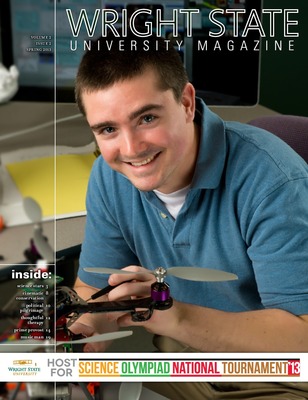
<p>Service-learning projects across campus are helping to solve problems. A public relations class provided research for Energize Clinton County after DHL, the area’s major employer closed, eliminating 8,000 jobs. While working on her Master of Public Administration degree, Lindsey Jarvis interned with East End Community Services. Her service-learning capstone project was instrumental in getting a grant that helped create Dayton Works Plus, a deconstruction and job training program. She is now a program coordinator with East End Community Services.</p>
<p>“Service-learning really addresses all aspects of Wright State’s mission statement to transform the lives of our students and the communities we serve,” Sayer concluded. “We are truly changing lives through our innovative instruction, our research, and our community service.”</p>
]]></content:encoded>
			<wfw:commentRss>http://webapp2.wright.edu/web1/community/2012/connecting-classroom-and-community/feed/</wfw:commentRss>
		<slash:comments>0</slash:comments>
	<wsud:featured-image>http://webapp2.wright.edu/web1/community/files/2012/03/Tara-Purvis-6829-364.jpg</wsud:featured-image><wsud:excerpt><![CDATA[At Wright State University, faculty and students are joining forces in innovative curricula that improve teaching effectiveness by providing hands-on learning. “Service-learning engages students, faculty, and community members in a partnership to achieve academic learning objectives, meet community needs, and &hellip; <a href="http://webapp2.wright.edu/web1/community/2012/connecting-classroom-and-community/" class="morelink">Continue reading <span class="meta-nav">&rarr;</span></a>]]></wsud:excerpt>	</item>
	</channel>
</rss>