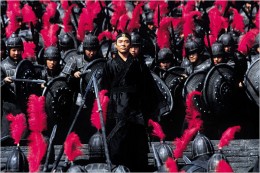
Hero is an example of Zhang Yimou’s transition to less controversial subjects and films that are more entertaining, but nevertheless visually compelling.
Lisa Morrisette, Ph.D., assistant art and art history professor, and the Chinese Studies Committee will begin screening Wednesday, May 4, a three-part film series highlighting the work and career of the internationally acclaimed director Zhang Yimou.
The three films will be screened on consecutive Wednesdays in May on the 4th, 11th, and 18th, and all will be shown in 135 Allyn Hall starting at 7:00 p.m. Discussion will follow after each screening.
In the first film, Raise the Red Lantern (1991), Zhang explores China’s feudal past and the plight of women.
The second film, To Live (1994), traces the life of one family who, through all their travails, manage “to live” over the course of four decades—from Shanghai in the 1940s, through the Great Leap Forward from 1958 to 1961, and ending with the Cultural Revolution.
The first two films were banned in China because of their gritty depictions of life and their implicit social commentary.
The third film, Hero (2002), is a more popular and entertaining martial arts historical drama starring Jet Li. Hero explores the art of the narrative construction through elaborate color symbolism.
Hero is an example of Zhang Yimou’s transition to less controversial subjects and films that are more entertaining, but nevertheless visually compelling.
This film series is part of the initiative seeking to expand Chinese Studies at Wright State University, which also includes Chinese language instruction, numerous China-related course offerings, and a Chinese Studies minor administered through the Department of Modern Languages.
 Wright State alum Emily Romigh builds on a family legacy in education
  Wright State receives $3 million grant to strengthen civic literacy and engagement across Southwest Ohio
  Fitness Center renovation brings new equipment and excitement to Wright State’s Campus Recreation
  Wright State University settles civil lawsuit against WSARC, now doing business as Parallax Advanced Research Corporation
  Wright State senior paints a new path through fine arts internship