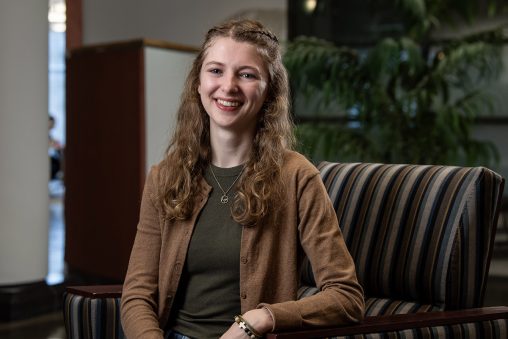
Wright State senior Lily Kaval has turned her experience living with narcolepsy into impactful research, earning an invitation to present her work at the highly competitive 2026 American Counseling Association conference. (Photos by Erin Pence)
When Lily Kaval takes the stage at the 2026 American Counseling Association annual conference, she will do so as one of the few undergraduate students selected and as someone whose research is grounded in her lived experience with narcolepsy.
For Kaval, a senior integrated human services major at Wright State University, managing daytime sleepiness is part of daily life. Rather than allowing the condition to define her limits, she has used it to shape her academic focus and inspire her research and career ambitions.
Kaval presented her research on narcolepsy at the Ohio Rehabilitation Association state conference last October, receiving overwhelmingly positive feedback from seasoned professionals across Ohio. Her proposal, “Clinical Implications of Narcolepsy: A Wake-Up Call for Counselors,” was also selected for presentation at the 2026 American Counseling Association annual conference in Columbus — an honor rarely extended to undergraduate students.
“It was a tremendous honor to present at the Ohio Rehabilitation Association conference,” Kaval said. “The year before, our program advisors had secured us free VIP tickets just to observe and learn from professionals in the field. I remember feeling inspired by the knowledge in the room and the incredible work being done. To return the following year as a presenter alongside those professionals was surreal.”
Joseph Keferl, Rh.D., professor of human services, said competition for presentation slots at the American Counseling Association conference is extremely competitive, and are awarded to doctoral and master’s students, counseling practitioners, researchers and educators.
“Lily Kaval is a remarkable person who has consistently shown extraordinary skills as a student, researcher and future scholar,” Keferl said. “As an undergraduate, she has demonstrated exceptional proficiency in professional writing. Her talents, skills and commitment to her studies in the Integrated Human Services program are well beyond what we typically expect at this level.”
Known as a daytime sleep disorder, Narcolepsy is a neurological condition characterized by excessive daytime sleepiness despite sufficient sleep. People with narcolepsy may fall asleep while reading, talking, eating or even driving.
For Kaval, the diagnosis came after a life-altering injury at age 15. While playing lacrosse, she collided with another player and struck her head. Though she initially showed classic concussion symptoms, her mother, who had recently been diagnosed with a different daytime sleepiness condition, suspected something more. After multiple misdiagnoses, Kaval was referred to a sleep clinic, where doctors confirmed she had narcolepsy.
The diagnosis reshaped nearly every aspect of her life. Most days, all she wanted to do was sleep. Her grades dropped and she became socially isolated.
“My life as I knew it — as a student, athlete, friend and person — was turned upside down,” she said.
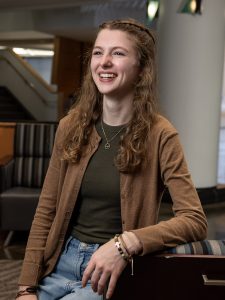
Lily Kaval plans to attend physician associate school, with the long-term goal of working in family medicine and serving under-resourced populations as well as military service members, veterans and their families.
Managing the condition required patience, structure and support. Kaval adopted a strict routine that includes a consistent bedtime, avoiding naps, walking and taking medication. Slowly, she began to regain stability.
After graduating from Oakwood High School in 2021, Kaval enrolled in an honors pre-medicine program at the University of Dayton with the goal of becoming a physician associate.
However, physical and mental health challenges eventually caused her to medically withdraw during her second year.
But she never gave up on her career aspirations and began exploring academic paths that aligned more closely with her lived experience.
That search led her to rehabilitation services and to Wright State. She began taking classes in the summer of 2024 and quickly felt at home.
“If I had to describe my experience at Wright State in one word, I would say ‘empowering,’” she said. “I’ve done things I wouldn’t have felt possible through the support of staff and other students.”
Initially, Kaval’s academic interest in narcolepsy was a way to better understand herself. Over time, it evolved into a broader goal of educating others about sleep disorders.
“Her talent, drive and determination align perfectly with her ultimate goal of pursuing advanced education to become a physician’s associate,” Keferl said. “We are so proud of Lily’s accomplishments while at Wright State and fully expect that she will make an incredible impact as a health care professional.”
Kaval expects to graduate this spring with a bachelor’s degree after completing her final courses and an internship. She plans to work in the rehabilitation field while finishing prerequisites for physician associate school, with a long-term goal of working in family medicine and serving under-resourced populations, as well as military service members, veterans and their families.
“My time at Wright State has shown me that our life experiences can serve as learning tools for others and also that I really enjoy teaching others about what I’m learning in class,” Kaval said. “Because of this, I could see myself entering the education realm later in my career and using my practical knowledge and nuanced experience to aid in the career development and learning of the next generation of helping professionals.”
Explore Wright State
Students and their families can learn more about academic programs, scholarships and campus life at wright.edu/admissions.
 Wright State’s Division of Campus Safety earns Ohio law enforcement accreditation
  Futbol is life
  Wright State hosts regional educators for film-focused learning
  Summer of discovery
  More than 2,400 Wright State students move in to on-campus housing for start of Fall Semester