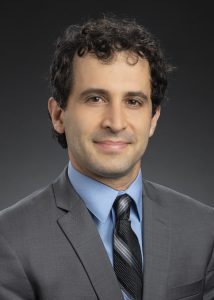
Dan Warshawsky, chair of the School of Social Sciences and International Studies, will use food bank research from India to help students gain a better understanding of global food insecurity.
A recent trip to India by Dan Warshawsky, Ph.D., professor of geography and chair of the School of Social Sciences and International Studies, will help inspire a new Wright State University course and give students a better understanding of global food insecurity.
Warshawsky’s research in India builds on his book, “Food Waste, Food Insecurity and the Globalization of Food Banks,” published in 2023 by the University of Iowa Press.
As of 2026, food banks are present in most major cities across India; however, food banks in India have developed rapidly over the past decade without adequate attention from scholars.
During his travels, Warshawsky interviewed managers and field staff at the India FoodBanking Network and Feeding India to learn about their programs, operations and impact in communities throughout the country.
Warshawsky plans to bring his food bank research back to the classroom. He is currently working on revamping Geography 2210: Environment and Development in the Twenty-First Century, one of the core curriculum courses offered at Wright State.
Beginning in Spring Semester 2027, Geography 2210 will be included in the Wright Questions Pathway courses that center around the theme of human-nature relations.
“The Wright Questions Pathway is an innovative cohort model designed to encourage a liberal arts community for new students in the College of Liberal Arts,” said Warshawsky. “To meet this thematic focus, the newly revised Geography 2210 course will integrate primary source data from my research on food banks into the student experience and learning process. As part of this course, students will be able to engage with real-world challenges in cities across India.”
Through his research interviews in India, Warshawsky was able to identify several key trends:
- Food banks in India have evolved to fit a food system that is dependent on fresh markets. Food banks collect surplus food from fresh market vendors and then redistribute this produce to local food charities in communities across the country.
- Unlike the United States, food banks in India have low, permanent fixed costs, since they do not have significant warehouse infrastructure, cold storage or transportation vehicles.
- In India, food banks operate large-scale, direct feeding schemes with children as a key focus of their work.
“These dynamics suggest that food banks operate differently in India than they do in other parts of the world,” said Warshawsky. “Food banks in India often operate in a bit more ad hoc manner to fit the local context and to keep costs down.”
Warshawsky’s trip was funded by an International Curriculum/Global Virtual Exchange award from Wright State’s University Center for International Education (UCIE) and the College of Liberal Arts.
The UCIE Seed Grants support Wright State University faculty in developing or revising courses to include international or comparative content. Grants can also fund virtual global exchanges to enhance study abroad programs or teaching methods, promoting student success through global learning experiences.
“International partnerships are central to research,” said Michelle Streeter-Ferrari, associate vice president of UCIE. “Collaborating with food banks and universities abroad exposes students and faculty to innovative practices and broadens the university’s perspective on global challenges.”
“International education helps in developing intercultural skills, fostering global perspectives and enhancing academic and career opportunities in an interconnected world,” said Streeter-Ferrari. “Dan’s trip perfectly captures international collaboration and outreach for recruitment, relationships and research, all of which are part of Wright State’s strategic plan.”
Warshawsky’s research on food banks in India supports his book’s key message that food banks are not a complete solution to hunger. At the same time, studying food banks outside the United States is valuable because it highlights different approaches that can offer important lessons for local communities.
For Wright State, this research underscores the importance of having highly qualified faculty who engage in international partnerships, bringing world-class learning and real-world problem-solving opportunities to students. It also generates valuable insights for the local community, helping address issues like poverty and hunger right here at home.
 Wright State’s Entrepreneurship Bootcamp helps veterans turn ideas into businesses
  Wright State motion pictures alumni win regional Emmy award
  Engineering jump-start
  Wright State filmmakers help bring Smithsonian exhibition to life at Dayton Art Institute
  Wright State MBA earns national recognition as one of The Princeton Review’s Best On-Campus Programs