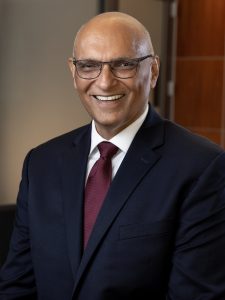
Raj Soin is the new dean of Wright State’s Raj Soin College of Business.
Rajneesh Suri is an engineer at heart: he sees a problem, brainstorms a solution, designs an implementation strategy full of tests and experimentation, and analyzes the results for a solution.
This mindset allows him to bring fresh ideas to his new role as the new dean of Wright State University’s Raj Soin College of Business, as he looks to strike a balance between the different skill sets students across campus bring to the table, the needs of real companies and the ever-changing landscape of the roles educators have in the higher-education sphere.
“When we become academics, we become more abstract and discussion-oriented only,” he said. “I was fortunate to [work at] McKinsey & Company for a short time, and I realized we were centered on deliverables and clients all the time. I think of those experiences now – I’m leveraging past [experiences]. That’s what I do. I focus on the endpoint, and then I work backwards. ‘Okay, this is what I need to structure,’ and structure from there.”
In this exclusive Q&A between Suri and the Dayton Business Journal, Suri provides an insight into how he plans to lead the college, including harnessing and developing student creativity, establishing strong external partnerships, AI integration and more.
Q: How did your early- to mid-career experiences help you get here?
A: It’s [been] an exciting journey, because I have worked with [many] companies in different places and countries.
I started as a mechanical engineer, worked at engineering companies like Suzuki. Then I did an MBA in marketing and finance. I worked for a couple of companies again. One was Unilever. I worked in the Middle East in a few countries, and then I came over here to do my Ph.D. in marketing, and that’s where I started understanding that people are more important than machines.
That was the starting point of my journey to understand human behavior. I became a behavioral pricing person, and then, in 2000, McKenzie offered me to work as a pricing expert.
I worked with McKinsey for a couple of years, and I found that I liked academics more. I wanted to be with students more. I felt that it was a right opportunity for me to go back to academics, and I came back to academia. It’s been a growth path.
Q: You have held multiple positions at other universities. Can you tell us about some of your work there?
A: [At Drexel University], I started these initiatives, like the Solutions Institute, where I bring faculty, students and companies together in one place for projects where they work together. Whether they work inside or outside of class, it’s a huge learning experience for them. [They work] on problems that are very cutting-edge for the company and that they want answers for.
Q: It seems like experiential learning is a key area of focus for you. How will you implement that at Wright State?
A: Working across disciplines is very important [to me]. A lot of projects [I] have done, I worked with education, sciences, design, engineering, medicine and business – all of them are part of these things which I have done in the past.
I foresee the students to be more successful as they leave. I foresee the faculty engaged as they go forward, with both students and with external partners.
What do I need to do to lay down those steps before that? Experiential activities, engaging students with entrepreneurship right from the first year itself. Every student should have experiential learning. Only when you run or make a business do you know what business education is all about.
The whole way I educate students, and the way I interact with the external world, is very important to me. I think we become more relevant in the classroom when we are working with the external world, because they are trying to deal with problems [that] are impacting their business every day. They are the ones who are looking for thought partners who would help them think ahead of the curve, so that they are more successful. I think students bring a unique creativity to that space.
My core objective is to see that we create a lot of experiential activities for our students. which would make them confident when they leave college. I want them to hit the ground running.
What I’m looking for from the community is a helping hand to kind of work with our students and faculty, [so we] become effective partners with them and grow the college in a meaningful manner. We have great resources on campus and in this college.
Q: How does that tie into your overarching vision for the college?
A: We want to be a co-op school, and we want to have experiential activities with our industry partners. So that it gives students authentic real-world experiences where they experiment and learn to succeed and fail.
When they leave, they are confident and they hit the ground running, and that’s what I want the employers to get: students who are already hitting the ground running when they come in. Our students are hardworking and they have a lot of grit. I think if they get these contextual, worldly experiences, that’s a big boost for them.
My vision is collaboration: to work across campus to see how we can bring [innovation] together within this college.
Q: One of the biggest shifts in academia over the past few years has been the adoption of AI. What’s your take on that?
A: AI and technology disruption is ripe in the market. The industry is learning about it as we are learning about it. What better way could there be to work together, learn together and bring our students along?
I think we need to start thinking about how we can change our curriculum with the help of the industry going forward. AI is going to become important as we go forward, and our students need to start learning [how to actually use it] from the first year.
All experiential activities we build should have AI in it, with the human element [in consideration throughout]. You do that in a lot of courses, and the model working with them would be extremely well trained by the time they graduate.
I look at it as a companion which is going to help them move their work faster. Firms are looking for AI to help expedite the task. If you have a trained model which will work with you, it’ll start doing the things with you. You are faster as well.
Our students might or might not be the small percentage of people who actually build those large language models. But they should become experts in using the models as they go forward.
Q: What specifically drew you to Wright State?
A: It’s a coincidence that Raj Soin and myself have gone to the same college [in India]. I really admired what he has done here. He has contributed immensely to this community, and he is an entrepreneur himself. I met him last week, and he’s so actively engaged, his mind is so sharp, [and] he still wants to contribute to things. That’s huge for me.
When I read the university’s strategic plan, I said, “This makes perfect sense to me.” President Edwards – her approach to this is important.
The university and senior leadership gave me the opportunity to do something all by myself, and that was what I was excited about: to lead the college, and to lead it in the direction that I think is important for the real world, for our students and for our faculty.
The faculty was also engaged when I came and talked. We have all the effective pieces: when you have the administration, when you have the faculty and when you have the students – you have an ecosystem.
I’m looking forward to doing what I have experience doing, learning new things and learning the college, ecosystem and Dayton area.
Read the full interview at bizjournals.com/dayton.
 Wright State enrollment continues to grow, reaching 12,157 students
  Wright State University honors staff for excellence, innovation and service
  Wright State University, Big Hoopla announce return of Stars, Stripes and Flight Classic featuring Air Force Falcons
  Wright State University honors faculty for excellence in teaching, research, professional service and community engagement
  Coming in to her own