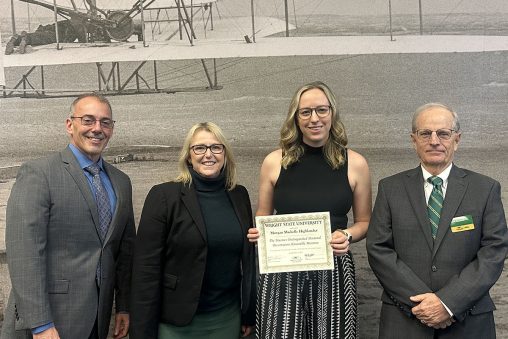
December grads Maram Almodhwahi, not pictured, and Morgan Highlander received Trustees’ Distinguished Doctoral Dissertation Awards. They were recognized by Provost Jim Denniston, left, President Sue Edwards and Board of Trustees Chair Tom Gunlock.
Two December doctoral graduates were recognized for exceptional research with Wright State University’s Trustees’ Distinguished Doctoral Dissertation Awards, celebrating research that showcases scholarly excellence and real-world impact.
Both graduates were recognized at the Wright State Board of Trustees meeting on Dec. 12.
Maram Almodhwahi, who earned her Ph.D. in computer science and engineering, received the Trustees’ Distinguished Doctoral Dissertation Award for her work developing an artificial intelligence system that monitors drivers’ emotional and cognitive states to improve road safety.
Her dissertation, titled “A Facial-Expression-Aware Edge AI System for Driver Safety Monitoring,” focused on using AI to detect signs of fatigue, stress and distraction by analyzing facial expressions in real time. Unlike many AI systems that rely on cloud computing, Almodhwahi’s system is designed to run directly on small devices inside vehicles.
By combining computer vision, machine learning and embedded systems, the system would provide timely alerts or trigger emergency responses without depending on continuous cloud connectivity.
Almodhwahi said research reflects her interest in applying artificial intelligence to problems with direct social impact.
“Road safety is a global concern, and emotional and cognitive driver states are often overlooked factors in accident prevention,” she said. “My motivation was to bridge the gap between advanced AI models and practical, deployable solutions that can operate in real time.”
Almodhwahi plans to continue working at the intersection of AI, embedded systems and human-centered technology, with a focus on safety and well-being.
“My goals include further developing this research into practical applications, exploring industry and research collaborations and contributing to projects that leverage AI for safety, accessibility and well-being,” she said.
Almodhwahi’s advisor was Bin Wang, Ph.D., professor of computer science and engineering.
Morgan Highlander, who earned her Ph.D. in engineering, received the Trustees’ Distinguished Doctoral Dissertation Honorable Mention Award for research that advances the study of motoneurons, the nerve cells responsible for controlling muscle movement and are damaged in neurodegenerative diseases such as amyotrophic lateral sclerosis, or ALS.
Her dissertation, “Unlocking the Potential of Motoneuron Data: Consideration of Biological Variables and a Revolutionary Approach to Structural Analysis,” addresses long-standing challenges in both measuring how motoneurons function and analyzing their physical structure.
Highlander developed a new automated, three-dimensional imaging algorithm that removes human bias from structural analysis, making results more objective, reliable and reproducible. She also applied the tool to examine a key motoneuron protein linked to ALS, identifying changes that may point to new therapeutic targets.
Her interest in neural research is personal.
“I became interested in applying my electrical engineering background to neural research because my brother suffered from a spinal cord injury when I was in high school,” Highlander said. “I love using my skills in math, programming and engineering to work toward better solutions for those living with spinal injury and disease.”
Highlander was a member of Wright State’s Neuro Engineering, Rehabilitation and Degeneration Laboratory, which researches how the neurons that control muscles degenerate in ALS patients. Her advisor was Sherif Elbasiouny, Ph.D., the Wright State University and Premier Health endowed chair in neurodegenerative diseases research and professor of neuroscience, cell biology and physiology.
Highlander plans to continue pursuing research opportunities in the region and hopes to eventually start a consulting company that provides engineering solutions for complex neural and biomedical research problems.
 Turning injury into impact
  From dance to data, Wright State students showcase research at annual celebration
  A lifetime of curiosity
  Wright State students raise more than $59,000 for Dayton Children’s Hospital at Raiderthon
  Wright State retains Carnegie Research 2 classification, reinforcing national research impact