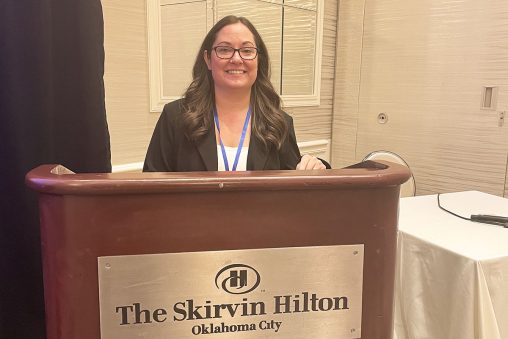
The Association of Literacy Educators and Researchers honored second-grade teacher Emily Romigh for the thesis she produced as a graduate student in the Master of Education in Literacy program at Wright State.
Wright State University alum Emily Romigh followed in her educator mother’s footsteps, with early classroom experiences shaping her path to the profession.
The matriarch of a family of nine, Romigh’s mother taught art in the Dayton Public School system for more than 30 years. Much of Emily Romigh’s formative years were spent in that classroom, where she first developed a love for learning and teaching.
Today, Romigh is in her first year of teaching second grade at the Dayton Regional STEM School.
“My passion for education began early,” she said. “I spent a lot of time in my mom’s classroom growing up, and watching the joy she found in inspiring her students made a lasting impression on me. I’ve always loved school, so becoming a teacher felt like a natural fit.”
A native of Englewood and one of a set of triplets, Romigh earned both a bachelor’s degree in elementary education and a master’s degree in literacy from Wright State.
“I chose to return to Wright State for my master’s degree because of the strong foundation I received in my undergraduate program,” she said. “The early childhood education program thoroughly prepared me for the classroom, so continuing at Wright State seemed like a natural step. My mentors, Dr. Hannah Chai and Instructor Lee Welz, were especially influential.”
Through her coursework, including Wright State’s dyslexia certificate program, Romigh developed an expertise in the science of reading, effective literacy instruction and data-driven practices to support diverse learners. That training, she said, has been transformative in her teaching and sparked new questions about instructional practice.
While teaching reading intervention, Romigh noticed that spelling instruction often received less attention, even though research shows strong spelling skills reinforce reading development. Curious about how to better support students, she began exploring strategies to strengthen spelling instruction in the classroom.
That inquiry became the focus of her master’s thesis, “Spelling Through the Senses: Using Multi-sensory Activities to Enhance the Spelling Abilities of First Graders.”
In recognition of that work, Romigh was named the 2025 recipient of the J. Estill Alexander Future Leaders in Literacy Master’s Thesis Award from the Association of Literacy Educators and Researchers (ALER). She was honored at the association’s fall conference in Oklahoma City, where she presented her research to fellow educators and scholars.
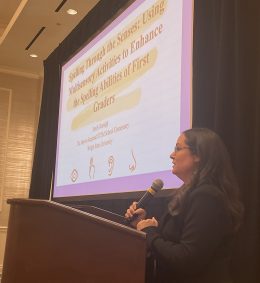
Emily was invited to present her research on spelling instruction at the Association of Literacy Educators and Researchers fall conference in Oklahoma City.
“Receiving the ALER Master’s Thesis Award was an incredible honor,” she said. “I was both surprised and thrilled when I found out. I remember starting my research class thinking, ‘I’m a teacher, not a researcher.’ But with Dr. Chai’s guidance and encouragement, I was able to design and conduct a meaningful study that I’m very proud of.”
Romigh, who earned a dyslexia certificate from Wright State and a dyslexia interventionist certificate through the Center for Effective Reading Instruction, is passionate about helping students with dyslexia and struggling readers become confident, capable readers and writers.
“I’m confident that the strategies she developed through her research are already making a meaningful impact in classrooms across all grade levels,” said Pat Murakami, principal of the Dayton Regional STEM School. “Emily’s success is a reflection of the excellence we strive for at STEM and the training she received from Wright State University.”
Romigh plans to continue refining her literacy instruction and integrating it into meaningful, project-based learning experiences.
“My goal is to create a classroom where students feel excited to learn, confident in their abilities, and supported as individuals,” she said.
For Romigh, that goal reflects both her own path as an educator and the example that first inspired her.
 New course gives Wright State students real-world experience in genetics research
  Wright State medical students discover where next journey as future doctors will continue at 2026 Match Day celebration
  Wright State Police Chief Kurt Holden graduates from FBI National Academy
  Wright State’s Nutter Center hosting Ohio basketball state tournament semifinals
  Reading madness