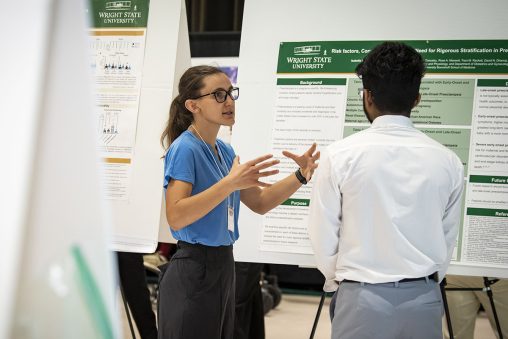
Research from students in six colleges and dozens of disciplines took center stage at Wright State’s Celebration of Undergraduate and Graduate Research, Scholarship and Creative Activities on April 1. (Photos by Erin Pence)
Student research projects on wildfire detection, focus and productivity, Civil War veterans and dance were among the projects highlighted at Wright State University’s 2026 Celebration of Undergraduate and Graduate Research, Scholarship and Creative Activities.
Several hundred students, faculty and staff attended the April 1 event in the Student Union conference wing, which featured 150 poster presentations and 15 podium presentations.
The event wasn’t only a learning experience for students, Provost Jim Denniston, Ph.D. said. It also provided them a forum to build knowledge, tackle important questions and develop skills that will carry them into the future as leaders and innovators.
“This event reflects the heart of our university’s mission: discovery, creativity and shared learning,” Denniston said. “Each poster reflects dedication, curiosity and collaboration, and together they showcase the incredible breadth of work across our campus.”
With research presented by students in six colleges from dozens of disciplines, the Celebration of Research encouraged discovery and connection across the university and fields of study, Denniston said. The event is an opportunity for students to engage with faculty, experts and peers beyond the classroom — and to see how their academic work might contribute their fields.
“Some of the most exciting ideas emerge when we connect beyond our own fields,” he said.
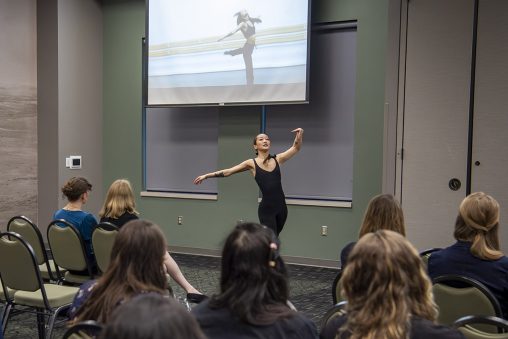
Dance and biomedical engineering major Bri Chan’s presentation, “Story Telling Through Movement,” demonstrated how dance is a form of research.
Dancing to communicate research
That idea was top of mind for Bri Chan, a dance and biomedical engineering major, who presented “Story Telling Through Movement,” featuring her performance of “Light, Dark, Light Again,” an original piece she created for the event.
The piece explored the idea that periods of darkness are an inevitable and necessary part of reaching moments of clarity, strength and light.
Chan was motivated to demonstrate that dance is a form of research. Through her preparation, she said, she grew as a dancer and choreographer while building something entirely new.
Through movement, she said, she shapes something with her body that didn’t exist before — and presenting it to others is itself an act of growth.
“You’re creating movement to express a feeling, to tell a story, to express my emotions,” she said. “I realized I could use dance instead of speaking. I could move and not have to say anything, and especially with music, you can put that behind it and express that story even further.”
Predicting wildfire spread with machine learning
Rachel Ballentine, a master’s degree student in computer science, presented a poster on her research on how to use machine learning to create neural networks, to map and predict wildfire spread based on environmental factors.
Her research builds on a previous study that aggregated wildfire spread data but produced inaccurate results.
Starting from scratch, Ballentine constructed her own model built on a multilayer perceptron, a basic neural network approach, that will learn to predict more accurately.
This was her second year presenting at the event, and she said she focused this year on improving how she communicates complex research to a general audience.
“Last year I had trouble framing how to launch into what I’m telling you about,” she said. “This year I have a better way to introduce the project.”
Beyond the battlefield
For Master of Public Administration student Shannon Doyal, what started as an internship at the Wright Dunbar Interpretative Center documenting local Civil War–era Medal of Honor recipients became a passion project.
“My focus is to present these individuals as people who are more than just what happened to them in the military,” she said. “Who they were before they went off to war, and who they became after.”
She examined census records, microfiches and journals, turning up lives she couldn’t stop thinking about. One recipient became a war correspondent after being wounded, then spent years advocating to turn battlefields into national parks. Another spent decades teaching school children what the Civil War was like.
“The one thing that’s been consistent is that they contributed to the community after they got out,” Doyal said. “It’s that resilience that I find attractive.”
She is also connecting her research to campus. Doyal works in the Veteran and Military Center and is sharing the stories she’s uncovered with military-connected students.
“I want to be able to hopefully create a connection and a bridge for the veteran students here,” she said.
Finding your flow
When guests approach Subiksha Vaidhyanathan to discuss her poster presentation, she would start with a question: what are you interested in?
It wasn’t small talk. It was her research in action.
Vaidhyanathan, a computer science undergraduate student, is developing an Android app that tracks flow areas, or flow states — a feeling of being so immersed in a task that time seems to disappear. The app will prompt users with questions, log the data and over time reveal the windows when a person is operating at optimal focus.
“Flow areas are the times when you’re very immersed and engaged in the activity that you lose track of time,” she said. “Our study helps you know at what time you are at your peak potential.”
For Vaidhyanathan, the Celebration of Research was a chance to introduce a concept she said most people are unaware of. Preparing her poster, she said, helped her understand synthesize months of research into a coherent, visually appealing presentation.
“I was able to see what I needed to prioritize,” she said, “so that people would be able to see not just visualization but also a little bit of the concept of what’s going on in the background.”
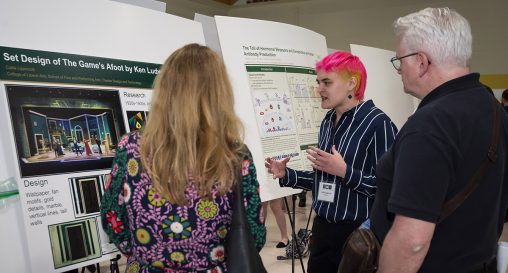
The Celebration of Research is an opportunity for students to engage with faculty, experts and peers and to see how their academic work might contribute to their fields of study.
Students honored at celebration
The following students were honored during the Celebration of Undergraduate and Graduate Research, Scholarship and Creative Activities:
Excellence in Research Poster Presentation Award:
Graduate Students:
Kamalika Biswas, biological sciences
Mittalkumari Shivsinh Chauhan, pharmacology and toxicology
Delaney Grant, biomedical sciences
Joshua Mallets, engineering
Jeet Thapa, mechanical engineering
Undergraduate Students:
Rhett Bailey, physiology and neuroscience
Rabia Dzhafarova, physiology and neuroscience
Navjot Singh, psychology
Provost’s Award for Excellence:
Rebecca Kurtz, elementary education
Trustees’ Award for Excellence:
Isabella Bacon, medicine
 From dance to data, Wright State students showcase research at annual celebration
  A lifetime of curiosity
  Wright State students raise more than $59,000 for Dayton Children’s Hospital at Raiderthon
  Wright State retains Carnegie Research 2 classification, reinforcing national research impact
  Wright State’s annual ArtsGala auction to spotlight student artwork