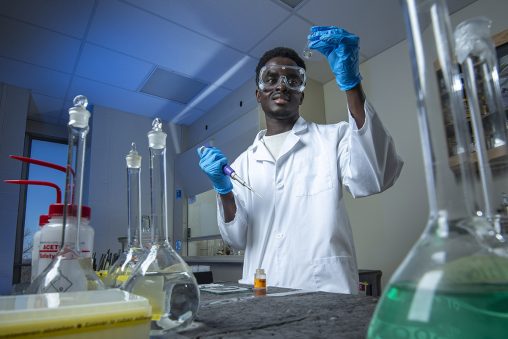
Inspired by challenges in Ghana, Wright State chemistry grad student Kwaku Nti Nyarko is working to make drinking water safer around the world. (Photo by Erin Pence)
While a funeral marks the end of a person’s life, in this case it also signified the start of a new life for a young man, leading him from Ghana to Wright State University.
That young man, Kwaku Nti Nyarko (pronounced: Kwaah-coo En-tea Yar-ko), was so moved by what he saw at that funeral that he vowed to address a national health crisis. Through his studies at Wright State, he’s closing in on that goal.
The health crisis is the number of heavy metals in the drinking water supply — levels of mercury, lead and cadmium have been rising. He knows this through his profession as an industrial quality control officer in the West African country.
Tainted water is harmful, causing kidney problems, liver and renal dysfunction, and cancer. Driving this problem is a boom in small-scale gold mining — both legal and illegal — which introduces toxic heavy metals to the soil and water. A friend of Nyarko’s died in an accident at one of these mines, and what he witnessed at the funeral changed his life.
“At his funeral in the village, I saw newborn babies with birth defects. That struck me to do something to help my people,” he said. “That fueled my already existing thoughts to pursue my master’s in chemistry to find an approach to curb or solve this issue.”
Nyarko opened up to a family friend who, it turned out, was a Wright State alumnus familiar with the university’s chemistry program and its research on heavy metals. Encouraged by that connection, Nyarko applied and arrived at Wright State in January 2025. He is now pursuing a master’s degree in chemistry.
But not just any chemistry — Nyarko is working with electrochemistry and is developing an electrode sensor to detect heavy metals like lead and cadmium in water.
“The unique part of his project,” said Suzanne Lunsford, Ph.D., professor of chemistry, “is to synthesize nanoparticles using household items like honey, pomegranate, turmeric and ginger, which he’ll make into a paste to coat the electrode. This is called the green method, because the items are not toxic.”
The coated electrode will gauge the levels of heavy metals in water quickly and inexpensively — showing whether the water is safe to drink.
Taking the research a step further, Nyarko is working toward eventually having the electrodes coated with a material that will remove the heavy-metal ions from the environment in a process called chelating.
“The first step is to identify the level of contaminants in the water,” Lunsford said. “The second step is the chelating.”
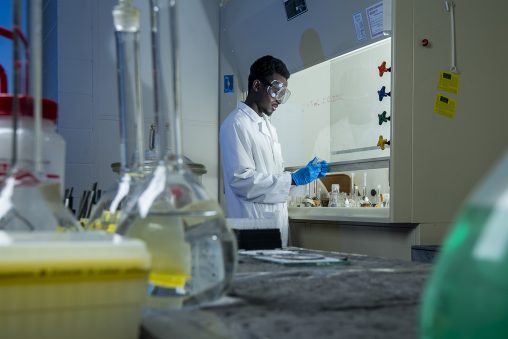
Chemistry graduate student Kwaku Nti Nyarko is developing an electrode sensor that uses nanoparticles made from natural household ingredients to quickly and affordably detect harmful heavy metals in drinking water. (Photo by Erin Pence)
Bringing chemistry to life
All this sounds so simple a child could do it, right? Well, how about a high school student? Or at least have high schoolers grasp the concept? That’s where Lunsford and Nyarko embarked on a side development.
To bring the concept to life, Lunsford and Nyarko developed a hands-on chemistry lab for high school students. In the experience, students tested and analyzed water quality using advanced instrumentation, gaining practical skills while learning more about STEM.
Supported by a nearly $50,000 award from the Ohio Environmental Protection Agency, the project, called Futures in Chemistry: Empowering Young Minds in Electrochemical Detection of Heavy Metals for Water, introduced them to advanced instrumentation to detect the toxins.
The project is also meant to inspire career exploration in fields like science, technology, engineering and math.
“Chemistry might not be in their future, but it might lead them to a place they would not have otherwise gone by taking part in this program,” said Tom Smith, a 2018 Wright State grad whose Batavia High School students participated in the project.
Nyarko, ever thinking of what he experienced in Ghana, had another kind of positive take on the hands-on lab: “Analyzing heavy metals in water is the best thing the high school students should know.”
Nyarko’s presence in the lab, not only with those high schoolers, but on a regular basis as a teaching assistant in the chemistry department, is inspiring.
“He’s phenomenal with young people,” Lunsford said. She added that he routinely volunteers for outreach activities, including any that involve high school students.
Being a good teaching assistant is admirable, but Nyarko focuses on the reason he’s here.
“He’s always available,” Lunsford said. “If I’m teaching a new technique on an instrument, he’s willing to stay and learn about it, where some other students wouldn’t. He’s willing to take the extra hour.”
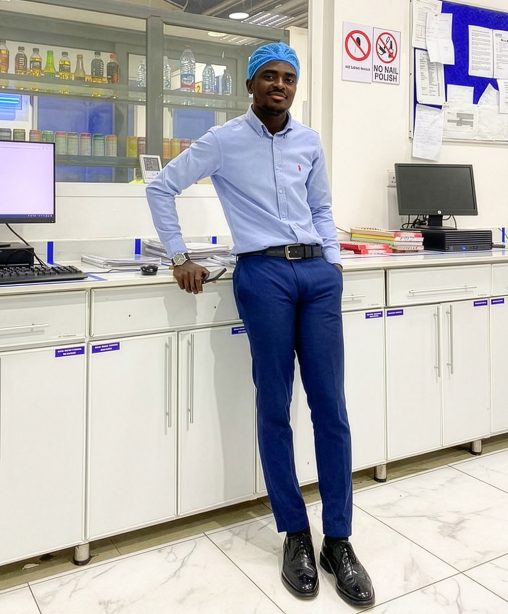
Before enrolling at Wright State, Kwaku Nti Nyarko worked as a quality control officer for a multinational beverage company in Accra, Ghana.
Lunsford said that the water readily available to 45% of the people in Ghana, a country of about 34 million, includes contaminants.
“Him coming up with how to build a sensor that can detect levels of heavy metals in water is a great way to help his country,” Lunsford said. “He’s extremely bright. He’s going to be an inspiring scientist and a great professor.”
While Nyarko is inspiring, he’s also inspired.
“Wright State has helped me a lot,” he said. “The chemistry department provides me with all the necessary resources. They’ve been supporting me in everything I do. I’m grateful to them. Wright State truly feels like home to me. From the professors to the students, everyone makes you feel like part of a big family.”
Harkening back to the nightmare of that funeral in his homeland and his reason for coming to Wright State, he added that with the help and guidance he receives, “I am on track to turn my dream into a reality.”
This article originally appeared in the 2026 issue of the Wright State Magazine. Read more stories at wright.edu/magazine.
 Finding the Wright Path
  Wright State University announces sold out game for Stars, Stripes and Flight Classic featuring Air Force Falcons
  Wright State’s Family Weekend brings Raider families together
  International scholars
  A fresh start leads to finding his people