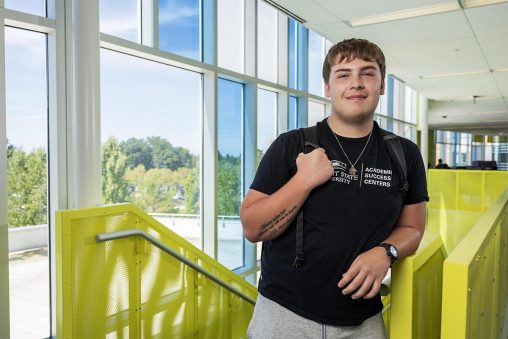
Noah Scott completed an internship at Licking Memorial Hospitals over the summer and stops by the Student Success Center to begin the semester. (Photos by Erin Pence)
Football injuries usually end careers. Noah Scott’s put him on the path to a new one.
Scott’s injury led to stingers, pain and weakness in his left arm, and eventually a scoliosis diagnosis. To manage it, he started physical therapy. During one session, he remembered thinking, “I might actually want to do this as a career.” So, he started to explore.
He began at Wright State in biomedical engineering, and by his sophomore year he’d switched his major to health sciences with a pre-physical therapy concentration. His goal is to earn his way into a competitive Doctor of Physical Therapy program.
He took a big step toward that this past summer when he turned his curiosity into real experience through an internship at Licking Memorial Hospitals, split between outpatient and acute inpatient rehab.
Landing the internship took some hustling. A family connection got his foot in the door. And a trip to Wright State’s Berry Family Career Hub, where staff showed him how to rework his engineering resume into something specific for a healthcare field, helped him land the position.
Scott said the Career Hub showed him how “different careers have different formats or expectations from a resume.” That kind of professional knowledge can help a candidate stand out for competitive positions.
And then during the internship and job shadowing, Scott developed some critical self-knowledge. He initially thought he’d prefer working with outpatient clients, but experiencing acute care with inpatient clients made an impact.
“I actually am all in on wanting to do inpatient,” he said. He liked the faster pace of acute rehab and working with patients recovering just days after surgery. “You can spend an hour with that person and really get to know them.”
He saw patients wrestle with grief and fear — over an amputation, a brain cancer diagnosis, a body that no longer felt like their own — while the physical therapists offered not just treatment, but reassurance.
“I got a good grasp of what’s right to say, what not to say,” Scott said.
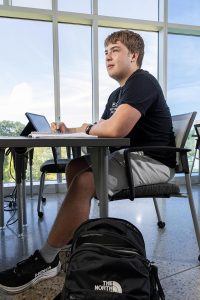
The Berry Family Career Hub helped Noah rework his existing engineering resume into one specific for healthcare.
One moment stuck with him as much as any clinical skill. In a separate shadowing opportunity at the James Cancer Hospital in Columbus, Scott was struck by watching a physical therapist move through the halls greeting people.
“She knew everyone — patients, family members, janitors — by name,” he said. “It was really cool to see how outgoing and caring she was for every single person in that hospital.”
That, Scott said, taught him something the classroom couldn’t: not just how to be a good PT, but the kind of person he wants to be — in the hospital and out.
The summer clearly paid off. Before it even ended, Licking Memorial’s clinic manager asked Scott to return during winter break, with another summer internship already on the calendar for next year.
“That made me happy to see — that I at least did somewhat of a good job this summer,” Scott said.
For students wondering whether a single shadowing experience is enough, Scott’s advice is simple: go further than the minimum, across the board. Struggling in a class? Go to the Student Success Center. Want to land an internship? Visit the Career Hub. Hoping to get into a Doctor of Physical Therapy program? Do more than the standard 50 hours of shadowing.
“I think PT schools might appreciate seeing a mix of both paid and unpaid hours,” he said — but landing something like a real internship shows initiative that 50 hours of shadowing alone won’t.
For Scott, that initiative built more than a good resume. It confirmed a career choice, and it has clarified exactly who he wants to become.
 A career-beginning injury
 Hundreds turn out for Trunk-or-Treat at Wright State
 Explore Wright State Day welcomes hundreds to campus
 Premier Health makes history as exclusive jersey patch sponsor of Wright State Athletics, marking new era in growing partnership
 Wright State’s cybersecurity program awarded nearly $200,000 to strengthen workforce development efforts