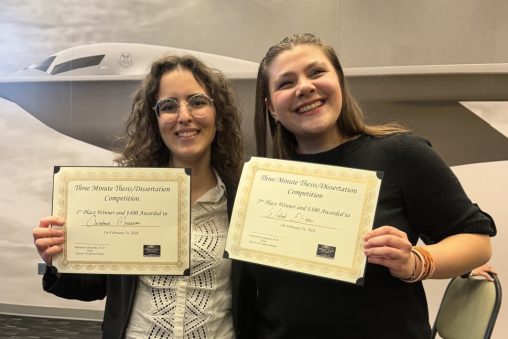
Christina Minassian, left, a graduate biological sciences student, won first place, and Widad El-Zein, a doctoral biomedical sciences student, won second place in Wright State’s Three-Minute Thesis Competition.
Christina Minassian spent several years working in a medical laboratory identifying diseases. The experience inspired her to learn more about biology and illness.
“I wanted to dig deeper and uncover the sources of these ailments,” said Minassian, who is now pursuing a master’s degree in biological sciences at Wright State University.
Her decision is paying off.
Minassian recently won Wright State’s Three-Minute Thesis (3MT) Competition, earning a spot at the Midwest Association of Graduate Schools Conference in Kansas City, where she will compete in the regional 3MT on March 27.
Organized by the School of Graduate Studies, Wright State’s Three-Minute Thesis Competition challenged graduate and undergraduate students to present their research to a general audience in just a few minutes, developing skills to communicate complex ideas with clarity and confidence.
“These skills are critical for sharing research with non-specialists, securing funding and teaching others,” said Paula Bubulya, Ph.D., associate dean of the School of Graduate Studies.
Minassian’s research focuses on Parkinson’s disease, the world’s second most common neurodegenerative disorder. More than 90% of cases are sporadic and have no known cause or cure.
Minassian’s research centers on a protein called α-synuclein, which normally helps release dopamine in the brain but can misfold and clump into toxic inclusions, known as Lewy bodies, a hallmark of the disease.
To better understand why that misfolding occurs, Minassian studied 18 genes involved in membrane and vesicle trafficking and their relationship to α-synuclein. Using yeast as a model organism, she studied how the genes interact with α-synuclein, whether they affect cell viability, and whether they play a role in increasing the size and number of protein inclusions.
Establishing that relationship could explain how sporadic Parkinson’s develops and potentially point toward new treatment options.
Minassian applied to Wright State to work in the lab led by Quan Zhong, Ph.D., associate professor of biological sciences, drawn by her research on Parkinson’s disease.
“I love that in research I get to do and learn something new every day,” Minassian said.
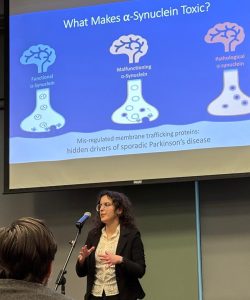
Christina Minassian won Wright State’s Three-Minute Thesis Competition for her presentation on her research into Parkinson’s disease.
Minassian decided to participate in the Three-Minute Thesis competition to practice her public speaking skills through a fun and challenging experience. Researchers often have difficulty communicating complicated topics to a general audience without relying on jargon, she said.
“The 3MT taught me how to better practice the skill of explaining complex concepts to a more general audience in a short amount of time,” she said. “It was certainly more of a challenge than I initially thought.”
Minassian, who is scheduled to graduate this May, has applied for Wright State’s Biomedical Sciences Ph.D. program, which she hopes will lead to a career as a full-time researcher.
“I knew I would enjoy research before starting my master’s, and now that I’m almost done, this has only further cemented my desire to continue down this path,” she said.
This year’s 3MT Competition drew a record number of participants — 23 graduate students and six undergraduate honors students from a variety of disciplines.
Aaron Cline, an English major with a concentration in creative writing, won the Honors Blitz competition.
 Greene County families visit Wright State for mass food distribution by The Foodbank
  Wright State’s Cardio-Renal Institute Summer Program prepares students for in-demand healthcare professions
  Wright State’s Entrepreneurship Bootcamp helps veterans turn ideas into businesses
  Wright State motion pictures alumni win regional Emmy award
  Engineering jump-start