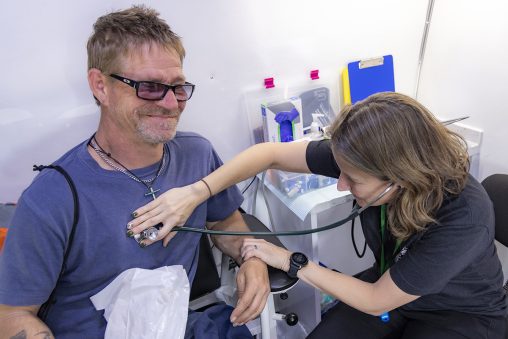
A five-year Health Resources and Services Administration Family Medicine Education Training Grant will allow the Dayton Street Medicine program to provide care for more patients and train additional medical students and residents. (Photos courtesy of Premier Health)
Wright State University’s Boonshoft School of Medicine and Premier Health received a $2.5 million federal grant — the first of its kind awarded in Ohio — to expand Dayton Street Medicine, a program delivering primary care directly to people experiencing homelessness.
The five-year Health Resources and Services Administration Family Medicine Education Training Grant will help the program provide care for more patients and train additional medical students and residents.
A collaboration between the Boonshoft School of Medicine, Premier Health, Premier Community Health and the Dayton Dream Center, the Dayton Street Medicine project launched in 2025 with support from the OneOhio Recovery Foundation.
It currently operates one half-day a week from the Premier Health Mobile Clinic at the Dream Center, on East Third Street, bringing health screenings and primary medical care to people who face overlapping challenges — such as chronic illness, behavioral health conditions and substance use — compounded by unstable housing. Along with medical services, the program connects patients to resources and social support.
In the first 12 months of operation, Dayton Street Medicine has delivered 448 clinical visits and 313 health screenings, serving about 300 unique individuals.
“Our program stood out because of our long-standing commitment to community-based care, our robust resident training infrastructure and our established cross-sector partnerships,” said Anna Squibb, M.D., program director of family medicine and addiction medicine at Premier Health and medical director of Dayton Street Medicine.
This summer, Dayton Street Medicine will add two new service days. One will extend care to a rural setting through a new partnership with the Bethany Center in Piqua and Miami County Public Health — a site, like the Dream Center, where people already come for support.
“Bringing street medicine to a rural setting is both a natural next step and a meaningful opportunity. It allows us to better serve communities with limited access to care while giving our learners firsthand experience navigating the complexities — and rewards — of practicing medicine in underserved areas,” said Marietta Orlowski, Ph.D., a professor of population and public health sciences at Wright State and the director of Dayton Street Medicine’s Rural Initiatives.
The second will launch street rounds, bringing a care team to individuals who may not reach either location by focusing outreach in high-needs areas in Dayton.
Each outreach team will include a family medicine physician, a peer recovery supporter and a program coordinator who is also a certified medical assistant, along with medical students and family medicine residents.
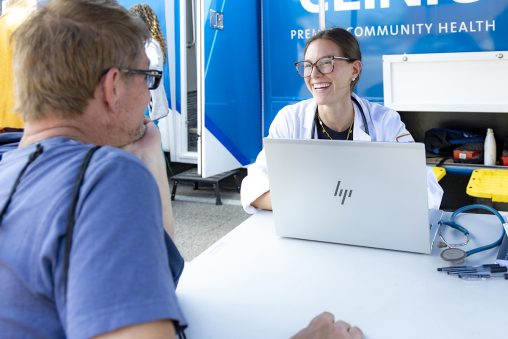
Dayton Street Medicine has created a highly innovative and immersive learning experience for medical students and residents.
Key to the Dayton Street Medicine program’s success is its close partnerships with more than a dozen community agencies and organizations, including Miami Valley Housing Opportunities; the City of Dayton’s GROW program, Police and Fire Departments, and Community Paramedicine; Public Health – Dayton and Montgomery; and Advocates for Basic Legal Equality.
“This work would not be possible without our community partners,” Squibb said. “These relationships allow us to coordinate care effectively and address the full spectrum of needs our patients face.”
Medical students, residents and addiction medicine fellows learn not only clinical skills but also how to understand and navigate patients’ lives outside the exam room. The program has created a highly innovative and immersive learning experience for students, said Sydney Silverstein, Ph.D., associate professor of population and public health sciences and the director of outreach, engagement and community partnerships at Dayton Street Medicine.
“Seeing the tremendous need and hearing about the struggles that our patients have faced in previous health care encounters has greatly motivated our students to seek out careers providing care to the populations that we see during street medicine and educating their peers and community about the great need for trauma-informed, quality health care in places like Dayton,” she said.
Medical student Beth Ekeh said the program reframed her understanding of what medicine can be.
“I have learned how to practice medicine outside the box,” Ekeh said. “Dayton Street Medicine has illustrated how we can address barriers to provide comprehensive and compassionate care for our patients. Additionally, I have gained an understanding of the challenges my patients are facing outside traditional clinical settings that are impacting their health.”
For fellow medical student Isabelle Fox, the lessons included more than techniques.
“Delivering care on the mobile bus has helped me problem solve and work through providing medical care without the full scope of resources at our fingertips,” Fox said.
Fox said the experience also influenced her approach to medicine.
“One of the biggest takeaways for me is that I want to be someone that patients can trust and feel comfortable with, especially those who may be hesitant to seek care because of prior negative experiences or stigma,” she said.
Dayton Street Medicine’s impact is designed to grow. As Boonshoft School of Medicine graduates and residents take street medicine training into practice, the program’s model travels with them.
“As graduates enter practice across Ohio, they will carry this training forward, expanding access to compassionate, community-based care beyond the Miami Valley,” Squibb said.
 Wright State MBA earns national recognition as one of The Princeton Review’s Best On-Campus Programs
  Wright State awards free tuition to two students at volleyball match
  Tropical takeover
  Wright State’s Division of Campus Safety earns Ohio law enforcement accreditation
  Futbol is life