Jean de Dieu Mukunzi had insurance. He just couldn’t use it.
It was 2008, and Mukunzi was living in a homeless shelter in Dayton, newly arrived from Rwanda with almost no English. Although he had Medicaid, accessing routine healthcare was another matter. Scheduling a doctor’s appointment meant making a phone call, in English, weeks in advance.
So when he got sick, he called 911. “I was calling 911 to go to the emergency room because I knew that if I call 911, I will get help right now,” he said.
The strategy worked. But it also cost roughly seven times more than an office visit.
Mukunzi’s experience reflected a challenge many immigrants and refugees face: they aren’t excluded from healthcare because they lack insurance, but because they lack the language skills and familiarity with a healthcare system built around preventive care, something many never experienced in their home countries.
Today, Mukunzi leads a nonprofit dedicated to closing that gap.
Ebenezer Healthcare Access, the organization he founded in 2019, now operates in three Ohio cities, employs nearly three dozen community health workers and fields a hotline that connects callers to help in 16 languages. Last year alone, it served more than 2,800 clients.
It started with his master’s thesis at Wright State University’s Boonshoft School of Medicine and a goal: to help non-English speakers navigate the U.S. healthcare system.
A blueprint for change
By the time Mukunzi graduated with a Master of Public Health, he had more than a degree. He had a blueprint.
His master’s thesis, “Assessment of Refugee Health Needs in Montgomery County,” outlined practical ways to help immigrants overcome the same barriers he faced: a multilingual hotline; medical information translated and culturally vetted; assistance completing government paperwork in English; and home visits for patients discharged from hospitals with instructions they can’t read or understand.
“Guess what?” Mukunzi said. “We are now implementing most of the recommendations we highlighted in our 2011 research.”
It would take nearly two decades to get there.
After graduating from Wright State, Mukunzi worked at CareSource, helping Columbus residents, including its large Somali community, to navigate the healthcare system. He later joined Public Health–Dayton and Montgomery County, addressing infant mortality among immigrant families, before becoming a population health project manager at Ohio State University’s Wexner Medical Center.
But he never lost sight of the organization he envisioned while at Wright State. Eventually, he left Ohio State to build it.
“I wanted to help new Americans address the social determinants of health that affect their lives, fully enjoy the opportunities this country offers and contribute their talents and strengths to building this beautiful nation,” he said.
Creating pathways to care
Mukunzi founded Ebenezer Healthcare Access in 2019 with one other employee, in partnership with local health systems and academic institutions. Early on, he worked with Public Health–Dayton and Montgomery County to secure a grant from the National Association of County and City Health Officials — funding that carried the organization through its first year and the early months of the COVID-19 pandemic.
That grant also opened the door to key partnerships with the Greater Dayton Area Hospital Association’s Community Hub, Dayton Children’s Hospital and Five Rivers Health Centers, laying the groundwork for a coordinated approach to healthcare access for immigrants and refugees. As the need grew, so did Ebenezer, adding more programs, services and partners.
Today, Ebenezer operates in Dayton, Columbus and Cincinnati. It employs 32 community health workers who collectively speak 16 languages, including Spanish, French, Amharic, Arabic, Kinyarwanda, Lingala, Russian, Tigrinya and Ukrainian. Calls to the organization’s hotline are routed to staff members who speak the caller’s language.
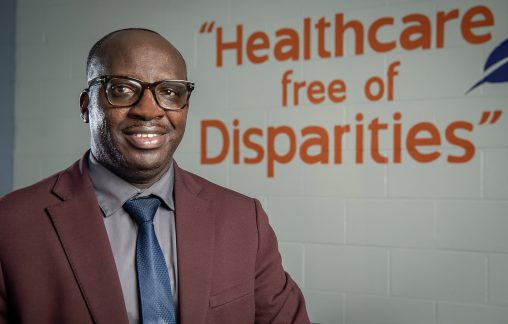
Its mission statement — “healthcare free of health disparities” — is painted on the walls throughout its Dayton headquarters in more than a dozen languages.
For staff, that mission means helping clients not just with healthcare access but other needs, including housing, transportation, food assistance and connections to education and employment opportunities. Staff also visit clients after a hospital stay to make sure they understand their discharge instructions.
“While they are in the hospital, language assistance is usually available,” Mukunzi said. “But once they return home, many individuals with limited English proficiency are left without the support they need to navigate the healthcare system. That’s why we go to see them in their homes to make sure there is a continuation of care from the hospital to their homes.”
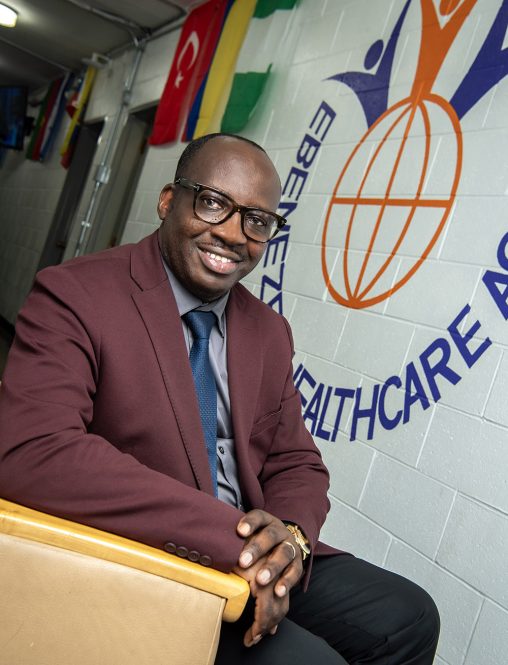
Ebenezer Healthcare Access, the nonprofit Jean Mukunzi founded in 2019, operates in three Ohio cities, employs nearly three dozen community health workers and fields a hotline that connects callers to help in 16 languages.
Ebenezer also partners with the Dayton Equity Center to translate forklift certification training into clients’ native languages, helping immigrants move into skilled jobs. The organization also helps clients navigate the difference between asylum seeker, asylee, refugee and green card status to determine eligibility for Medicaid and other services.
Staff call the services they provide to their clients “pathways” — each one is a single, concrete service for a single client. Last year, they logged 37,426 pathways.
“I want people to be self-sufficient,” Mukunzi said. “We are U.S. citizens, and since this is our new home, we need to build it, to work together with other people so that we can make it better.”
A personal calling
Mukunzi’s commitment to serving others began long before he arrived at Wright State University.
In Rwanda, Mukunzi worked as national youth program manager for Population Services International, a U.S.-based nonprofit, leading HIV prevention and malaria control programs for young people. He saw firsthand how much health education, community outreach and culturally sensitive care could change a life.
Those experiences inspired him to bring that same community-based approach to the United States. He’d seen how many immigrants and refugees ran into language and cultural barriers trying to get care, and he believed the same community-based health education and outreach models that worked in Rwanda could help new Americans navigate the U.S. healthcare system too.
Mukunzi eventually immigrated to the United States, landing in Dayton after he heard about a local shelter that took in immigrants. He taught himself English by borrowing CDs and DVDs from the Dayton Metro Library before enrolling at Wright State.
Wright State provided Mukunzi with much-needed stability during this transition. A university staff member hired him as a personal aide and offered him a place to live, allowing him to move out of the shelter and focus on his education while continuing to serve others.
One faculty member who made a lasting impression was Sara Paton, Ph.D., professor of epidemiology and interim chair of the Department of Population and Public Health Sciences.
As a student in Paton’s epidemiology class in 2009, Mukunzi learned research techniques and worked on class projects that formed the basis of his thesis.
What Paton remembers most, however, is the perspective he brought to every discussion.
“Jean always enriched the class discussion because he had a different lens that he looked at the health outcomes through,” Paton said. “I think it enhanced the classroom environment and the students got a lot out of those discussions.”
She could see even then that he was struggling — with English, with finding basic services, with a country that wasn’t yet home. What she couldn’t see was where that journey would lead.
“I had no idea it was going to be what it is,” she said.
When Mukunzi founded Ebenezer in 2019, he asked Paton, by then a colleague in the close-knit public health community, to join its board. She accepted immediately. Today, Wright State’s Master of Public Health program places a student with Ebenezer each year, continuing a relationship that began in her classroom nearly two decades ago.
“It’s a full-circle moment for me,” Paton said. “It speaks to how far he has come himself from the person that was struggling to speak English and to find a place in our country, and now he’s mentoring and inspiring the next generation of public health professionals.”
Mukunzi’s connection to Wright State is about to grow even stronger: his son will begin classes this fall with a 4.1 GPA and scholarship offers that could have taken him anywhere.
“If I did not have a chance to come to Wright State,” Mukunzi said, “today, maybe we would not be able to impact the lives of all these people.”
Looking beyond Ohio
Mukunzi believes the model developed in Dayton can help communities far beyond Ohio.
He is working with researchers at Harvard to study whether Ebenezer’s approach could expand nationally and, eventually, internationally, to support refugees and immigrants navigating unfamiliar healthcare systems.
“First to the national level, second to the global level,” he said. “That’s our next goal.”
 Ohio Medical Education Day brings aspiring physicians from across the state to Wright State University
  Connecting students with career opportunities
  Preparing students for the workforce from day one
  10th annual Wright Day to Give scheduled for Sept. 30 and Oct. 1
  Wright State University Foundation welcomes four new trustees