As Wright State University students returned to the Paul Laurence Dunbar Library to study this fall, they may have noticed that the Wright Flyer hanging above them looks a little different. The replica of Orville and Wilbur Wright’s first airplane, the 1903 Flyer, was lowered over the summer for an extensive three-week cleaning project.
A team of four staff members from Wright State’s Special Collections and Archives began the project by removing litter that had accumulated on the flyer.
“Because it is suspended from the ceiling, we do have a lot of students throw paper airplanes on it, which — contrary to my feelings as an archivist — the Wright brothers probably would have thought was really funny,” said Anna Helmig-Sampson, a digital and preservation archivist and two-time Wright State graduate. “They were tinkerers and they liked making toys, so you can’t be too mad at the students.”
Creating a condition report to document the current state of the flyer was the next step. While the staff was expecting a thick layer of dust, they were pleasantly surprised to find the fabric was not as dirty as they had assumed. It helped that a Facilities Operations crew had gone up in a lift in 2023 to vacuum the replica.
“What was unanticipated was some of the rust bits from the chain. As probably some of the students have noticed, the propellers will spin a few minutes every hour. From the chain mechanism that’s in the middle of the plane, some rust was falling down on the wing,” said Grace Ethier, a reference and outreach archivist.
To remove the rust and dust, Special Collections and Archives staff used a museum-grade quality Nilfisk vacuum with a HEPA filter.
“It’s an archivist’s dream. You can control the speed of the vacuum’s suction, so you’re not damaging the artifact itself,” said Helmig-Sampson. “The muslin is really susceptible to any grit. We wanted to do a very slow speed, slow suction so we don’t cause any damage to the plane. It’s very repetitive, slow and even, over and over again.”
Conservation-grade Renaissance wax was applied to the flyer’s metal components to prevent corrosion. But the biggest issue was water stains.
“It’s very difficult to get water stains out of fabric on an artifact without taking all of the fabric off. To take the fabric off would pretty much be disassembling the plane, which would be a whole other project,” said Toni Vanden Bos, head of Special Collections and Archives. “We consider the water stains part of the display history of this replica, because it was meant to fly in this library — not in a museum — where the students, faculty, staff and community can come in and be inspired by it.”
Since the water stains could not be fully removed, a light sponging technique was used to make the stains less obvious, and facilities sealed the leaks in the skylight to prevent future damage.
Some of the ties that attached the fabric to the ribs of the flyer had weakened and loosened over the years. To ensure replacement ties were authentic to the flyer’s original ties, Special Collections and Archives collaborated with the Department of Chemistry, which found the ties closely matched linen. Based on this analysis, deteriorated or missing ties were replaced with a similar linen cord.
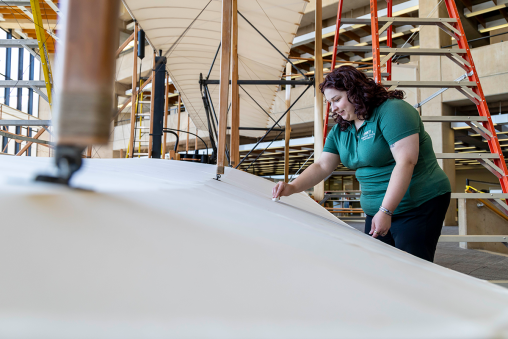
Dunbar Library’s replica of Orville and Wilbur Wright’s first airplane, the 1903 Flyer, was lowered over the summer for an extensive three-week cleaning project. (Photos by Erin Pence)
Built by volunteers
Building a replica of the 1903 Wright Flyer was the brainchild of Howard Dufour, a master machinist who worked on armaments for World War II and later as a fabricator for Wright State in the 1970s.
“He wanted to see what it was like — what the problems and challenges were that the Wright brothers ran into building the flyer,” Vanden Bos said. “In 1999, he decided he was going to put out a call. He placed an ad in the local paper, asking for others who wanted to help him unlock the secrets of the Wright brothers’ first flyer and build it with him.”
Twenty-one Wright State-affiliated volunteers and others joined Dufour’s herculean task. They consulted the Louis P. Christman drawings of the Wright Flyer in Special Collections and Archives to design their plans and tried to find materials that were as close as possible to those used in the original flyer.
“It was not as easy as just following the plans. When you actually put the pieces together, you encounter issues. One was bending wood. So, they actually soaked the wood pieces in industrial-strength ammonia for a day, and then they put them in a vice to get the curve,” said Vanden Bos. “It was overcoming those challenges to keep moving forward, and two years later, they were able to assemble the flyer and put it up in the library. It was really a journey for them, walking in the footsteps of the Wright brothers throughout that process.”
“A Dream Fulfilled,” a book documenting the construction of the flyer and its installation in 2001, is available on Core Scholar.
“At the very end of the book, they talk about the quiet in the library as the flyer was raised,” said Vanden Bos. “It’s a hold your breath moment, because it really does want to fly.”
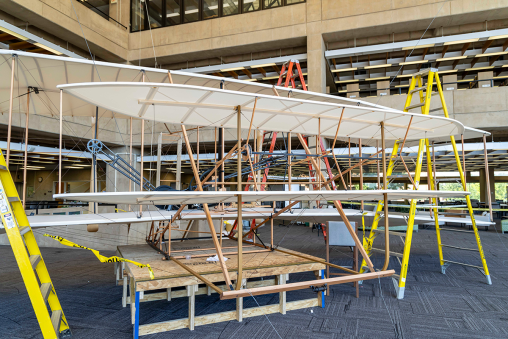
Twenty-one volunteers, along with Wright State fabricator Howard Dufour, consulted drawings found in Special Collections and Archives to build the replica using materials as close as possible to those used on the original flyer.
A source of inspiration
Since the Wright Flyer replica was last lowered for a full-scale cleaning in 2014, most of the staff in Special Collections and Archives never had the opportunity to examine the intricate work of Dufour and his volunteers until now.
“This is something completely new and exciting for me to work on. Walking into this library every morning and seeing the flyer and now getting up close and personal with it is really thrilling,” said Ethier. “It’s an object that a lot of people have a relationship with because they’re studying under it and they’re walking by it every day. To take care of it has been fun.”
Beyond the flyer itself is the legacy of innovation and determination that it represents.
“Even before I worked in Special Collections and Archives, I was enamored with the Wright brothers. I think their story is a uniquely Ohio one, because they were just two simple boys from Ohio who changed the world with their flying machine,” said Helmig-Sampson. “Being at Wright State and having that name as part of everything, it’s hard to forget their impact. It’s not that we’re studying the Wright brothers constantly, but they’re always kind of in the background reminding us that ordinary people can achieve extraordinary things.”
Thanks to the work of Special Collections and Archives, students will continue to be touched by the story of the Wright brothers for generations to come.
“We attribute Orville and Wilbur’s success to their tenacity in overcoming challenges, and that’s an inspiration to all of us at Wright State and in the community,” said Vanden Bos. “As you’re studying in this library or you’re visiting and you’re burdened with a problem that you feel like you’re never going to overcome, just think about the Wright brothers. They also felt that way but look forward and know that you too can overcome a challenge. And before you know it, you too can change the world.”
 Flying high
  Greene County families visit Wright State for mass food distribution by The Foodbank
  Wright State’s Cardio-Renal Institute Summer Program prepares students for in-demand healthcare professions
  Wright State’s Entrepreneurship Bootcamp helps veterans turn ideas into businesses
  Wright State motion pictures alumni win regional Emmy award