This past summer, Kara Sheridan Ayers took a trip down memory lane. She returned to her alma mater, Wright State University, to visit the people and places that helped prepare her for success as a student-athlete and her current career as an advocate for people with disabilities.
After growing up in Frankfort, Kentucky, Ayers was drawn to Wright State for her college education thanks to its accessible campus.
“Accessibility as a disabled person was important, but I also wanted to find community,” she said. “I came from a place where I was often the only person with a visible disability.”
Adapted sports and adapted recreation were also big draws for Ayers, who originally set out to compete in wheelchair track.
“I was interested in wheelchair track, primarily because that was one of the few sports that I knew of. I just hadn’t been exposed to the larger list of what’s possible in terms of sports and recreation for people with disabilities,” Ayers said. “Once I got to Wright State, I quickly realized that track wasn’t for me and I was able to pivot to swimming.”
Along with developing a passion for swimming, Ayers was learning new ways to exercise. She took a course on adapted strength training that opened her eyes to a whole new world of fitness opportunities.
“Growing up with a physical disability, I hadn’t had as many opportunities to work out and get strong and enjoy fitness,” said Ayers. “Wright State not only had the environment for that in terms of accessible spaces, but it also had the people power behind it. People that allowed me to find out new potential that I had that I didn’t know existed.”
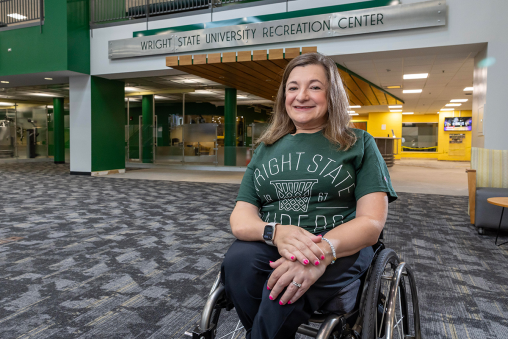
Kara Ayers ’03 was drawn to Wright State because of the campus’s accessibility and the opportunities to participate in adapted sports and recreation. (Photo by Erin Pence)
Along with her swim coaches, Drew Corbett — who now serves as director of the Student Union and campus recreation — became instrumental in Ayers’s development not only as an athlete, but also as a person.
“I met Drew during my orientation. And he was so supportive as I figured out what I wanted to do,” said Ayers. “He was my adaptive strength training teacher, and he helped me build my first workout — one that I would eventually escalate and use at a time when I was training to compete internationally.”
Corbett had a front-row seat to Ayers’s journey as a successful student-athlete in adapted swimming.
“I got to see Kara pretty much every day, help her with her workout routine, travel with her, get her registered for competitions,” said Corbett. “Kara is such a great person. She wasn’t afraid to try something that she had never done before.”
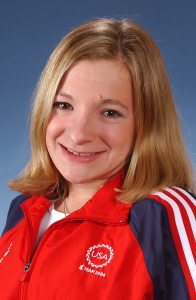
Ayers competed in the 2004 Paralympics in Athens, Greece, where she set two American records.
Ayers’s dedication and persistence paid off. As a Wright State swimmer, she set her first world record in swimming — a feat that set Ayers on the path to competing in the 2004 Paralympics in Athens, Greece, where she set two American records in the 100-meter breaststroke.
“I didn’t medal, which kind of gives you some insight into the competitiveness of the Paralympic space that you can set records for your country with your time and not medal,” said Ayers. “It was still a life-changing experience to get to be in the Paralympic Village and to meet so many incredible people from across the world that share having a disability in common.”
After graduating from Wright State in 2003 with a bachelor’s degree in psychology, Ayers relocated to Florida to further her education at Nova Southeastern University.
“I remember Wright State staff, including Drew, were very supportive of me figuring out where I was going to go next, because I wanted to further my studies but also continue swimming,” she said. “We were figuring out all of those variables, which is extra challenging for an athlete with a disability, because we don’t necessarily have all the same pathways that non-disabled athletes have.”
Ayers swam for a few more years while working on her Ph.D. in clinical psychology. Her final competition was at a world championship in England.
While she may not spend as much time in a pool these days, Ayers is able to revisit her passion whenever she chooses.
“One of the awesome things about swimming is it’s a lifetime sport,” said Ayers. “I get in and out of the pool with different phases in my life. Right now, I’m a little out of the pool phase, because my three kids are so busy in their sports. What I love doing most during my free time is cheering them on.”
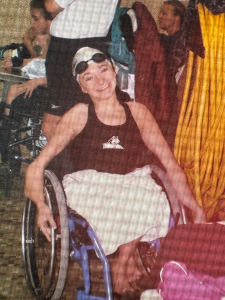
As a Wright State swimmer, Ayers competed across the county and set her first world record.
As a former student-athlete, Ayers knows firsthand the positive impact sports can have on the lives of her children and countless other young people.
“Sports has so much to offer. You don’t have to go to the Paralympic level to benefit from those lessons,” she said. “Participation in sports is connected to leadership opportunities, especially for women and people with disabilities. It’s critical that students have the opportunity to participate in a wide range of adaptive sports, because it will give them gifts throughout the rest of their lives.”
Today, Ayers is associate director of the University of Cincinnati Center for Excellence in Developmental Disabilities and an associate professor in the Division of Developmental and Behavioral Pediatrics at Cincinnati Children’s Hospital Medical Center.
“I’m a researcher and I also work in disability policy, so I study how policies would impact people with disabilities,” Ayers said. “I try to make what can be boring and confusing policy meaningful for people with disabilities and their families, so that they can be a part of the process in trying to make them things better or just know what’s coming around the corner.”
Ayers and Corbett have stayed in touch over the years, and they reconnected when Ayers visited campus and toured the newly renovated Fitness Center.
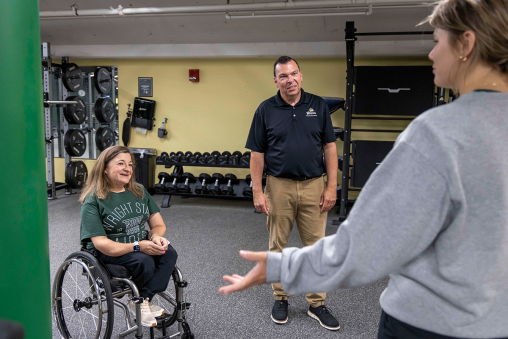
Drew Corbett, who now serves as director of the Student Union and campus recreation, was Ayers’s adaptive strength training teacher during her time at Wright State. (Photo by Erin Pence)
“Kara is the perfect story for somebody like me, who interacts with students on a daily basis,” said Corbett. “It’s so important to be able to meet students where they are, guide them through their journey, see the end results and then, years later, be able to reconnect and know that we are making a difference in people’s lives because we have them coming back and telling us their story.”
Returning to her alma mater reminded Ayers of the safe, welcoming community that Wright State has always strived to provide.
“I wish more places were like Wright State in terms of not only the accessibility, but the inclusion and acceptance,” said Ayers. “I remember disability being just a part of campus life here. That was really instrumental in building who I am.”
 Coming in to her own
  Wright State University celebrates two decades of Air Force Marathon partnership
  Flying high
  Greene County families visit Wright State for mass food distribution by The Foodbank
  Wright State’s Cardio-Renal Institute Summer Program prepares students for in-demand healthcare professions