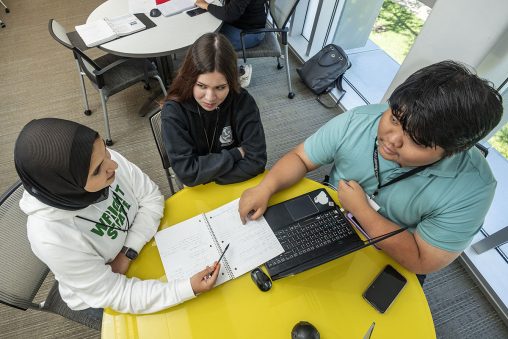
The Academic Success Centers are among several resources available to Wright State students that have helped drive three consecutive years of retention above 70% among first-year students. (Photo by Erin Pence)
Wright State University’s first-year retention rate has remained above 70% for a third consecutive year, marking continued progress toward one of the university’s key student-success goals, the Provost’s Office announced at the Wright State Board of Trustees meeting on Sept. 17. More than 72% of the fall 2025 cohort returned this fall.
The retention rate reflects Wright State’s focus on helping students persist toward graduation.
Laura Luehrmann, Ph.D., vice provost for undergraduate education, credited academic advising, faculty collaboration and intentional retention programming with supporting students and helping them develop a sense of belonging.
“Student success extends beyond retention,” Luehrmann said. “Our broader goal is to help students complete their degrees and develop the knowledge and skills and experience they need to succeed in their chosen careers and lives.”
Wright State is also strengthening connections between students and career opportunities through the newly named Berry Family Career Hub and experiential learning, including work-based learning.
The Division of Student Success is bringing academic support directly to students where they live through a new residential tutoring initiative, with study tables in three residence halls and tutoring for targeted courses.
Susan Schaurer, vice president for enrollment management, also reported that Wright State’s enrollment increased again this fall, reaching 12,157 students across the Dayton and Lake campuses — up 2% from last fall and 12% since 2022. Read more about the university’s fall enrollment.
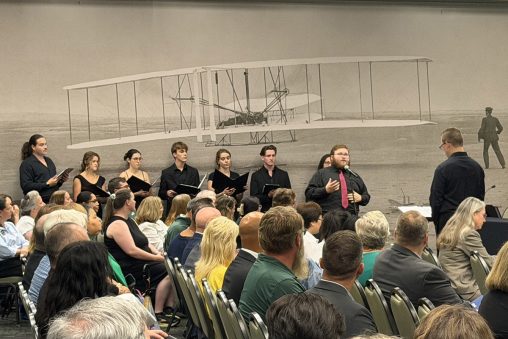
In honor of Constitution Day, Wright State student vocalists sang the National Anthem and “Anthem” from the musical “Chess” during the Board of Trustees meeting. (Photo by Sarah Umbdenstock)
Trustees approve three new academic programs
Trustees also approved three new academic programs designed to expand educational opportunities and respond to workforce needs:
- Accelerated bachelor’s degree in business administration
- Bachelor’s degree in mathematical sciences
- Associate degree in radiological technology
The radiological technology degree is Wright State’s first academic program created in partnership with Premier Health to address regional workforce needs. Graduates of the 65-credit-hour program will be eligible for credentialing as radiographers.
The Accelerated Bachelor of Science in Business Administration is an intensive, 90-semester-hour program designed for high-momentum students seeking a direct, efficient pathway into the modern global economy. This program will equip graduates with the versatile skills required by top employers across corporate, nonprofit and entrepreneurial sectors. Students can customize their degree by including a 12-hour certificate program and completing a workforce-aligned internship.
The Bachelor of Science in Mathematical Sciences offers seven concentrations: actuarial science, applied mathematics, data science, discrete applied mathematics, mathematics education, pure mathematics and statistics.
The new degree programs must receive approval from the Ohio Department of Higher Education and the Higher Learning Commission before they are launched.
Provost Jim Denniston, Ph.D., also announced modifications to existing undergraduate degree programs, including combining Bachelor of Arts programs in art, theatre studies, music and motion pictures; anthropology and geography; and modern languages and international studies. Students can begin enrolling in the new programs in fall 2027, following approval by the Higher Learning Commission.
Denniston also provided an update on a proposed reorganization of the university’s colleges and schools. The proposal includes a new College of Arts and Sciences, a standalone School of Creative and Performing Arts and a new Institute of Medicine and Health that would include the Boonshoft School of Medicine and health science and nursing programs.
“The primary goal of the proposal is to align our academic units with emerging industry trends and workforce needs and promote research and entrepreneurial collaboration, creative endeavors and enrollment growth,” Denniston said.
University leaders are reviewing feedback on the proposal before finalizing it for presentation to the Board of Trustees in December.
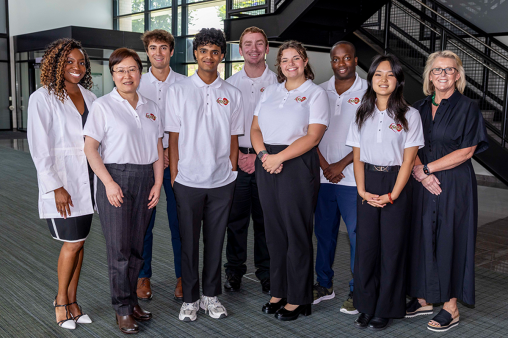
Representatives of the Cardio-Renal Institute Summer Program spoke to the Board of Trustees about how the program connects high school and undergraduate students with faculty on cardiovascular and renal research projects. (Photo by Erin Pence)
Student success showcased through research, engineering and campus engagement
Presentations to the board illustrated how Wright State is creating opportunities for students to gain research experience, develop leadership skills and connect their education to future careers.
The Cardio-Renal Institute Summer Program (CRISP) gave high school and undergraduate scholars an eight-week research experience focused on heart and kidney disease. The program paired students with faculty and peer mentors and combined research training with clinical experiences through Wright State and Dayton Kidney, an affiliate of Premier Health.

Management major Chloe Detty was sworn in for a two-year term as student trustee on the Wright State Board of Trustees. (Photo by Sarah Umbdenstock)
Tim Bunning, Ph.D., interim dean of the College of Engineering and Computer Science, and graduate student Rachael Ballentine highlighted the role of relationships, scholarships, research and internships in helping students succeed. Ballentine earned her bachelor’s degree in mechanical engineering from Wright State in 2025 and is pursuing a master’s degree in computer science. She has accepted a position with the Air Force Life Cycle Management Center through the federal SMART Scholarship program.
Student trustees Ella Vaught and Chloe Detty highlighted opportunities for students to get involved on campus and develop leadership skills. Wright State has 217 active student organizations and 704 students serving in leadership positions.
New Air Force research units coming to campus
Wright State will expand its partnership with Wright-Patterson Air Force Base beginning Oct. 1, when three new Air Force units will begin using space on campus.
The Air Force Research Laboratory’s Autonomy Capability Team, known as ACT 3, will focus on applying artificial intelligence to Air Force operations. The Digital Capabilities Team will work on digital transformation, while the Air Force Institute of Technology will provide educational programming for base personnel.
Greg Sample, executive vice president and chief operating officer, said the new units build on Wright State’s existing collaboration with Wright-Patterson and add to research activity underway in the Vishal Soin Center for Innovation.
 Wright State trustees approve new academic programs, highlight student success and new research partnerships
  Wright State’s Future Teachers Day inspires next generation of educators
  Lake Campus students saddle up for success at eighth annual Laker Lawn Party
  Ohio Medical Education Day brings aspiring physicians from across the state to Wright State University
  Connecting students with career opportunities