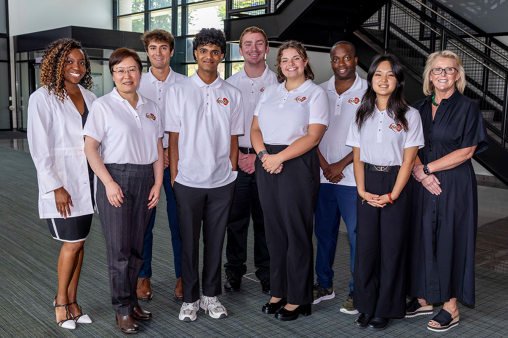
From left: Clintoria Williams (Director), Hongmei Ren (Co-Director), Gavin Soin (Clemson University), Sushaen Prabhala (Centerville High School), Zachary Kuntz (Wright State University), Kylie Bachmann, John K. Kamau, Grace Dong (Dayton Regional STEM School) and President Sue Edwards. (Photos by Erin Pence)
The future of healthcare is taking shape at Wright State University through a new summer program that introduces students to biomedical research, clinical medicine and healthcare careers.
The Cardio-Renal Institute Summer Program (CRISP) provided four high school and undergraduate students with intensive training in cardiovascular and kidney disease research. The cohort concluded July 31 with student research presentations at the CRISP Symposium, held at the Vishal Soin Center for Innovation.
“By introducing high school and undergraduate students to authentic research experiences and careers in medicine, biomedical research and other health professions, CRISP helps prepare students to pursue careers that address the growing national need for physician-scientists and biomedical researchers,” said Clintoria Williams, Ph.D., scientific director of the Cardio-Renal Institute and associate professor of neuroscience, cell biology and physiology.
For students still exploring their future career paths, CRISP provides an opportunity to discover new interests and build confidence in research and medicine.
Grace Dong, a rising sophomore at the Dayton Regional STEM School, found value in shadowing physicians and gaining real-world experience in the laboratory as she continues to explore her interests in medicine and biomedical research.
“My experience in CRISP helped me better understand the connection between research and patient care, and I can apply what I learned to my future academic and career goals,” she said. “CRISP reminded me to stay curious, be open to new experiences and to learn about different areas in the medical field where I can apply my skills and knowledge.”
Unlike many research opportunities that focus primarily on laboratory research, the CRISP program engages scholars in multiple stages of the research process. They conducted laboratory experiments, analyzed data, received hands-on training in animal handling and husbandry through Wright State’s Laboratory Animal Resources (LAR) and learned techniques such as echocardiography and blood pressure measurement.
“The CRISP students are now cognizant, not only of the need to maintain animal welfare, but also of the positive impact good care has on research results and data reproducibility,” said Noé Tirado-Muñiz, D.M.V., director of Laboratory Animal Resources.
“Engaging with them multiple times, we could see their curiosity grow. Their collective enthusiasm for learning was truly remarkable, making CRISP a great asset to Wright State,” added Loren Prince, laboratory technologist.
Gavin Soin, a junior health science major at Clemson University who plans to attend medical school, joined CRISP over comparable programs at other universities.
“Along with loving the research project that I’d be contributing to, I was also excited to gain hands-on experience in other areas of the research, such as animal handling, clinical shadowing and mentorship,” he said. “I truly believe that this program has set me up for success moving forward in my academic and professional careers.”
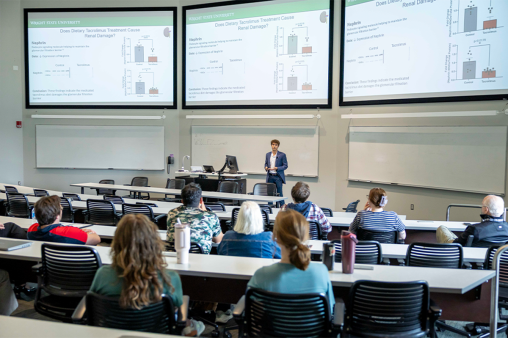
The CRISP program engages students in multiple areas of the research process while working alongside skilled mentors and healthcare professionals.
An important aspect of the program was giving students the opportunity to contribute to ongoing biomedical research addressing significant health challenges. Their efforts included investigating how medications used to prevent organ rejection after transplant may contribute to kidney disease and studying a potential new therapy to improve heart function in people with Duchenne muscular dystrophy, a genetic disorder that weakens both skeletal and heart muscles.
“Our goal is that after working alongside experienced mentors, every scholar leaves CRISP with increased confidence, practical research skills and a clearer vision for their future research, academic endeavors and careers,” said Williams. “We hope that the program inspires them to become future leaders who will improve human health through research, innovation and patient care.”
Throughout the summer, participants also learned directly from medical students and healthcare professionals. The students shadowed at Dayton Kidney and participated in Lunch Learning sessions led by Wright State faculty, researchers, clinicians and medical students. The symposium also featured a career panel in which Boonshoft School of Medicine students shared different educational pathways and career experiences.
Kylie Bachmann, an M.D./Ph.D. student at the Boonshoft School of Medicine, credits her undergraduate opportunities for helping her find her passion for research.
“After my own life-changing experiences, I was so excited to be a part of CRISP and help students not only discover a passion for science and research in an encouraging environment but also have the opportunity to grow personally and gain confidence,” she said. “Being able to participate in groundbreaking research allows students to see the applications of their coursework and can strengthen their ‘why’ when it comes to pursuing a career in science and medicine.”
Tara-Yesomi Wenegieme, a 2020 alumna and CRISP program coordinator, said she was excited to give students the same opportunities that she experienced at Wright State.
“I have personally benefited immensely from similar programs during my time at Wright State, and it has been a pleasure to give back by contributing to a program that provides those same opportunities to the next generation of physicians, scientists and healthcare professionals,” she said.
With the inaugural program complete, Williams is excited for the Cardio-Renal Institute’s future and CRISP’s role as a workforce development initiative.
“With the support of Wright State University leadership, including President Sue Edwards, we look forward to the institute’s continued growth and for CRISP to play a central role in developing the next generation of students who are equipped to tackle some of the nation’s most pressing health challenges,” she said.
 International scholars
  A fresh start leads to finding his people
  Wright State alumna and faculty member Amy Faust receives Emerging Cinematographer Award
  Weeks of Welcome helps Wright State students find place on campus
  Federally funded conservation treatment helps preserve Wright brothers’ family history