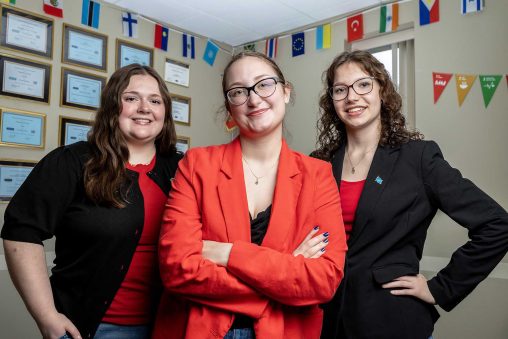
Siobhan O’Boyle, left, Chloë Johnston ’26 and Victoria Kunc wearing their traditional power red in the lab for Wright State’s Model United Nations team. (Photo by Erin Pence)
Wright State’s Model United Nations team keeps winning at the National Model U.N. Conference in New York.
For 46 years straight, they’ve returned to campus award winners — one of the longest streaks of its kind in the nation. Ask anyone on the team about it, though, and the awards aren’t what they want to talk about.
They want to talk about the moment their voice stopped shaking, or how they met the best friends ever.
Siobhan O’Boyle, a senior human resource management major, joined the team after meeting members at a student organization tabling event. She didn’t have a special interest in foreign policy — or any love for public speaking.
“My voice would shake, or I would lose my train of thought,” O’Boyle said of her early speeches. “But now I love it. I don’t have those fears anymore. And that’s a skill I will use forever.”
O’Boyle’s roommate, Victoria Kunc, can relate. The senior political science major who plans to attend law school said she’d been too shy to join Model U.N. in high school despite a teacher who spent two years asking. At Wright State, Professor Liam Anderson, Ph.D., who co-advises the team with Professor Vaughn Shannon, Ph.D., made an appeal to her future, and he wasn’t subtle about the pitch.
“He said, ‘Listen, you want to be a lawyer, you need to have good communication skills,’” Kunc said. “‘If that isn’t on your resume, you’re never going to get hired.’”
Understanding how Model U.N. would further her own goals was the nudge Kunc needed. She signed up, and then she grew into one of the team’s strongest delegates.
The team’s advisors say that arc is the point, not a side effect, and seeing students’ growth is why both of them continue to lead the team.
“We teach them the skills to speak in public, to interact with others effectively, to do research and work as a team,” said Anderson, a professor of political science. “And it transforms them into much more confident human beings.”
And they do it through support and lots of guided practice. Advisors and veteran delegates critique every practice speech, and Kunc remembers her first feedback was about her nervous feet — she couldn’t stop swaying.
“They had to teach me from day one: stop swaying when you’re speaking. You have to plant your feet,” she said.
It took a full semester of speeches before planting her feet stopped feeling like the hardest part of the job. It’s more difficult than it sounds, and that’s by design. Every spring, students are assigned a country and expected to argue its actual policy positions.
Model U.N. doesn’t ask students to believe in those policy positions. It asks them to commit to the argument anyway, plant their feet and hold the position until their voice stops giving them away.
“Whatever country you represent, you need to detach personal opinions and feelings from your state’s policy,” said Shannon, professor of political science and director of the Master of Arts in International and Comparative Politics program. “It’s a good exercise in resolving cognitive dissonance.”
As the year progresses, the arguments keep getting harder to make. O’Boyle once drew North Korea.
“It was very hard to blend in,” O’Boyle said. “A lot of the policies go directly against North Korea’s views, so I’m left on the outside, trying to work my way back in.”
To make it even tougher, Kunc was given the role of South Korea. The two were paired to test whether the close friends could hold opposite positions without flinching. They could. And they had fun with it. After the session, O’Boyle, fully in character, texted Kunc that “the glorious Republic of North Korea” was demanding Kunc go get something from her room.
They laugh about it, but there was a lesson in the session that resonated with everyone in the room.
Later at the New York conference, Chloë Johnston, a graduate student in international and comparative politics and one of the head delegates for 2027, represented Russia shortly after they invaded Ukraine. She spent two full days on the outside, defending her right to co-sponsor a policy paper while other delegates tried to get her removed from the process — not because her position was wrong, but because of whose position it was.
She stood her ground and kept her cool. She also kept her name on the paper on the way to winning an award.
Ask Johnston what she walked away with, though, and she doesn’t lead with the victory.
“A lot of what I’ve taken away from Model U.N. has nothing to do with the international system,” Johnston said. “A lot of it just has to do with strategies of interpersonal communication. How to talk to people and best present yourself.”
The 46-year streak makes it clear that the Model U.N. students are representing themselves, and Wright State, very well. In a program that Shannon likes to call “academic athletics,” they field a team he’s proud to get to coach every year. He also gets to watch students who were once afraid of speaking in public walk into a room of strangers and make them listen.
They’ve learned to speak up, even when they’re terrified. Especially then.
Related links:
- Learn more about Wright State’s Model United Nations Program.
- Read about the team winning top honors at the 2026 competition in New York.
- Explore information on the WrightMUN High School Model United Nations Conference.
 Make the argument that changes you
  Wright State brings campus community together to celebrate mental health and well-being
  Wright State trustees approve new academic programs, highlight student success and new research partnerships
  Wright State’s Future Teachers Day inspires next generation of educators
  Lake Campus students saddle up for success at eighth annual Laker Lawn Party