Growing up was a rocky road for Adrian McLemore. His mother and father divorced. He fought with his parents and teachers. He ran away from home a lot. And then there was the string of foster homes…
By the time McLemore emancipated from foster care at age 18, he was left largely on his own to navigate and survive in an unfamiliar and unforgiving world.
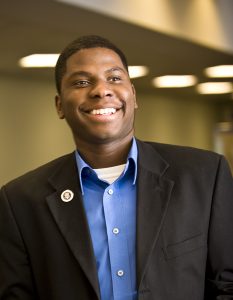
Today, the 25-year-old McLemore is preparing to graduate from Wright State University in political science and readying himself to launch a career in public service. He spent two years raising his 2-year-old nephew and 4-year-old niece, tutors students at Dunbar High School in Dayton, and is helping develop an innovative program at Wright State to nurture, educate, and graduate emancipated foster students like himself.
A low percentage of the nation’s emancipated foster youth graduate from college, and they experience a greater rate of homelessness and joblessness as a result of their lack of preparation to face the challenges of the world.
Wright State officials believe their new Independent Scholars Network—which provides foster students with a living and learning community, life-skills enhancement, opportunities for employment, and a higher education experience—just might be the answer.
“It breaks the cycle of poverty, limited education, and the cycle of minimized opportunity for these students,” said Sonseeahray Ross, former graduate assistant, Office of the Vice President for Student Affairs. “It transforms and changes lives, but it also gives hope.”
Each year, more than 1,000 youths age out of foster care in Ohio. While a few universities around the country have similar foster student programs—including the University of Alabama, Central Florida, and Texas-El Paso—Wright State’s program is the only one of its kind in Ohio.
“This is an extremely wonderful and unique program,” said Crystal Ward Allen, executive director of the Public Children Services Association of Ohio, a nonprofit membership organization for each of the county’s child welfare agencies. “No other campus in Ohio I am aware of has the same type of setup. It’s tremendous.”
Ross said many foster students arriving at college have moved multiple times in their lives, resulting in a fragmented academic experience. They may also not have had opportunities to practice life skills such as cooking and housekeeping and may have had limited social interactions.
“Now they’re forced to engage and interact with people from diverse backgrounds, from diverse cultures, from diverse life experiences,” Ross said. “It’s very scary for them because it’s all new. They’ve stepped into a new big world, one where they know no one.”
McLemore said foster care took a toll on him.
“I didn’t like changing homes. I didn’t like some of my foster siblings. I didn’t like some of my foster parents,” he said. “It’s just a really, really, really tough system.”
McLemore described himself as mouthy, sarcastic, and constantly challenging authority. He said his anger was further fueled by his mother placing him in foster care, separating him from his two sisters.
“That was a traumatic experience because I felt like she didn’t want me,”
he said.
Teachers and caseworkers saw promise in McLemore, telling him he was smart and needed to focus his energies on the positive. Embarrassed one day at school because he was wearing dirty clothes that smelled, McLemore began wearing coats and ties. It’s a practice that filled him with confidence and continues to this day.
McLemore’s high school principal took him under his wing, teaching him how to be a leader. McLemore learned to put others before himself, how to get to the root of people’s problems, and went so far as to memorize the full names of all of the students at the high school as they came and went over three years.
Patriotism courses through McLemore’s bloodstream. He wants to be president of the United States one day and has surrounded himself with inspiration.
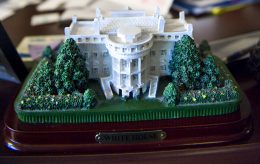
In the living room of his apartment, McLemore has created his own Oval Office, replete with desk and a black leather chair emblazoned with a “United States of America” seal. An American flag hangs from the ceiling, and McLemore’s framed snapshots of the White House and Capitol Building look down from the walls. The ringtone on his cell phone? The Star-Spangled Banner.
From his first day at Wright State, McLemore realized that college for someone with a foster background was going to be a challenge.
While everyone else was moving into the dorms accompanied by their parents, McLemore arrived in a sticking-out-like-sore-thumb county van, carrying one suitcase, in the company of foster agency officials.
McLemore said foster students some-times have to battle a misguided belief by some people that they are troublemakers, that it is their fault they were placed in foster care, and that they aren’t smart enough to go to college. As a result, they try to blend in with fellow college students.
“They just want to feel normal, and it’s kind of hard,” he said.
When McLemore’s roommate would leave on the weekends to visit family and enjoy home-cooked meals, McLemore remained in his dorm room surrounded by all of his earthly possessions. While his fellow students had been driving for years, McLemore had to go through driver’s education and then obtain his license. He worked a full-time job at a steakhouse to pay for school.
“I’d come home and instead of doing homework, I would just pass out on my dorm room floor and sleep almost until the next day,” he recalled.
Academics were a struggle. McLemore was placed on academic probation and was once temporarily dismissed from school for academic reasons. But he returned and persevered.
McLemore recalls the day he took custody of his niece and nephew. It came following a telephone call from the sheriff’s office, telling him there had been a situation with his sister and that the kids would be turned over to a child welfare agency unless he came and picked them up.
“My fear was that they were going to be placed in foster care,” he said. “It’s a very scary thought when you take two people that young and place them in a stranger’s house indefinitely. After I saw the perils of foster care, I really didn’t want to repeat
the cycle.”
During a recent evening at McLemore’s apartment, his niece, A’Rayiah, and nephew, Tyiaun, were an energy-packed blur, each vying for their uncle’s undivided attention. When not peppering him with questions and comments, they were on the balcony bouncing balls or slurping blue ice pops. A swordfight with their uncle featuring plastic weapons is a regular ritual.

“I’m very strict in structure, but you have to find time to have fun,” McLemore said. “They just need someone to be there to climb on, to talk to, to be in their face 24/7, and to listen to them. My mission statement in life is to become the protector of my children and to be a great father.”
McLemore’s days often begin at 6 a.m. and don’t end until nearly midnight. In between, there was getting the kids to daycare, going to classes or work, tutoring high school students, attending various board meetings, picking the kids up from daycare, feeding them, and doing homework.
He said the biggest challenge was juggling all of his responsibilities.
Simone G. Polk, assistant vice president for student services, Office of the Vice President for Student Affairs, said the new Independent Scholars Network is an effort to assist the underserved foster student population and provide them with tools necessary to support their academic achievement and social cultural development.
“We want to do the best possible job in transforming and changing their lives to enhance their success and to prepare them when they graduate for an increasingly competitive global employment market-place,” Polk said.
From his first day at Wright State, McLemore realized that college for someone with a foster background was going to be a challenge.
Word has spread beyond Montgomery County about Wright State’s new program, and the university will have about a dozen foster students from four Ohio counties this fall.
Polk said the background of the foster students should be a diverse educational learning opportunity for other Wright State students.
“Oftentimes we look at ethnicity, culture, nationality, ability, veterans and military connected status, but we don’t often look at the life experience diversity of our individuals,” Polk said. “And if we value individuals, we have to value the life experience they bring to campus.”
 Weeks of Welcome helps Wright State students find place on campus
  Federally funded conservation treatment helps preserve Wright brothers’ family history
  Lake Campus expands recreation and engagement opportunities on campus
  Dream, innovate and soar
  Make the argument that changes you