One student is researching how robots can work with humans. Another, how electric-powered flying vehicles can recharge while airborne. And another is examining how the brain controls eye movement to track objects.
They are among the six Wright State University engineering and computer science students who received prestigious Department of Defense SMART (Science, Mathematics and Research for Transformation) Scholarships, which provide full tuition, a stipend, summer internships and a guaranteed job after graduation.
The program aims to cultivate the next generation of leaders in science, technology, engineering and mathematics fields critical to national defense.
Each of the past two years, one Wright State student earned the scholarship. This year, though, is a bonanza.
“As the College of Engineering and Computer Science continues to focus on providing internships to our students and facilitating employment opportunities after graduation, one way our relationships and interactions with Wright-Patterson Air Force Base are paying off for our students is SMART scholarships,” said Dean Darryl Ahner, Ph.D. “These scholarships are highly competitive since they cover both full tuition and a generous stipend. Our students stand out with their commitment to excellence and service to our nation. We are exceptionally proud of these six scholarship award winners.”
The SMART Scholarship program is quite competitive, said Ahsan Mian, Ph.D., professor of mechanical engineering and director of research and outreach in the College of Engineering and Computer Science.
“That we have six students getting this shows that we are preparing out students well in the area of STEM,” he said. “When our students receive SMART Scholarships, we should celebrate.”
Meet several of Wright State’s latest SMART Scholarship recipients:
Rachael Ballentine
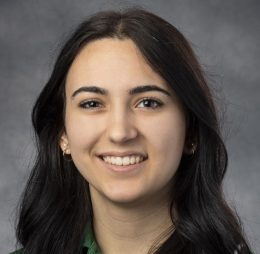
Rachael Ballentine, computer science graduate student.
Rachael Ballentine, who is pursuing a master’s degree in computer science, studies how neural networks can predict wildfire spread based on environmental factors.
“Wildfire ignition and spread depend on a number of environmental factors like weather conditions, available fuel and topography, making it a fairly complex problem,” Ballentine said.
Her goal is to gain an expertise in machine learning and data analytics and to work for the Air Force Life Cycle Management Center at Wright-Patterson Air Force Base.
“The SMART Scholarship has allowed me to focus on classwork and my research full-time while giving me the opportunity to work at Wright-Patt after graduation,” Ballentine said.
Diana Johnson
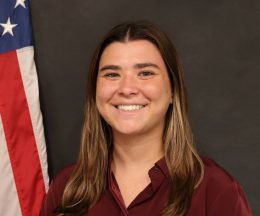
Diana Johnson, computer science graduate student.
Diana Johnson, who graduated with a bachelor’s degree in industrial and systems engineering at Wright State, is pursuing a master’s degree in computer science. Her research uses neural network models to understand how the brain controls eye movement and tracks objects.
Johnson plans to apply her expertise in machine learning to lead projects that use data-driven technologies to solve complex problems.
“Receiving this award has given me the opportunity to pursue graduate studies in a field I’m passionate about,” she said.
Ava Megyeri

Ava Megyeri, Ph.D. student in computer science and engineering.
Ava Megyeri, a second-year Ph.D. student in computer science and engineering, will work with the U.S. Navy in Newport, Rhode Island, focusing on artificial intelligence and robotics in underwater unmanned vehicles.
Working with Associate Professor Natasha Banerjee, Ph.D., Megyeri researches how robots can safely grasp and manipulate objects based on human behaviors to improve human-robot collaboration. Her goal is to develop robots that can assist soldiers in supply distribution, equipment handovers and search-and-rescue operations.
News of receiving the SMART Scholarship left her excited and grateful.
“It’s an amazing opportunity to learn from the experts through summer internships and gain that hands-on experience,” she said.
Ayinde Ramsey

Ayinde Ramsey, undergraduate mechanical engineering student.
First-year mechanical engineering student Ayinde Ramsey, from Centerville, is an aerospace engineer in the flight systems division at Wright-Patterson Air Force Base.
His interests lie in lightweight, high-performance structural design.
The SMART Scholarship, he said, will make completing his degree more attainable and will help him advance more quickly toward his goals.
Michael Rogers
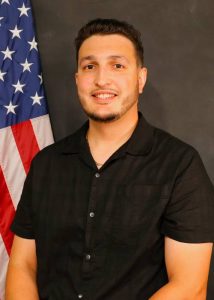
Michael Rogers, electrical engineering graduate student.
Michael Rogers completed his bachelor’s degree in electrical engineering in May and is now pursuing a master’s degree at Wright State.
His research involves designing, fabricating and testing an antenna for wireless power transfer in electrified flying vehicles and autonomous drones — technology that could enable aircraft to recharge midair.
Such in-flight recharging would provide a life raft if the flying vehicle’s battery died, he said.
Rogers will join the Air Force Life Cycle Management Center full-time after he graduates.
He said earning the SMART Scholarship was both an honor and a relief, easing the financial pressure of graduate school while providing a direct path to a career.
 Wright State’s Boonshoft School of Medicine ranked No. 1 in Ohio for producing primary care physicians in U.S. News rankings
  ArtsGala to showcase Wright State students’ artistic growth with elegant entertainment extravaganza
  Turning injury into impact
  From dance to data, Wright State students showcase research at annual celebration
  A lifetime of curiosity