
Academy Award-winner Hannah Beachler ’05 balanced parenthood, multiple jobs and her studies in Wright State’s motion pictures program. (Photo by Chris Britt)
There is no doubt that Hannah Beachler has made a name for herself in the film industry. Two Academy Award nominations and one win. Three Art Directors Guild Awards. And the list goes on.
Beachler’s story is rooted far away from the red carpets of Hollywood. It is the story of a young girl from Centerville, Ohio, who always had an eye for design. A student at Wright State University who juggled the responsibilities of being a single mother with the rigors of a demanding motion pictures program.
A story of grit, determination and perseverance. A story of a woman with a deep passion to make this world a more beautiful place.
From fashion design to filmmaking
A gift for design runs in the Beachler family. With a father who was an architect and a mother who was an interior designer, Beachler was exposed to the design world from an early age and, by 8, set her sights on becoming a fashion designer.
“That was all I ever wanted to do,” she said.
Beachler enrolled at the University of Cincinnati to study fashion design but soon realized the field wasn’t as fulfilling as she had expected.
“It started to feel more like work than a passion, and I sort of got lost,” she recalled.
She would eventually become inspired by the ’90s music scene in Cincinnati, helping a friend make a music video on an 8mm camera they purchased in a thrift store.
“I was doing art direction with no idea what I was doing,” said Beachler.
She recalled telling her mother that she would like to work in film, possibly as a director. After her mother mentioned that Wright State had a film program, Beachler headed back to Dayton and began her studies as a motion pictures student in 2000.
Like many nontraditional students, Beachler had to balance parenthood, multiple jobs and her studies. She worked as an outreach coordinator at the Boonshoft Museum of Discovery and helped with filing at a Dayton law firm. And she had a young son, Dominic, who was born in 1998.
One special moment at Wright State came in Bill Lafferty’s class when Beachler brought Dominic, who was home from daycare due to illness. As he rested on a blanket, Dominic raised his hand to ask Lafferty about his favorite Power Ranger.
“Dr. Lafferty said, ‘I like the pink Power Ranger, and I’ll tell you why.’ Then he flipped it into a color discussion about ‘Red Desert,’ which is the Michelangelo Antonioni film that we were studying,” said Beachler. “I just thought it was brilliant.”
While she rarely brought Dominic to class, she was grateful that she could.
“The film program made it so I could go to school. They made it so I could keep learning, and I could have my family,” she said. “For a young, single mother, it made life a lot easier.”
Beachler’s family and peers were also a constant source of support. She developed a close friendship with Carol Trevino, a fellow classmate and single mother of three young children.
“Carol was so creative and more mature than me and everybody else. She had a lot more life experience, so she brought a lot more to her stories,” Beachler said. “She just had this way about her that was very motherly, very nurturing. She was always there for me, no matter what.”
On Beachler’s birthday, Trevino surprised her with a cake in the Creative Arts Center basement, where the motion pictures students would gather.
“I didn’t even know that she knew it was my birthday,” said Beachler. “I certainly wasn’t celebrating because I was trying to get projects done. She got everybody else in the program to come, and they sang ‘Happy Birthday.’”
Following Trevino’s tragic death in a car accident while working on a film in Louisiana, Beachler created a scholarship at Wright State in memory of her dear friend
“That unconditional kindness is where the scholarship comes from, because that’s who Carol was,” said Beachler.

Hannah Beachler’s work on “Black Panther” earned her her first Academy Award nomination and made history as the first African American to win the Oscar for Best Production Design. (Photo by Chris Britt)
Setting the stage for success
While Beachler initially thought she would become a director, her professors noticed her gift for art direction. Inspired by their encouragement, she spent time in the theatre department learning about scenery and honing her skills at computer-aided design.
“It was more visual because it was almost 3D,” said Beachler. “You can turn things around and look at them in ways that you can’t do on a hand-drawn blueprint.”
One of Beachler’s film projects, “Passion Fruit,” featured Trevino and her children. After her professor told her it didn’t have to be linear, she mixed mediums and genres.
“That was my best project,” she said. “It gave me the freedom to not have to stay in a box.”
Film theory classes were her favorite, and those deep dives into cinema continue to pay off for Beachler to this day. Her command of film history and theory so impressed one producer that it helped open the door to a career-defining collaboration with Ryan Coogler.
“We would just watch thousands of films, which gave me a leg up when I started in the industry. I stood out in that way, because I could talk to people about films and theory and the ideas behind them,” she said. “That was nice, because you have to learn how to have a voice in the film industry.”
Wright State gave her the confidence and courage to pursue a career in the film industry, where there is far less representation for women, especially women of color. Julia Reichert, the late Wright State faculty member and Oscar-winning documentarian, is still one of Beachler’s role models.
“There are not many women doing these jobs,” said Beachler. “Seeing Julia be a strong, powerful woman — a big voice in the industry — and being successful for as long as she was, doing what she loved, is an inspiration.”
Beachler believes that Wright State is among the country’s top five film programs and ranks her professors’ passion for the art of film as second to none.
“They confirmed that it would never feel like work, like a job. It was purely from your soul and your spirit. That went into all of us. They were serious about it being a real career. It’s almost like they had a stake in us. They were invested in us,” said Beachler. “Wright State made it possible for me to do what I do.”

Hannah Beachler was honored as Wright State’s Alumna of the Year in 2018. (Photo by Erin Pence)
Working toward a defining collaboration
After graduating in 2005, Beachler packed her car and headed to New Orleans, where she started as a set dresser. She was at the bottom, but she focused on learning everything, and she kept working.
“It took a while to get my first set decorator job. I can remember jumping up and down and screaming,” she said.
A few years later, fellow Wright State alumna Karri O’Reilly ’94 offered her a production designer role. After a few jobs, the work dried up. One of her mentors helped her move past the setback.
“He really straightened me out,” Beachler recalled. “He said, ‘Number one, stop feeling sorry for yourself. Number two, you’re lucky to be working in the industry at all. And number three, go get an agent.’”
After about 50 agencies turned her down, Beachler shifted her focus to boutique firms and ultimately secured an agent.
The first script her new agent gave her was for “Fruitvale Station,” directed by Ryan Coogler.
That’s when everything changed.
Coogler was only 25 when filming started on “Fruitvale Station.” The budget was so small that Beachler’s lodging in Oakland during the five-week shoot wasn’t covered. She dog sat during that time, so she’d have a place to stay.
“Ryan and I got along famously,” she said. “I just knew in my heart that he was going to be an important director.”
A year later, Coogler contacted Beachler about working on “Creed.” And then came the project that would change the trajectory of both of their careers — “Black Panther.”
“I didn’t even know what it was,” said Beachler. “My son was freaking out. My agent was freaking out.”
Knowing that about 100 people were interviewing to lead production design on the blockbuster Marvel film, Beachler thought she had no chance of being selected. She was just grateful to be in the same room with some of the biggest names in the business.
But Beachler still poured her heart, soul and pocketbook into landing the job.
“I spent every dollar I had,” said Beachler. “I was literally like, ‘If I don’t get this job, I’m going to be homeless.’ And that was real. I had put everything into it.”
The day after her presentation, Beachler was driving to the airport when Coogler called.
“He said, ‘You got the job.’ And I just started crying,” Beachler recalled. “I’m glad he told me to pull over, because I would have wrecked. We just screamed and cried over the phone.”
She then called her agent, who was also in a state of shock. Her agent said, “You just scorched the earth in Hollywood, because they had to call everybody back and tell them that you got the job.”
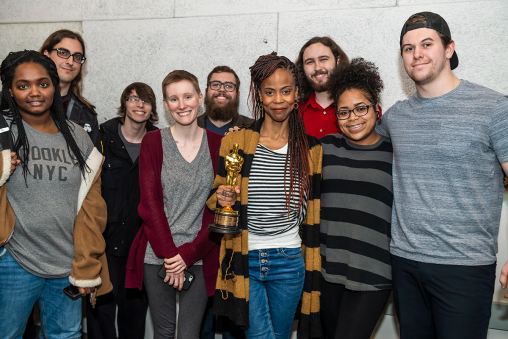
Hannah Beachler visited Wright State after winning the Academy Award for Best Production Design for “Black Panther.” (Photo by Erin Pence)
A historic win
Even after landing “Black Panther,” Beachler still credited Wright State for her success.
“I think a lot of people in LA and Hollywood were shocked, because it usually takes years to get to that. And I kind of jumped in a really big way,” said Beachler. “And it was all because of what I learned in my training and my knowledge of film from Wright State. There were kids from NYU, USC and UCLA that weren’t doing that and didn’t have that same knowledge.”
Beachler’s work on “Black Panther” led to her first Academy Award nomination and her historic milestone as the first African American to win an Oscar for Best Production Design.
“Standing up there, I was shaking like a leaf. I was fighting back tears, and I was overwhelmed,” she recalled. “But the one thing that didn’t leave me was the thought of Carol and the fact that this is way bigger than me.”
Beachler knew that the eyes of young girls and women of color with similar dreams were on her at that moment.
“It wasn’t just me getting a gold statue, but the ripple effect that it could cause and that I wanted it to cause,” she said.
While Beachler is a trailblazer, she is far too modest to describe herself as one. She prefers to remain true to her Midwestern roots and stay grounded in an industry known for being cutthroat and soul crushing.
“You have to keep your feet on the ground and your head out of the clouds to make it through Hollywood,” she said. “The industry can eat you up. It can gobble you up and spit you out. Being from some place like Ohio, you will last longer because you have come from a place of being grounded.”
When she is not working, Beachler prefers to retreat to her Yellow Springs farm, not far from the Wright State campus where she first honed her craft. Away from the world of Hollywood, she is committed to putting her passion for design into projects that will help improve the human condition.
“Design goes much deeper than just the facade of any one set,” she said. “For me, it’s: How can I turn some of these crazy ideas I have into working reality to make people’s lives better? Can I make it easier for young girls in Africa to not have to spend their day walking for water? Can I figure out how to filter water from contaminated waterways and bring it to them? Now they only have to get an education. Maybe one of those girls will be the next big innovator. And if they’re not going to school, we’ll never know.”
In her immediate future, Beachler is busy collaborating with Coogler on a reboot of the television series “The X-Files.” She has made sure to pay homage to the original series in her design.
“I love Easter eggs. I love to put things in there for people to look for,” she said. “I can’t wait for it to come out. It’ll be even more beautiful than you’re expecting. It’s such a cool story that Ryan wrote, and I’m so excited.”
As she reflects on her life and career, Beachler acknowledges that her success has exceeded any dream that she ever had. She encourages current students to stay the course in any path they decide to pursue.
“To the young people going to Wright State with a big dream — whatever that dream is — know that if I can make my dream come true, so can you,” said Beachler. “You just have to look to the community around you to get there and then hold steady and keep moving forward. And just remember that a ‘no’ is never a ‘no,’ it’s just a change in direction.”
This article originally appeared in the 2026 issue of the Wright State Magazine. Read more stories at wright.edu/magazine.
 Finding the Wright Path
  Wright State University announces sold out game for Stars, Stripes and Flight Classic featuring Air Force Falcons
  Wright State’s Family Weekend brings Raider families together
  International scholars
  A fresh start leads to finding his people