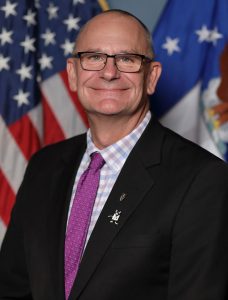
Timothy J. Bunning, retired chief technology officer at the Air Force Research Laboratory, was named interim dean of Wright State’s College of Engineering and Computer Science.
Timothy J. Bunning, Ph.D., a retired Air Force Research Laboratory leader, has been named interim dean of the Wright State University College of Engineering and Computer Science, effective June 1.
“Dr. Bunning brings truly exceptional credentials to this role,” said Provost Jim Denniston, Ph.D. “Equally important, he is a people-centric leader with a deep commitment to developing the next generation of scientists and engineers.”
Bunning retired last year after a distinguished 35-year career at the Air Force Research Laboratory at Wright-Patterson Air Force Base. Most recently, he served as chief technology officer, the primary science and engineering adviser to the AFRL commander, overseeing an annual $3.5 billion science and technology program and a workforce of nearly 6,000 people across nine technology directorates and the 711th Human Performance Wing. He previously served as chief scientist of the Materials and Manufacturing Directorate.
Bunning said he is truly humbled to have the opportunity to serve as interim dean.
“I will bring the same type of empowering, bottom-up leadership style that I have employed throughout my career to the College of Engineering and Computer Science and Wright State,” Bunning said. “As an outsider looking in over the last few years, strategically, I believe the college and Wright State are on a very positive path. My goal is to continue this positive momentum by providing strategic growth recommendations, ultimately to produce graduating students who are well prepared for an ever-increasing technologically rooted world. These students are a key feeder to an incredibly diverse, local technology ecosystem that supports the Dayton area.”
Bunning has played a key role in advancing Wright State’s strategic partnership with the Air Force Research Laboratory and Wright-Patterson Air Force Base, bringing government researchers onto campus to work with faculty and students on emerging technologies.
More than 60 AFRL researchers work in Wright State’s Vishal Soin Center for Innovation, and an expanded 2024 agreement gives Air Force personnel access to laboratories, classrooms and offices throughout the rest of campus.
The collaboration provides students with hands-on opportunities through internships, cooperative education and applied research, while strengthening the talent pipeline for the Air Force and the region’s advanced technology workforce.
“As interim dean, Bunning will be positioned to further align the College of Engineering and Computer Science’s research and academic programs with this strategic partnership, expanding opportunities for students and faculty to engage in critical engineering and computer science work,” Denniston said.
Bunning is one of the most prolific materials scientists in the country, with a focus on soft matter materials and their application in the photonic field. He has written more than 325 peer-reviewed publications (h-index of 93) and given hundreds of technical lectures. He holds 18 patents and was recently elected to the National Academy of Engineering.
Bunning is a fellow of seven major scientific societies, including the American Chemical Society, the American Physical Society, the Materials Research Society, the Optical Society of America and SPIE, the international society for optics and photonics. He has received many government awards, including the Arthur S. Flemming Award, one of the highest honors for federal scientists and engineers.
He credits his success to the people around him. Reflecting on his career, Bunning said his greatest accomplishment was the people who took a chance to work for him and are now strengthening the Air Force Research Laboratory ecosystem.
He earned a Ph.D., master’s degree and bachelor’s degree in chemical engineering from the University of Connecticut and conducted his Ph.D. research at Wright-Patterson Air Force Base in the AFRL labs.
 Finding the Wright Path
  Wright State University announces sold out game for Stars, Stripes and Flight Classic featuring Air Force Falcons
  Wright State’s Family Weekend brings Raider families together
  International scholars
  A fresh start leads to finding his people