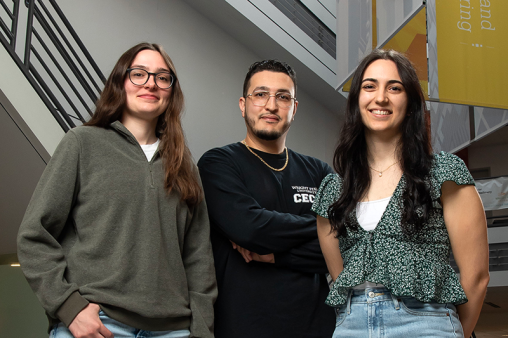
From left: Ava Megyeri, Michael Rogers ’25 and Rachael Ballentine ’25 are three of six Wright State students who received Department of Defense SMART Scholarships, which cover tuition, provide paid internships and guarantee employment after graduation. (Photos by Erin Pence)
No two paths to a SMART scholarship are the same.
Some find their way through mentors and leadership. Others lean into a talent for research. And, occasionally, there’s a long detour before the persistence pays off.
In 2026, six Raiders were selected by the highly competitive Department of Defense Science, Mathematics and Research for Transformation Scholarship-for-Service Program. That’s a remarkable number considering the department receives close to 9,000 applicants, and awards funds to only about 8%.
“Most of our six were already Wright State students,” said Darryl Ahner, Ph.D., former dean of the College of Engineering and Computer Science. “And the SMART scholarship isn’t the beginning of their story. It’s enabling them to go even further.”
Built for mission
The connection between Wright State and the defense community runs deep.
The university was founded through a partnership between the Dayton community and Wright-Patterson Air Force Base. The result is a campus located minutes from one of the largest and most influential military research centers in the world.
“We’re joined at the hip geographically with the Air Force base,” Ahner said.
Engineers from the base collaborate with Wright State faculty members, and students intern on base, at defense laboratories and with contractors. Many continue on to careers supporting national security.
For the students who receive a SMART scholarship, the benefits can be transformative. The scholarship provides full tuition, a $30,000–$46,000 stipend, summer research internships, healthcare and conference allowances, and a guaranteed job after graduation.
Those benefits can reshape a student’s education.
“It provides certainty,” Ahner said. “It empowers students to focus on maximizing their experience here at Wright State.”
For many students, the SMART scholarship represents access — something Ahner understands firsthand as the son of a steelworker whose father left school after ninth grade.
A first-generation college student, Ahner saw how education shaped his success, leading the Air Force Institute of Technology and then Wright State before joining Kennesaw State University near Atlanta to head a rapidly growing program.
“Wright State’s professors teach the classes. That’s not a given every place, but it is here,” said Ahner. “Wright State is big enough to have a lot of capability, but small enough that we care.”
Leadership will change, but the lessons — and the mission — remain.
Our Raiders’ paths to earning SMART scholarships reflect that.
Mentorship opens the door
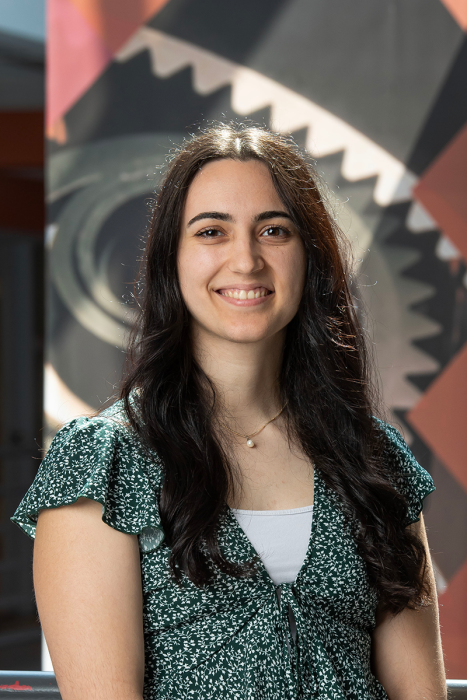
Rachael Ballentine credits faculty mentorship with leading her to meaningful work and becoming a SMART scholar.
Rachael Ballentine ’25 grew up immersed in engineering. Her parents are both engineers, and she was homeschooled. Yet, she wasn’t sure if engineering was the right fit.
One problem was that she didn’t see herself as a math person.
“I was never very good at doing calculations in my head,” she said. “I just didn’t like it and had a mental block until I got into calculus and higher math.”
But she did like the flexibility built into the engineering program, and that was where she found her affinity for her master’s program.
“That puzzle or logic aspect is why I like computer science. There’s still the problem solving,” she said.
The flexibility, discussions with her mom and keeping an open mind helped her see the discipline differently. But it was faculty mentorship that helped her go further.
Her advisor, Michael Raymer, Ph.D., professor of computer science and engineering, has extensive expertise in neural networks and machine learning. He helped guide her toward work that was challenging and meaningful.
Along the way, mentors helped her find opportunities. As an undergraduate, Ballentine received an Ohio Space Grant Consortium Scholarship. And Mitch Wolff, Ph.D., professor of mechanical engineering, was the first to introduce her to SMART.
“I wouldn’t have known about it if he hadn’t told me,” Ballentine said.
Now her master’s thesis is focused on building a machine-learning model to map and predict the spread of wildfires — research that could support environmental monitoring and emergency response.
“The fact that I got to continue something that I had already started with my same advisor was a big part of the advantage of staying at Wright State for my master’s versus going somewhere else,” said Ballentine.
She’ll work at the Air Force Life Cycle Management Center after graduation.
Driven by research
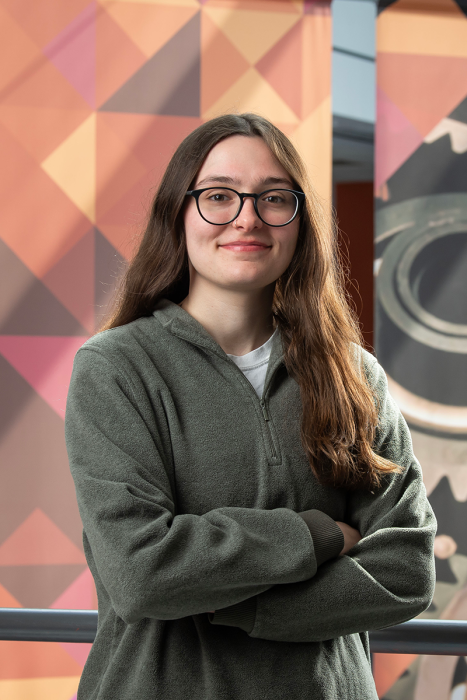
The SMART Scholarship is giving Ava Megyeri the opportunity to gain real-world experience at the Naval Underwater Warfare Center in Rhode Island.
Ava Megyeri’s journey began at Clarkson University, in upstate New York. When her undergraduate advisors, Natasha Banerjee, Ph.D., and Sean Banerjee, Ph.D., joined Wright State, Megyeri came to Wright State to continue her work with them and earn her doctorate.
Megyeri’s research focuses on artificial intelligence and robotics. She’s exploring how robots can interact with humans more naturally by learning from human behavior rather than relying solely on rigid programming.
“If a robot trains on how humans do something, it behaves more naturally,” she said. “That could make a person less uncomfortable around the robot.”
Her interest in robotics, and in focusing on the human elements of the outcomes, are partially inspired by personal experience.
“My grandma died of ALS,” Megyeri said. “Seeing what people go through with those diseases made me interested in how technology can help.”
The systems she studies could assist patients recovering from neurological conditions or mobility injuries. And her research has attracted attention.
Megyeri was also offered the National Science Foundation Graduate Research Fellowship but ultimately chose the SMART scholarship.
The reason was practical.
SMART scholars complete internships every summer with their sponsoring defense organization and commit to working there after graduation.
“For me, that meant I’d be gaining real experience the whole time,” she said. “And my end goal is a job.”
She’ll work at the Naval Underwater Warfare Center in Newport, Rhode Island, after she completes her doctorate.
“A dream of mine would be to help the medical field take the next step forward with AI and robotics,” Megyeri said.
Persistence pays off
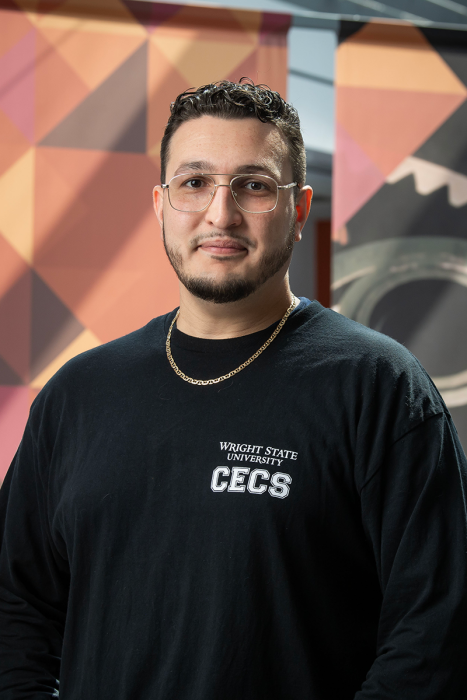
A SMART scholarship is allowing Michael Rogers to complete his master’s degree in electrical engineering while caring for his family.
Michael Rogers ’25 earned his GED at 15 and studied automotive technology at Sinclair Community College until a motorcycle accident forced him to exit. By the time he recovered, he had a young family and needed to work.
Nearly 10 years later, he was successful, but he wasn’t fulfilled. Life threw him another curve in the form of his grandmother’s diagnosis with Alzheimer’s.
“We had to figure something out quick,” said Rogers. “Part of our solution was that I agreed to take on full caretaker responsibilities and, while I was doing that, I’d restart.”
He wasn’t sure how much he’d be able to do. Quite a lot, it turns out.
After he graduated from Sinclair, he followed his passions to Wright State and is now pursuing a master’s degree in electrical engineering supported by a SMART scholarship. He was also able to care for his grandmother for five years.
“When my grandmother’s situation changed, I needed to get back to work,” Rogers said, and he interned at the Air Force Research Laboratory for a year.
“I started asking people about graduate school,” he said. “I was just trying to see if there was any opportunity to go to graduate school, because I wasn’t going unless I could get it paid for.”
Now he’s working with his advisor, Yan Zhuang, Ph.D., professor and interim chair of electrical engineering, to prove that vehicles can be charged while in flight. Rogers calls it “validating continuous wireless power transfer to electric aerial platforms,” and it could change the way we all fly someday.
For Rogers, the SMART scholarship represents something more than academic recognition. It’s the power of believing in yourself. It’s proof of putting in the work. And it is a part of the path forward.
Rogers will work with the Air Force Life Cycle Management Center upon graduation.
“I want to be part of a team that creates and builds tech to contribute to society in a way that I can feel good about,” he said.
Our path leads further
Why are so many SMART scholars from Wright State? Part of the answer is location.
Proximity to Wright-Patterson Air Force Base means students frequently intern with defense laboratories and contractors, introducing them to programs that employ SMART scholars.
But culture matters too. SMART doesn’t fund programs; it funds people. And these students, who could probably pick almost any university to advance their education, are choosing to come to, or stay at, Wright State.
Each student described a campus environment where professors care, invite collaborative research, tell them about scholarships and encourage the pursuit of opportunities.
They’re motivated to ask questions, willing to explore options and dedicated to making a difference by solving problems that matter.
This article originally appeared in the 2026 issue of the Wright State Magazine. Read more stories at wright.edu/magazine.
 Lake Campus students saddle up for success at eighth annual Laker Lawn Party
  Ohio Medical Education Day brings aspiring physicians from across the state to Wright State University
  Connecting students with career opportunities
  Preparing students for the workforce from day one
  10th annual Wright Day to Give scheduled for Sept. 30 and Oct. 1