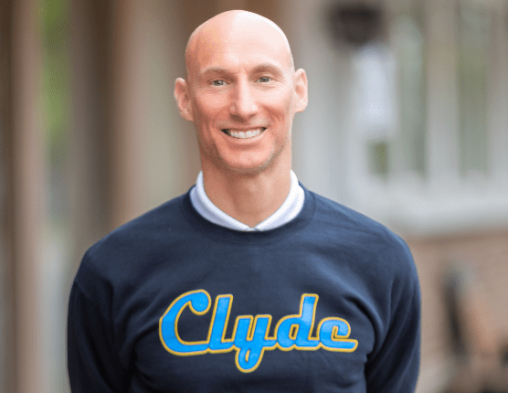
A heartfelt email from alumnus Joe Letterhos ’97 sparked a reflection on how Wright State’s supportive environment helped transform a struggling student into a successful educator and school district leader.
After following the Wright State University men’s basketball team throughout their successful 2025–26 season and watching the Raiders almost pull off an upset in the first round of the NCAA tournament, 1997 grad Joe Letterhos felt compelled to reach out to his alma mater.
He sat down and drafted an email to Wright State University President Sue Edwards and Marty Sexton, dean of the College of Health, Education and Human Services.
“The foundation of both my career and my life was laid on your campus. The tools, mindset and experiences Wright State instilled in me continue to shape decisions, influence others and create ripple effects every single day,” Letterhos wrote. “Because of that, I would simply encourage you to never underestimate the difference you are making — whether it is for one student or thousands. The work happening at Wright State is meaningful, lasting and far-reaching.”
Letterhos never expected his email to be read, let alone to elicit a response.
“I honestly thought it would just go to spam and nobody would see it,” he said. “But I felt like I needed to reach out to somebody at the university to let them know how much I appreciated what they did for me.”
A fresh start
Growing up in the small community of Tiffin, Ohio, Letterhos did not envision going to Wright State or embarking on a decades-long career in K–12 education.
“Education is the last thing I wanted to do,” said Letterhos, who describes himself as a “poor student” throughout his formative years.
“When students are struggling, they just tune things out and they become behavior problems. I struggled with that really through the first 12 years,” he recalled. “I wasn’t a terrible student, but I could have done much better.”
For Letterhos, heading to Wright State represented a fresh start.
“Nobody else from my high school was going there,” he said. “I needed distance. And I wanted to go there and just be me, learn who I am.”
Even before enrolling at Wright State, he felt welcomed by the students, faculty and staff that he met during his campus visit.
“A lot of the information that they gave me was about the things that they have in place to help you grow as an individual. And that is exactly what I needed,” he said. “I knew I was a good person, and I knew academically I could be successful. I just needed to find a climate and a culture that was going to allow that to happen.”
He found exactly that at Wright State.
Letterhos vividly remembers walking into History 101 on his first day of classes with 400 other students.
“I didn’t have 400 kids in my high school, and there were 400 kids in this lecture hall,” he recalled. “But it was exciting and I embraced it and I ran with it. And it ended up being one of the best decisions I’ve ever made.”
An unexpected path
After his first quarter, Letterhos thought he might pursue a career in business or physical therapy. When he returned home for winter break, he visited his high school and talked with some of his former teachers. Two of his teachers asked him if he had ever thought about being a teacher or a coach. He had not.
When he returned to campus, he met with his Wright State advisor and had an aha moment. The advisor asked him, “Who’s been an influence in your life?”
Letterhos realized that the most profound influences in his life, after his parents, were his teachers and coaches. But he hadn’t found role models in his teachers and coaches — until his junior and senior years of high school.
He decided to major in elementary education so he could help kids at a younger age.
“I wanted to be there in the early stages — the foundational years for a child,” he said. “We need to reach them at a young age. They need to know that they’re loved, that they’re going to be safe, that we’re going to be here for them.”
Letterhos enjoyed the hands-on approach that Wright State faculty took to training future educators.
“They were very involved and they wanted you to succeed. They wanted to sit down and talk to you,” he said.
His favorite professor was Larry Chance, and Letterhos even ended up doing his student teaching with Chance’s wife, who taught first grade at Milton Union.
“It was just an awesome experience for me,” he recalled. “She was a fantastic teacher, and he was a great resource, as were all of my professors.”
From classroom to leadership
When he graduated from Wright State, Letterhos felt well prepared for his new career. He began by teaching first- and second-grade reading at an elementary school, where he was the first male teacher. He later moved on to teaching fourth and fifth grade while coaching high school football and wrestling. He was then offered a position as an assistant athletic director while also teaching sixth-grade social studies.
At one point, he moved back to the Dayton area to become assistant high school principal and head football coach at Stebbins High School. He spent three years at Stebbins before returning home to be closer to family.
After serving as assistant high school principal at Clyde High School for three years, he was promoted to assistant superintendent of Clyde-Green Springs Schools near Sandusky.
“I’ve been in this district for 15 years now,” said Letterhos. “I’m getting close to retirement, which I never thought would come, but I’m not ready yet. I still have a lot of work to do. I still have a lot of energy left in me.”
As he was advancing from the classroom into school administration, Letterhos had yet to fulfill his dream of being an elementary school principal — until last year, when he served as interim principal.
“It was just tremendous. I got the chance to go into a classroom every single day and see kids learning. I had kids hugging my leg,” he recalled. “I used to joke, ‘it’s a B12 shot.’ I needed that. I needed a B12 shot at that stage in my career.”
Letterhos credits Wright State with equipping him with the knowledge and wherewithal to tackle varying roles throughout the years.
“That’s how well they prepared me to handle those diverse situations,” he said. “They instilled that confidence in me.”
Just as Wright State made a difference in his life, Letterhos is able to witness the impact his school district has as students progress from kindergarten to their high school graduation.
“I can see these programs working and the things that we’re doing for students. And I hear their success stories, especially during May with all of their presentations and the award ceremonies,” he said. “To me, that’s the most rewarding part. Regardless of what pathway they go — career, college, military — I just need to know that when they leave here, they’re problem solvers. They can collaborate. And they’re good citizens and good people.”
A message of gratitude
As he reflects on current Wright State students who are training to be the teachers of tomorrow, he encourages them to keep one priority at the forefront.
“It’s all about relationships — relationships with your students, relationships with your colleagues, relationships with the parents, relationships with the community,” he said. “I think the most important relationship is colleague to colleague, because students see how we treat each other. And that is what they start to emulate. That is what they start to mirror. And that is how they start to behave.”
He added, “It is so important for us as adults to act like adults. We don’t all have to agree with everything, but we have to respect each other, and we have to do it in a professional way.”
Even his time at Wright State all boils down to the relationships with friends and faculty who continue to make a profound impact to this day. As he wrote his email, that was something he wanted current Wright State leaders to know.
“Those years from 18 to 22 are so important in developing who you are as an individual, and I just wanted to express that. I needed somebody to hear, ‘continue to do what you’re doing, because it matters,’” he said. “There was a kid from Tiffin, Ohio, that showed up in 1993 that had very little confidence, had many challenges to overcome, and somehow that kid made the Dean’s List. Somehow that kid is now assistant superintendent at a school district. Every day matters. It can make or break a person. And I never felt like I was on my own at Wright State. Never. And I needed the university and people to understand that.”
 Wright State brings community partners together for Campus Safety Day
  Wright State Dean Timothy Bunning inducted into National Academy of Engineering
  Finding the Wright Path
  Wright State University announces sold out game for Stars, Stripes and Flight Classic featuring Air Force Falcons
  Wright State’s Family Weekend brings Raider families together