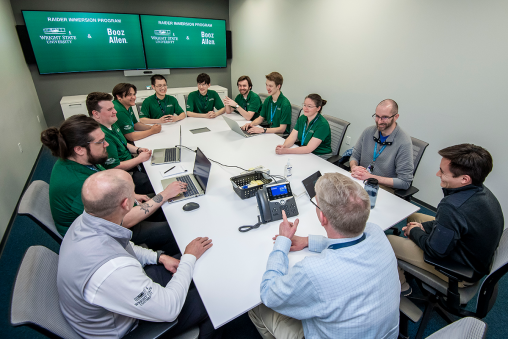
Through the Raider Immersion Program, students work on sponsor-guided projects in structured teams that mirror modern workplace expectations. (Photos by Erin Pence)
Wright State University’s Raider Immersion Program, a new paid workforce development initiative, is designed to prepare students for careers in the defense, technology and business sectors through real-world experience solving current problems for external partners while building the skills needed for long-term career success.
“At Wright State, we want our students to be hired after graduating, which means they need to be ready to meet the demands of today’s workforce,” said Jason Anderson, Ph.D., executive director of the Center for Civics, Culture and Workforce Development and vice president for military relationships and veteran success. “The Raider Immersion Program offers an alternative to internships — integrating industry-sponsored problems into a structured learning model while delivering measurable outcomes for partners and accelerating student readiness for employment.”
Through the Raider Immersion Program, students work on sponsor-guided projects in structured teams, progressing from team member roles to team leader responsibilities as they gain confidence, technical proficiency and professional maturity. The program is intentionally designed to mirror modern workplace expectations, including sprint-based project cycles, regular feedback, measurable deliverables and evaluations tied to performance, teamwork and project outcomes.
Additionally, students build both technical and interpersonal skills. On the technical side, they gain experience with programming, data analysis, modeling and simulation, user-interface development, secure computing practices and specialized tools connected to real-world problem sets.
As projects mature, students may move beyond simply using existing tools to help design or develop new tools based on the problems they are solving. In some cases, the work also introduces students to the expectations associated with controlled unclassified information and potentially classified environments, helping them understand the security, discipline and professionalism required for defense-related work.
The program was launched with support from Booz Allen Hamilton as its inaugural sponsor, helping establish the model for the paid, sponsor-driven student workforce development.
“Partnering with Wright State on the Raider Immersion Program demonstrated how this initiative accelerates student readiness while delivering innovative solutions to real-world challenges,” said Michael Bennett, director of modeling and simulation at Booz Allen Hamilton’s Beavercreek location. “This program not only strengthens our talent pipeline but also fosters meaningful collaboration between academia and industry.
Building on the foundation, ASRC Federal Company is joining as an additional early program sponsor, expanding the program’s reach and creating more opportunities for students.
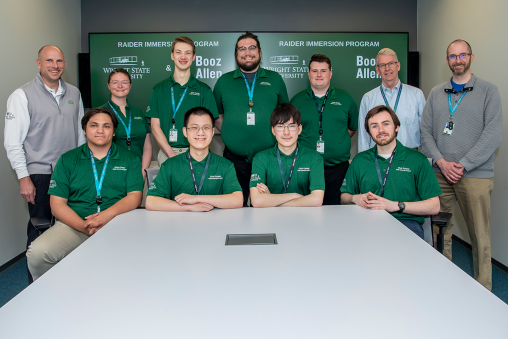
Wright State’s current pilot with Booz Allen Hamilton includes six team members, one team lead and one faculty member.
Wright State’s current pilot with Booz Allen includes six student team members, supported by one team lead and one faculty member serving as technical strategist.
Colburn Riffel, a member of the current pilot and graduate student studying computer science, experienced first-hand how participation in the program can lead to future job opportunities — he accepted a position as an aerospace engineer at Booz Allen Hamilton.
Riffel learned about the program through Discord. “I saw a message about the opportunity to participate in the Raider Immersion Program and thought that it sounded like an interesting project. I wanted to broaden my horizons and work on something new, and this presented the perfect opportunity to get in the door at a respected employer,” he said.
The meaningful and applied experience that students gain during the program serves as a powerful resume builder. Successful participation may lead to direct job opportunities with the sponsoring organization or similar employers, as students have already demonstrated their capabilities in a professional, results-driven environment.
Riffel encourages future students to join the program while at Wright State. “Give it a shot. It provides a great opportunity to gain hands-on experience while also allowing you to focus on your classes throughout the semester,” he said.
Not only do students benefit from this experience, but it is equally beneficial for the sponsors. While making meaningful progress against real-world challenges, sponsors gain access to emerging talent — reducing the burden typically associated with onboarding and early-stage training — while helping shape the future workforce in their industries.
The new program is already looking towards the future and hopes to include 25 sponsored projects and 250 student employees engaged in year-round applied work within the first five years.
“The Raider Immersion Program positions Wright State as a dependable hub for workforce preparedness, applied innovation and long-term industry partnership,” Anderson said.
“The Center for Civics, Culture and Workforce Development has provided an exceptional opportunity for both myself and other students,” said Jake Hamblin, team lead of the Raider Immersion Program who is studying computer science. “As a recent graduate with a bachelor’s degree, the program has allowed me to continue my education by pursuing a master’s degree while gaining valuable hands-on experience working alongside industry partners. I have been able to apply what I learned in the classroom to real-world projects, develop professional skills and build connections with organizations that are actively shaping the workforce.”
“The Raider Immersion program has been the highlight of my time at Wright State University. Taking me outside the vacuum of a classroom and putting me in a position to put my education to work for the university, the sponsors and myself,” said Evan Timmons, a computer science major. “I think I can speak for all involved — it has been a challenging, rewarding and growth-enabling experience throughout. I am proud to be a part of the Raider Immersion Program team, and am excited to see where it will continue to take me.”
 Dream, innovate and soar
  Make the argument that changes you
  Wright State brings campus community together to celebrate mental health and well-being
  Wright State trustees approve new academic programs, highlight student success and new research partnerships
  Wright State’s Future Teachers Day inspires next generation of educators