 A $2.5 million grant — the first of its kind awarded in Ohio — will allow two major organizations to expand a critical healthcare program in Dayton.
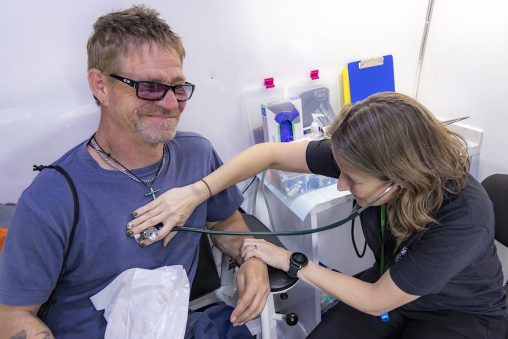
Wright State University’s Boonshoft School of Medicine and Premier Health received a $2.5 million federal grant to expand Dayton Street Medicine, a program delivering primary care directly to unhoused individuals.
Launched in 2025, the program entails a collaboration between the Boonshoft School of Medicine, Premier Health, Premier Community Health and the Dayton Dream Center. It also launched with support from the OneOhio Recovery Foundation.
It currently operates a half-day each week from the Premier Health Mobile Clinic at the Dream Center, located at 2720 E. Third St. on the east side of downtown Dayton.
Through the program, faculty provide health screenings and primary care services to individuals facing overlapping challenges such as chronic illness, behavioral health conditions, substance use and unstable housing. The program also connects patients with resources and social support services.
In its first year of operation, Dayton Street Medicine delivered 448 clinical visits and 313 health screenings, serving about 300 unique individuals.
Under the five-year Health Resources and Services Administration Family Medicine Education Training grant, the program can expand and provide care for more patients, as well as train additional medical students and residents.
“Our program stood out because of our long-standing commitment to community-based care, our robust resident training infrastructure and our established cross-sector partnerships,” said Anna Squibb, program director of family medicine and addiction medicine at Premier Health and medical director of Dayton Street Medicine.
Over the summer, Dayton Street Medicine will expand by two additional service days.
One will focus on extending care to rural residents through a new partnership with the Bethany Center in Piqua and Miami County Public Health.
The second will support street rounds, allowing care teams to reach individuals who may not access either location by conducting outreach in high-needs areas across Dayton.
Each outreach team will include a family medicine physician, a peer recovery supporter and a program coordinator who is also a certified medical assistant, along with medical students and family medicine residents.
Wright State officials told the DBJ at this stage, the emphasis remains on strengthening existing capacity to support continued program delivery, as opposed to hiring new employees.
“Bringing street medicine to a rural setting is both a natural next step and a meaningful opportunity. It allows us to better serve communities with limited access to care while giving our learners firsthand experience navigating the complexities – and rewards – of practicing medicine in underserved areas,” said Marietta Orlowski, a professor of population and public health sciences at Wright State and the director of Dayton Street Medicine’s Rural Initiatives.
The program’s expansion will allow medical students, residents and addiction medicine fellows to learn not only clinical skills, but also how to understand and navigate patients’ lives outside the exam room.
Read the full article at bizjournals.com/dayton.
 Lake Campus students saddle up for success at eighth annual Laker Lawn Party
  Ohio Medical Education Day brings aspiring physicians from across the state to Wright State University
  Connecting students with career opportunities
  Preparing students for the workforce from day one
  10th annual Wright Day to Give scheduled for Sept. 30 and Oct. 1