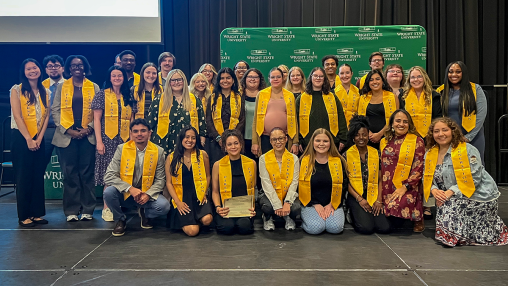
Wright State has been named to the FirstGen Forward Network, providing access to support the success of first-generation students. (Photo courtesy of the Academic Engagement Team)
FirstGen Forward named Wright State University to its Class of 2026, joining a select national network of institutions committed to enhancing the first-generation student experience through evidence-based practices and data-driven strategies, leading to increased retention and graduation rates.
During Wright State’s 2025-26 academic year, 28.9% of undergraduates and 45.8% of first-year students at the Dayton campus self-identified as first-generation students.
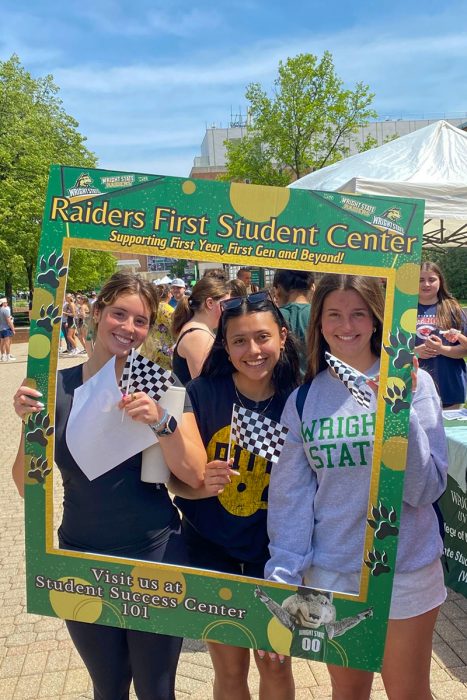
The Academic Engagement Team provides support and campus resources, hosts events and offers a peer mentoring program. (Photo courtesy of the Academic Engagement Team)
The university’s Academic Engagement Team supports first-generation students by providing support and campus resources in the Raiders First Student Center, the Peer Navigator mentoring program, hosting celebrations aligned with National First-Generation College Celebration Day and recognizing students’ accomplishments at a special graduation ceremony.
First-generation students made up 64.29% of the Fall 2025 first-year cohort in the university’s Take Flight program — a needs-based program for Ohio students which offers up to 18-credit hours of tuition, a laptop, textbook vouchers and a dedicated success team.
“Wright State is proud to join the FirstGen Forward Network and strengthen our commitment to supporting first-generation students,” said Catherine Hernandez Hogan, assistant vice provost for academic engagement. “This opportunity connects us with institutions across the country that are developing innovative strategies to help students succeed academically, personally and professionally.”
“The Academic Engagement Team was crucial in my first-year success in college,” said Leslie Perez-Soria, a sophomore nursing major and first-generation student. “Being a first-generation student typically means figuring out how college works on your own — how to apply for financial aid, how to study for tough classes, how to best manage your time — but having the support of the Academic Engagement Team at Wright State, including the peer navigators and Catherine (Hernandez Hogan), made me feel welcomed and seen on campus. I always had the information I needed to help me succeed.”
To join the network, institutions must be an accredited two- or four-year institution, secure leadership support and establish a campus leadership team. Prior to this application cycle, only three other schools in the southwestern Ohio region had joined the network.
After receiving support from President Sue Edwards and other university leaders, Wright State established a steering committee to guide the application process. The committee included Laura Luehrmann, Ph.D., vice provost for undergraduate education; Tom Webb, associate vice president for accessibility; and Destinee Biesemeyer, director of student advocacy and wellness; and Hernandez Hogan.
“We are excited to welcome Wright State University to the FirstGen Forward Network,” said Martina A. Martin, vice president at FirstGen Forward. “Throughout the application process, Wright State demonstrated a clear commitment to advancing success for first-generation students — backed by a willingness to align strategy, data and campus-wide efforts for long-term impact. Their leadership reflects a meaningful investment in creating the conditions where first-generation students can thrive.”
As a Network Member, Wright State’s steering committee can engage with more than 500 peer institutions in 48 states working to create environments that improve the experiences and success of first-generation students. They will also participate in monthly calls, professional development, goal setting, blog development, annual reporting and more.
The FirstGen Forward Network provides a three-phase approach to scaling holistic first-generation student success by engaging and empowering higher education institutions to transform the first-generation student experience, advance academic and co-curricular outcomes, and build more inclusive institutional structures.
After successful completion of the Network Member phase, institutions may progress to FirstGen Forward Network Leader, in which institutions receive an evidence-based and research-supported framework of actionable priorities supported by monthly workshops, diagnostic tools providing critical institutional insight, robust data-sharing as part of the national Postsecondary Data Partnership, guidance of expert coaches along each step of the experience and more.
The network’s impact is reflected in student outcomes. For the inaugural 2021-22 National Leader Cohort, FirstGen Network reported a 58.4% four-year graduation rate — 34.4 points above the national average.
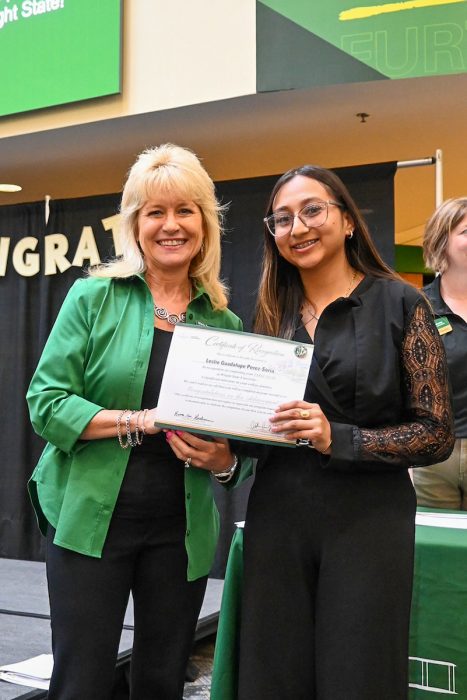
Nearly 50% of the Dayton campus’s first-year students during the Fall 2025 Semester self-identified as first-generation. (Photo provided by Leslie Perez-Soria)
“Earning my degree means everything to my family and I,” said Perez-Soria. “It represents growth, stability and a future that wasn’t guaranteed. It’s proof that all the work that goes into graduating leads to something bigger — for me, a career where I can help people, make an impact and honor the sacrifices that my parents made to get me here.”
“By participating in this network, we will strengthen our ability to identify, implement and assess high-impact practices that improve retention, persistence and college completion of first-gen students,” said Hernandez Hogan. “Our goal is to ensure that these students not only have access to higher education, but that they thrive and complete their degrees with the skills, support and sense of belonging needed for long-term success.”
“There is nothing quite like seeing a new generation of institutions step into this network with purpose and passion,” said Stephanie J. Bannister, Ph.D., president of FirstGen Forward. “FirstGen Forward exists because we believe institutions are strongest when they learn alongside one another — sharing evidence-based practices, working through challenges together and advancing first-generation student success at scale. Wright State University is joining a community of practitioners doing exactly that, and the Class of 2026 represents a remarkable groundswell of energy and commitment. I know Wright State will be a meaningful contributor to what we build together.”
 Dream, innovate and soar
  Make the argument that changes you
  Wright State brings campus community together to celebrate mental health and well-being
  Wright State trustees approve new academic programs, highlight student success and new research partnerships
  Wright State’s Future Teachers Day inspires next generation of educators