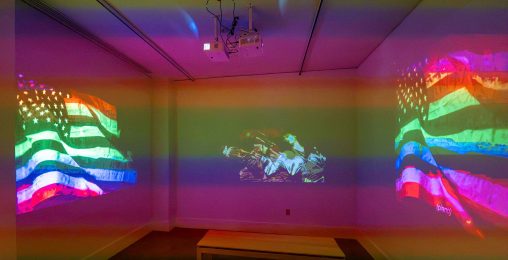
Wright State students and alumni bring William H. Johnson’s “Fighters for Freedom” paintings to life through an immersive short film at the Dayton Art Institute. (Photo courtesy of the Dayton Art Institute)
Visitors to the Dayton Art Institute’s current Smithsonian exhibition can do more than view history — they can experience it through film created by students and alumni from Wright State University’s Tom Hanks Center for Motion Pictures.
The immersive short film accompanies “Fighters for Freedom: William H. Johnson Picturing Justice,” a nationally touring exhibition organized by the Smithsonian American Art Museum.
The exhibition, on view at the Dayton Art Institute through Sept. 13, reunites all 34 paintings from Johnson’s “Fighters for Freedom” series, which honors African American activists, scientists, teachers and performers along with international leaders who advanced peace and justice.
Inspired by Johnson’s celebrated paintings, the film explores the lives of Marian Anderson, Josephine Baker and Paul Robeson, connecting their stories to the exhibition’s themes of justice, identity and artistic expression.
The creative team included current motion pictures student Ciarah Jenkins, 2026 graduate Lauren Schack and alumnus Cameron Henderson, who directed the project. Nichol Simmons, a Wright State alum and director of the Tom Hanks Center for Motion Pictures, produced the film.
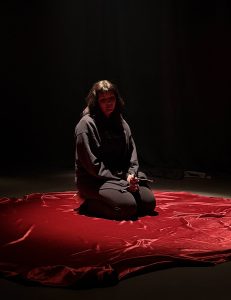
2026 motion pictures graduate Lauren Schack served as production designer on the “Fighters for Freedom” film project.
For Schack, who served as production designer, the project offered a chance to explore Johnson’s work while collaborating on a film that would reach a broad audience.
“I learned a lot about William Johnson and the civil rights and political work that he did through his art,” she said. “And, of course, I learned about what can be accomplished when creative minds come together to make something special.”
Having her work featured in a museum was especially meaningful to Schack.
“I’m very proud that my work is being exhibited at the Dayton Art Institute,” she said. “It makes me feel very accomplished and also very honored that I get to be a part of sharing such an important artist.”
Jenkins, who served as the gaffer, or lighting technician, said the project introduced her to influential Black artists and history while reinforcing the importance of collaboration.
“The more I learn about important people and information that involves my culture, the better,” she said.
Jenkins said seeing her work featured in a museum at such an early stage of her career was both surreal and validating. “I suppose it means I’m on the right track,” she said.
Both filmmakers credit Wright State’s motion pictures program with preparing them for opportunities beyond the classroom.
“My time at the Tom Hanks Center for Motion Pictures prepared me greatly for this opportunity,” Schack said. “I learned how to work with fellow creatives, hone my creative skills and forge connections with new people through art.”
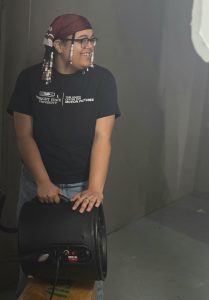
Motion pictures student Ciarah Jenkins, the film’s gaffer, on set during production.
Jenkins said the guidance she received from Wright State’s faculty prepared her for professional opportunities beyond the classroom.
“I couldn’t have done any of the jobs I completed without our wonderful faculty and staff being there to teach us everything we need to know to carry us forward in our careers,” she said.
Dan Zehringer, D.M.A., director of outreach and engagement for the School of Fine and Performing Arts, said the students’ experience reflects the type of real-world learning opportunities Wright State provides.
“Professional projects introduce students to an entirely different level of responsibility and collaboration,” he said. “Those experiences teach flexibility, communication, accountability and creative problem-solving in ways that simply cannot be fully simulated within a traditional academic environment.”
Zehringer said the collaboration with the Dayton Arts Institute also allows the students to contribute to a nationally visible project while showcasing the caliber of work produced in the Tom Hanks Center for Motion Pictures.
“Having work featured as part of a Smithsonian-organized exhibition is an experience that many young filmmakers only dream about,” he said. “It demonstrates that the quality of work being produced at Wright State is not simply meeting classroom expectations — it is contributing to projects of national historical and cultural significance.”
 Finding the Wright Path
  Wright State University announces sold out game for Stars, Stripes and Flight Classic featuring Air Force Falcons
  Wright State’s Family Weekend brings Raider families together
  International scholars
  A fresh start leads to finding his people