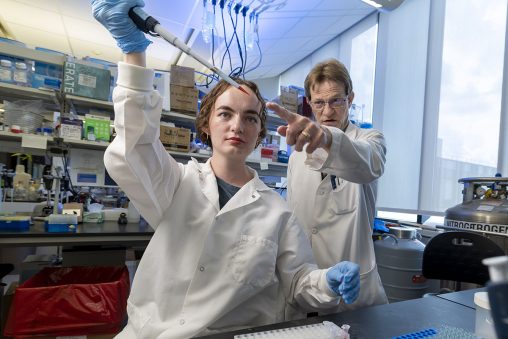
A Wright State team, led by researcher Thomas Brown, has identified what may be driving severe early-onset preeclampsia and a possible way to treat it without medication. (Photos by Erin Pence)
Severe early-onset preeclampsia has confounded doctors for more than 2,000 years. It can strike as early as 20 weeks into pregnancy, sending blood pressure soaring and putting both the mother and baby at risk.
A Wright State University team led by pregnancy researcher Thomas L. Brown, Ph.D., may have identified a key piece of the puzzle — and a possible way to treat it without medication.
The team discovered that women with severe early-onset preeclampsia have far more circulating extracellular vesicles — tiny particles released by cells — than women with healthy pregnancies. When researchers reduced those particle levels to normal in laboratory testing, the blood vessel dysfunction associated with preeclampsia disappeared.
“It was so exciting,” said Brown, the associate chair for research and a professor in the Department of Neuroscience, Cell Biology and Physiology, and professor of obstetrics and gynecology. “What this means is, in a severe preeclamptic, if you can just reduce the number of these circulating extracellular vesicles, you can prevent endothelial dysfunction — the blood vessel formation will be fine, and you should be able to reduce the blood pressure and alleviate the condition.”
Preeclampsia is a leading cause of maternal and infant illness and death worldwide. It develops in the placenta during pregnancy and can lead to a sudden and life-threatening increase in the mother’s blood pressure, putting her and her baby at serious risk.
From a clue to a potential cause
The team’s findings, published in Hypertension, the leading journal serving the international hypertension community, were selected for the September cover.
The breakthrough builds on research Brown and his team published last year, when they found significantly elevated levels of extracellular vesicles in the blood of women with preeclampsia. The levels were especially high in women with severe early-onset preeclampsia, the form of the disease that poses the greatest risks to mothers and babies.
In their latest study, the researchers investigated whether those particles could be responsible for the blood vessel problems associated with the condition.
They isolated extracellular vesicles from the blood of healthy pregnant women and women with severe early-onset preeclampsia and applied each to endothelial cells, which line blood vessels and are responsible for forming new ones.
The difference was clear. Extracellular vesicles from healthy pregnancies allowed the cells to form blood vessels normally, while vesicles from preeclamptic patients did not.
Then came the key discovery: The problem appeared to be caused not by what the particles were carrying but by how many were circulating in the blood.
When researchers increased the number of extracellular vesicles in healthy pregnancies to levels found in women with severe early-onset preeclampsia, the cells developed the same blood vessel dysfunction.
However, when they reduced extracellular vesicles from women with severe preeclampsia to levels found in healthy pregnancies, normal blood vessel function was restored.
They also found that a tenfold reduction in extracellular vesicle levels was needed to restore normal blood vessel function in the lab.
If they can develop a safe way to reduce the number of circulating extracellular vesicles in women with severe preeclampsia, Brown said, it could potentially prevent the blood vessel dysfunction that can lead to dangerously high blood pressure in preeclamptic women.

From left: The Wright State research team behind the preeclampsia findings includes David Dhanraj, chair of obstetrics and gynecology; Traci Rackett, program manager, obstetrics and gynecology; Rose Maxwell, director of research, obstetrics and gynecology; Thomas Brown, professor of neuroscience, cell biology and physiology and obstetrics and gynecology; and Scout Bowman-Gibson, a dual M.D./Ph.D. student.
A potential new approach to treatment
The study did not establish a treatment for preeclampsia, but it provides a clearer understanding of what may be driving the blood vessel dysfunction and identified a specific target to investigate when designing possible treatments.
Because few treatments can safely be given during pregnancy without risk to the baby, Brown’s team is pursuing an early-stage method to remove excess vesicles from a patient’s blood, rather than treating the condition with medication.
Their goal is to extend pregnancies complicated by severe early-onset preeclampsia safely past 34 weeks, the point at which outcomes for both mother and baby improve significantly.
That goal shapes the focus of Brown’s research. Rather than studying preeclampsia broadly, his lab concentrates on patients with severe early-onset disease, which can develop as early as 20 weeks.
“Those are the ones that put the moms and the babies at the most risk,” Brown said.
Collaborative research project
That focused approach depends on a close partnership with clinicians. Physicians at Premier Health and in Wright State’s Department of Obstetrics and Gynecology obtain patient consent and collect blood samples, while Brown’s campus lab analyzes them using specialized equipment that can measure a patient’s vesicle levels in about an hour.
David Dhanraj, M.D., chair and associate professor of the Department of Obstetrics and Gynecology who practices at Premier Health OB-GYN, said the partnership has been one of the most productive and consequential research efforts he has ever been a part of.
“Our collaboration has accelerated the translation of findings from bench science to human pathophysiology and soon to clinical application,” Dhanraj said. “I feel hopeful that in my lifetime a detailed understanding of this disease through research such as ours could lead to actual treatments to prevent or reverse preeclampsia.”
The collaboration has also given numerous students opportunities to contribute directly to the research.
Brown credits much of the research’s pace to Scout Bowman-Gibson, a dual M.D./Ph.D. student in Wright State’s Boonshoft School of Medicine who drove the project forward.
“To have that kind of breakthrough in a relatively short time — it really was a freight train,” Brown said. “It just kept moving, and everything just kept falling into place.”
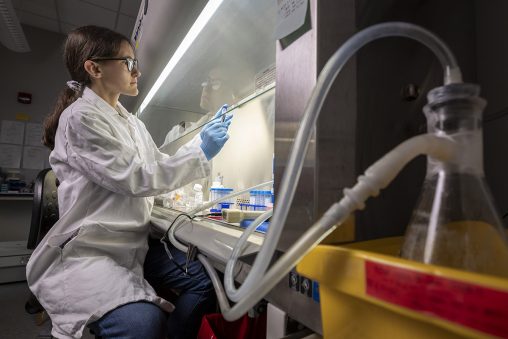
Thomas Brown’s lab in the Visal Soin Center for Innovation serves as a training ground, bringing students at every level into research that bridges basic science and patient care.
Training the next generation of researchers
Bowman-Gibson, who based her doctoral dissertation on the extracellular vesicles study, was drawn to preeclampsia research because so much is still unknown about the condition.
“Research focused on improving maternal health outcomes is historically underfunded and slow to progress,” Bowman-Gibson said. “Helping design this study has been fulfilling and exciting. Our lab is motivated to share the significance of our work to advance reproductive research and ultimately see a significant difference in the rates of pregnancy-related morbidity and mortality.”
The project was designed around integrating patient care with innovative research strategies, Bowman-Gibson said.
“Mothers are genuinely excited when they are able to contribute to work that could improve the well-being and health outcomes for other mothers in the future,” she said.
Bowman-Gibson, who received her Ph.D. in biomedical sciences and is now in her third year of medical school, said the research experience reinforced her interest in integrating research with everyday patient care.
“If we never understand the basic underlying mechanisms that contribute to a patient’s pathological state, then we will never fully understand or know how to treat that person,” she said. “Although this process is long and difficult, doing the combined M.D./Ph.D. program has provided me the unique opportunity to learn how to be an effective and productive researcher while also training to provide high-quality, compassionate patient care.”
A leading expert on preeclampsia, Brown has secured more than $10 million in external funding to support his research, including several grants from the National Institutes of Health.
With appointments in the departments of Neuroscience, Cell Biology and Physiology and Obstetrics and Gynecology, Brown collaborates with investigators in numerous areas, helping bridge fundamental molecular biology with clinical and translational research in obstetrics, fetal medicine and cardiovascular physiology, while mentoring dozens of Ph.D., medical, graduate and undergraduate students.
“We have an M.D./Ph.D. student, we have medical students, we have undergrads, we have graduate students,” he said of his lab in the Visal Soin Center for Innovation. “It’s representative of the mission here — to train future scientists in very cutting-edge research. And it’s rewarding to be a part of something that’s getting so close to maybe making a difference. It’s hard to do in science. When you get that close, it’s pretty gratifying.”
 Wright State researchers identify potential driver of severe early-onset preeclampsia
 Wright State nursing students spend Fall Semester in upgraded facilities
 Sold-out crowd cheers on Raiders at Stars, Stripes and Flight Classic
 A new look with a nod to the past: Wright State unveils redesigned basketball court
 A career-beginning injury