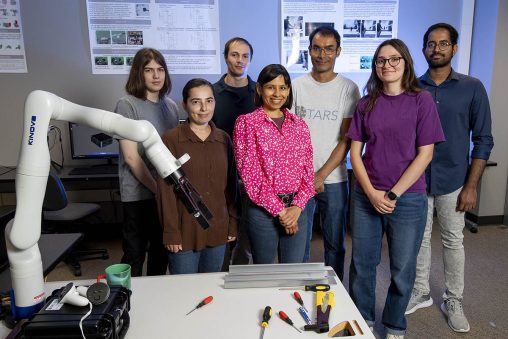
 “Recyclofacturing” is set to enter Dayton’s manufacturing vocabulary, as two faculty members at one of the region’s largest universities undertake the transformation of scrap metal recycling into new products.
Natasha and Sean Banerjee, associate professors in Wright State University’s Department of Computer Science and Engineering, have secured a nearly $3 million research grant to spearhead research into a more sustainable metal recycling process. This is the second-largest National Science Foundation research grant Wright State has ever received.
The two will lead the research project, collaborating with California’s Santa Clara University and Chapman University; the University of Lynchburg in Virginia; and New York’s Clarkson University.
Wright State will serve as the project’s lead institution.
“This grant brings novel technologies to Wright State,” Natasha Banerjee said. “Wright State will be the face of pushing new technologies for manufacturing.”
The couple’s goal is to keep more manufacturing operations in the United States by equipping recycling facilities with advanced technologies, allowing workers to turn usable metal parts into new products rather than shipping scrap overseas. For example, a customer could request a custom item, such as a pencil holder, that would be designed, cut and assembled locally from recycled materials.
Recycling plant employees would be trained as “recyclofacturers,” using AI-driven design tools, virtual reality headsets for step-by-step guidance and collaborative robots to assist with assembly and welding. This approach can be likened to the small fabrication shops once common across the U.S., but with a modern, high-tech update.
Instead of robots eventually replacing workers, a concern that has been voiced to the Banerjees, the researchers will focus on how robots can be used collaboratively, like tools, in the workplace.
As part of the project, the Wright State team will acquire high-tech equipment in September, including a robotic weld-training system, a robotic arm, a high-performance GPU computer and augmented reality and virtual reality systems.
The project incorporates an education and workforce development component, offering both community courses to introduce new tools and techniques and research assistant roles for Wright State students beginning in spring 2026.
Read the complete article at bizjournals.com/dayton.
 Wright State Dean Timothy Bunning inducted into National Academy of Engineering
  Finding the Wright Path
  Wright State University announces sold out game for Stars, Stripes and Flight Classic featuring Air Force Falcons
  Wright State’s Family Weekend brings Raider families together
  International scholars