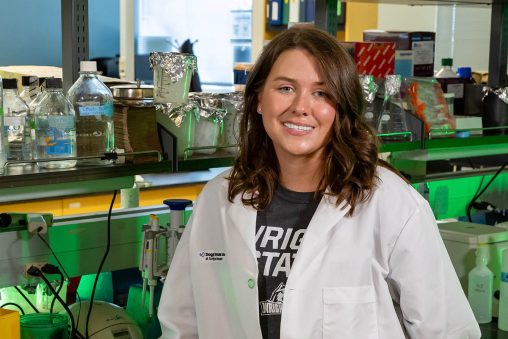
Now at the No. 1 graduate school in the country for biological sciences, Christina Davis ’21 credits her Wright State education for helping lay the foundation for her success. (Photo by Mike Burianek)
A person with true vision doesn’t overlook the promise right in front of them. Christina Davis ’21 has already proven that twice: first, when she chose to attend Wright State University, and now once again, as she explores soil for the next breakthrough in cancer treatment.
Davis earned her bachelor’s degree in biochemistry and molecular biology at Wright State and is in the doctorate program in the Skaggs Graduate School of Chemical and Biological Sciences at the Wertheim UF Scripps Institute for Biomedical Innovation & Technology, U.S. News & World Report’s No. 1 graduate school for biological sciences (tied with MIT).
The nature of discovery
At UF Scripps, she’s also conducting research in the Natural Products Discovery Center, growing bacteria from soil samples to identify their bioactivity and determine their benefits.
“A lot of modern-day medicines come from natural sources. People tend to forget that,” Davis said, naming penicillin as a prime example. The World Health Organization states that over half of medicines in use today are derived from natural sources.
“We’re trying to find clinically relevant compounds from soil bacteria and identify their bioactivity,” said Davis.
In other words, they’re searching for bacteria that produce compounds that naturally fight cancer, tuberculosis, malaria and other known diseases.
The samples currently held by the Natural Products Discovery Center hold the potential for 3.75 million new discoveries built upon the foundation of millions of years of evolution.
That entails a lot of lab work, and Davis got a strong start before she even entered Wright State. As a student at Archbishop Carroll High School, she was able to participate in an iGEM (International Genetically Engineered Machine) competition where the team was co-mentored by Air Force Research Laboratory scientists.
It was a connection that stood out because she already knew that she wanted to earn her doctorate. College was on her mind early.
Five minutes from AFRL
Davis grew up in a Raider family. Her parents met at Wright State, and they worked there when she was younger. Her mom, Cathy Davis, earned two degrees from the university and is currently the director of the early college high school programs.
So, when it was time to choose her own path, Davis was all in with Wright State.
“If you grew up around Dayton, you can forget how unique that opportunity is,” she said about Wright State’s connections to Wright-Patterson Air Force Base and the collaborative research opportunities available. “AFRL is a top research institution in the country, and it’s about a five-minute drive from campus.”
During her four years at Wright State, she worked part-time at the Air Force Research Laboratory. She assisted on COVID-19 projects during the pandemic and saw scientists across the country drop everything to converge on a single problem with remarkable speed. She also competed on the Raiders’ inaugural iGEM team — bringing her experience from winning gold with her Carroll High School team.
“Ever since then, I’ve been hooked on research. And graduate school is a lot more research than it is coursework,” Davis said. “Getting lab experience during your undergraduate degree is essential.”
In addition to the lab work she was able to do at the Air Force Research Laboratory, Davis pointed to the rigorous academics at Wright State as laying the foundation for her success at UF Scripps.
“For example, the advanced biochemistry classes have translated especially well to my Ph.D. program,” said Davis. “I think those courses aren’t offered at a lot of institutions, and the professors in that department are incredible. Their research labs are doing incredible things. It was inspirational as an undergrad.”
Going further
After earning her doctorate, Davis is interested in moving beyond the lab to help the maximum number of people.
Her vision? She sees opportunity in helping company founders and venture capitalists identify the most promising research discoveries from academic labs or early-stage startups and advance those technologies to clinical development.
“It requires a lot of money,” said Davis. “Venture capital has always been a major piece of the puzzle for getting new discoveries into clinical trials.”
It’s an issue that Davis learned about in graduate school as she got deeper into clinical and translational — or practical — research. And what drives her is treating disease. The more people that can be treated and, more specifically, the earlier they can be treated, the better off everyone will be.
She is set to earn her doctorate in November, completing a journey that began at Wright State but is only the beginning of a life’s work that could benefit us all.
“Ultimately, I want to help bridge the gap between academia and industry so that innovative technologies have the best chance of improving lives.”
 A fresh start leads to finding his people
  Wright State alumna and faculty member Amy Faust receives Emerging Cinematographer Award
  Weeks of Welcome helps Wright State students find place on campus
  Federally funded conservation treatment helps preserve Wright brothers’ family history
  Lake Campus expands recreation and engagement opportunities on campus