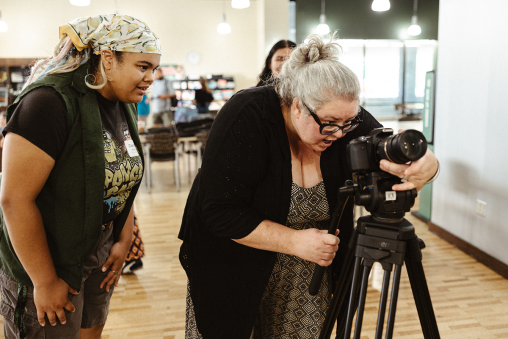
Wright State staff, faculty, students and alumni led the Muse Machine Summer Institute at the Tom Hanks Center for Motion Pictures. (Photos by Sarah Babcock)
At Wright State University, K–12 educators traded their classrooms for the set of a documentary film studio, stepping behind the camera to explore how stories take shape.
Hosted by Wright State’s Tom Hanks Center for Motion Pictures, Muse Machine’s Summer Institute for Educators challenged teachers to become students themselves as they learned the fundamentals of documentary filmmaking and collaborated with peers.
This year’s institute, “What the Camera Asks of Us: Curiosity, Care and Critical Thinking,” brought 38 educators, two undergraduate students and one teaching artist representing 26 schools across the Greater Dayton region to Wright State’s campus from July 20–23.
“Collaboration is intrinsic to the arts but can be challenging for educators who are the only subject-matter expert in their building and often have to be independent contributors,” said Emily Gray, director of secondary and educator programs at Muse Machine. “The educators who come to this institute get the opportunity to work with their peers in this kind of creative, messy atmosphere where the process is more important than the outcome.”
Muse Machine is a nationally celebrated arts education organization serving more than 76,800 students across 114 schools in Southwestern Ohio and Kentucky.
While Wright State and Muse Machine have previously worked together to offer performance tickets and backstage experiences to high school students and their teachers, this marked the first time the university hosted the Summer Institute. It was also the first time that motion pictures was the institute’s focus, drawing on the expertise and facilities of the Tom Hanks Center.
“As an alumna and instructor in the motion pictures program, it was wonderful to share our facilities with regional educators,” said Selena Burks-Rentschler, instructor of motion pictures and 2003 graduate. “I feel a deep pride being associated with this program, and it was especially meaningful to share this experience with our student volunteers, who represented the program beautifully with their professionalism.”
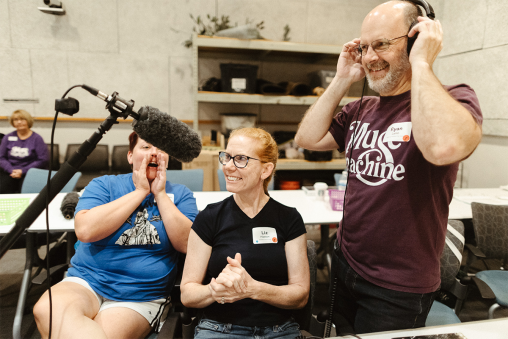
Participants left the program with hands-on filmmaking experience and new approaches that they can adapt for their own students.
A pre-institute workshop was held earlier this year at The Neon, where participants gathered for a screening of “Seeds,” the award-winning documentary by 2014 Wright State graduate Brittany Shyne. The film, which won the Documentary Grand Jury Prize at the Sundance Film Festival in 2025, launched the institute’s conversations around storytelling and truthful filmmaking.
The institute was facilitated by Nichol Simmons, a 1999 alum and director of the Tom Hanks Center. She was joined by student assistants Ciarah Jenkins and Haylie Chavez, as well as alumni and faculty members serving as teaching mentors:
- Parker Bowling ’21, motion pictures facilities and equipment manager
- Selena Burks-Rentschler ’03, instructor of motion pictures
- Amy Faust ’04, instructor of motion pictures
- Jazmyn Jefferson ’24
- Alvoro Leite ’05
“Our goal was to inspire these educators to take something from documentary storytelling that they could use as a tool for their classrooms,” said Bowling.
Thanks to the Begley Family Fund, eight alumni came on board to assist the educators in editing their films at the end of the week: Josh Rapson, Em Ranalli, Zach Voght-Lowell, Ethan Frederick, Matt Wilson, Joey Meyers, Ben Gabriel and Luke Buell.
Participants left the program with hands-on filmmaking experience and new approaches that they can adapt for their own students. For Wright State faculty, the experience offered an opportunity to see how educators outside the film world approach the creative process, providing new ideas they could bring into their own classrooms.
“I have such an appreciation for how quickly non-filmmakers can develop a cinematic eye when given the right frameworks and the freedom to create,” said Burks-Rentschler. “Watching educators who have never held a camera produce thoughtful and meaningful short films reminded me that the barriers to entry in documentary filmmaking are often lower than we assume and that, along with a stronger commitment to collaborative project-based learning model, is something I want to bring into my teaching.”
“There is a lot of concern about young people’s abilities to navigate a world of competing narratives mediated by screens,” said Gray. “Wright State’s motion pictures program at the Tom Hanks Center offered our institute participants a hands-on exploration of documentary filmmaking and showed how the camera can be a tool of discovery. The teachers had great discussions about group dynamics, ethics, truth and the role of editing in how we choose to tell stories.”
 Finding the Wright Path
  Wright State University announces sold out game for Stars, Stripes and Flight Classic featuring Air Force Falcons
  Wright State’s Family Weekend brings Raider families together
  International scholars
  A fresh start leads to finding his people