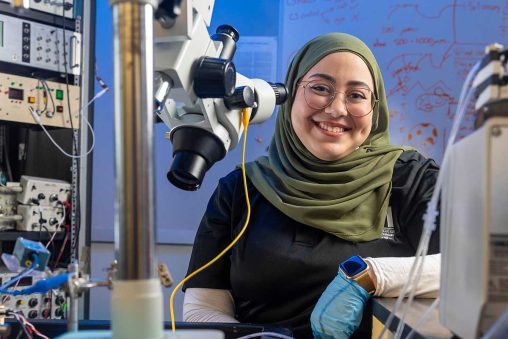
Hana Habib spent the summer researching how motor neurons change during the progression of ALS. (Photo by Erin Pence)
Hana Habib almost became fluent in more than one future.
She studied German, passed the language exam for medical school in Germany and started online coursework. Her mother was a big advocate of the plan, both for Habib’s future as a doctor and for her attending university in Europe; it’s a lot closer to their hometown of Port Said, Egypt, than the United States. But Habib was having second thoughts.
Her grandfather had lost his leg after a blood clot was spotted too late, and she watched him struggle to adjust to living with a prosthetic, eventually opting not to use it.
Habib knew that, as a biomedical engineer, she could work to improve outcomes for people like her grandfather. That’s how she found Wright State University half a world away; it was one of the few universities offering a dedicated biomedical engineering program.
So, she made her pitch to her parents — a full presentation — explaining why she should study biomedical engineering at Wright State. If you ever meet Habib in person, it will come as no surprise that she was convincing.
“I applied to the biomedical engineering program and also for a scholarship after learning about the You Are Welcome Here scholarships for international students,” said Habib.
As deadlines loomed with no confirmation from her top choice, she began to make plans at another university. Then she received the letter.
“I remember the exact day — May 3,” she said about opening the scholarship letter from Wright State. “My dad was like, well, sleep on it for a day. Wake up and see how you feel tomorrow morning.”
She woke up certain.
Studying in the U.S. offered immediate advantages. In Germany, her med school admission would hinge on an in-person exam and acceptance. And, once admitted, she’d need to arrange her own apartment and roommates.
“That’s a lot of uncertainty for an 18-year-old,” said Habib. “At Wright State, I would know which dorm I’m living in and who I’d be living with. I’d know my major. All of that is already before ever stepping foot in the U.S.”
A Career Hub visit spurs growth
Habib’s top recommendation to students to overcome potential homesickness? Get involved.
As a first-year student who moved here alone, she started joining organizations early. She’s now active in student government and is a President’s Ambassador, treasurer of the Biomedical Engineering Society, president of Engineers Without Borders, and that just touches the list of activities she’s involved in.
She also wanted professional experiences but knew she could use some help since she was new to American norms. So, she visited Wright State’s Career Hub to build her resume from scratch, meeting with a career consultant to learn what to add and what to leave out.
“That helped me establish a base format, and I still use that same format today,” Habib said.
She sent that resume to about 30 national research programs, and it helped her land an internship at the highly competitive Summer Program for Undergraduate Research at the University of Utah in Salt Lake City.
At SPUR, Habib worked directly with amputees, and she published her findings at the conclusion of her research: “Using the Posterior Root Muscle Reflex to Infer Changes in Spinal Cord Excitability.”
“The experience was very hands-on,” said Habib. “I spent all three months of summer working full-time in the lab. I was there every day with the participants collecting data and analyzing it afterward.”
Now she’s applying what she learned through experience on campus in the Neuro Engineering, Rehabilitation and Degeneration Lab of Sherif Elbasiouny, Ph.D., where her focus has shifted from amputation to ALS — studying how motor neurons change before and during the disease’s progression.
“With ALS, they do degenerate, but we just don’t know why, what happens, or how it happens,” Habib said. “We’re trying to find what those changes are.”
Looking forward to future and family
Habib is currently finishing applications to doctoral programs, including at the Utah lab where she interned. Her goal: become a professor and run her own research lab focused on the nervous system.
“I love teaching,” said Habib, whose parents both teach high school. “With college students, they want to be there willingly.”
Her advice to other students considering Wright State: ask questions before you arrive, and say yes to opportunities once here.
“Even if you are still in your home school and not in the U.S. yet, email UCIE (University Center for International Education) if you have any questions,” Habib said. “They are very responsive.”
And she credits campus involvement — Student Government and two engineering organizations — with helping her push past homesickness early on.
Wherever her education takes her, Habib said that any success will always circle back to family: she’s hoping she can land somewhere she can easily visit her parents or bring them to her.
“My parents are my biggest supporters right now.”
 Wright State University announces sold out game for Stars, Stripes and Flight Classic featuring Air Force Falcons
  Wright State’s Family Weekend brings Raider families together
  International scholars
  A fresh start leads to finding his people
  Wright State alumna and faculty member Amy Faust receives Emerging Cinematographer Award