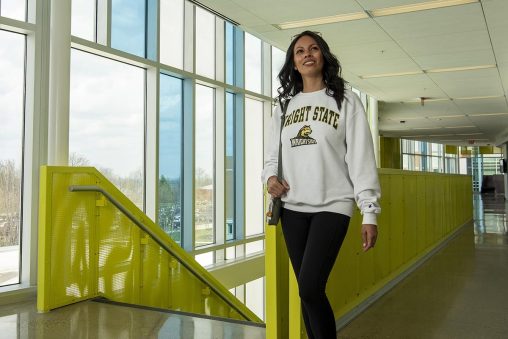
Monica Sewell transferred from Sinclair Community College to Wright State, where she earned her degree in social work. She’s now pursuing her master’s degree. (Photos by Erin Pence)
Transfer students often wonder which of their credits will count. When Monica Sewell ’26 transferred to Wright State, she had that information locked in.
Sewell transferred from Sinclair Community College through the Wright Path Program, earned her bachelor’s degree in social work and will now finish her master’s degree in just one year.
But it was a long road to get there. Sewell, 46, earned a GED and spent years managing restaurants, convinced that was her ceiling without a degree.
After her family experienced a tragedy, she attended counseling with her children and was surprised to learn that their counselor was a social worker. When she thought of social workers, she had only considered jobs like caseworkers or working for children’s services.
“I didn’t know social workers could do counseling,” she said. “I looked into it, and I was like, ‘This is what I want to do.’”
She had tried college once before, at 22, and quit after a class or two. One big reason was that she was reluctant to ask for help when she was struggling with the technology.
This time around, she offered herself more grace and asked questions when she had them. That’s how she found the Wright Path Program.

Monica Sewell hopes others can learn from her experience, and she’s now the one helping students find the Wright Path Program.
During her first semester at Sinclair, she passed the program’s table between classes and took a pamphlet. By her second semester, she had stopped to talk. Then she was set up with an advisor at Wright State and entered the program.
“I don’t wait for other people to tell me answers anymore,” she said.
The Wright Path Program links Wright State with Sinclair and other area community colleges, so transferring is easier and brings a bachelor’s degree within reach for more students.
“Sinclair and Wright State literally work together to make that transfer as easy as possible so that you know exactly what classes you need and what is and is not going to transfer over,” she said.
Advisors at both schools helped her get everything lined up for success.
In fact, Sewell’s Wright State advisor became one of her biggest assets. For her first three semesters at Wright State, they registered for classes together.
“My advisor said, ‘I’ll help you — I don’t want you to miss a class because something went wrong,’” and Sewell explained how important that was to her. “If you go in to register and something’s wrong, advisors have the ability to fix it — they know the people to work with.”
The program also offers a $1,000 scholarship, which “You literally just sign up,” Sewell said, explaining how easy it was to apply for the scholarship. “They don’t require anything of you, but you can do so much with it,” she said.
For Sewell, that included joining Tau Sigma, a national transfer student honor society after excelling in her first semester at Wright State. Now she’s one of the people at the table, talking with prospective transfer students in the five partner schools (Cincinnati State, Clark State, Edison State, Sinclair and Southern State) about how the Wright Path Program can help them earn their degree.
“I didn’t know what resources were available to me, and I want to help provide that information to other students so they know they can succeed,” she said. “If I can do this at 46, anything is possible.”
 Finding the Wright Path
 Wright State University announces sold out game for Stars, Stripes and Flight Classic featuring Air Force Falcons
 Wright State’s Family Weekend brings Raider families together
 International scholars
 A fresh start leads to finding his people