From investigating invasive species to determining what temperature light makes someone perform at their best, Wright State University students in the College of Science and Mathematics spent the summer sharing research that holds real-world implications. Through faculty mentorship and hands-on experiences, these scholars expanded their knowledge, presented their findings and prepared for future careers.
Finding the flow
Tim Fauley, Ph.D. student in environmental sciences
International Conference of the IEEE Engineering in Medicine and Biology Society
Toronto
At his first conference outside of Wright State, Fauley shared his research regarding how the temperature of light in your environment affects your ability to get into a flow state — a period of deep focus when someone becomes fully immersed in a task and loses track of time. Fauley’s research conducted in the DASH lab with William Romine, Ph.D., professor of biological sciences, suggests that flow states are more easily achieved in warm-temperature lighting than under standard ambient light. As the research continues, it could provide insights into how people can perform better simply by changing the lighting in their environment.
“It was so much fun learning about others’ projects and having the opportunity to share my project with them. People had questions about my research that I genuinely hadn’t considered, and it is always helpful to have that outside input.”

Tim Fauley’s research could provide insights into how people can perform better by changing the lighting in their environment. (Photos provided by students)
Sounding off
Rachel Mansfield, Ph.D. student in environmental sciences
Ecological Society of America Annual Meeting
Salt Lake City
Using small, weatherproof audio recorders, Mansfield tested how automated sound analysis can improve the monitoring of secretive marsh birds in the Great Lakes region. The birds are difficult to survey because they live in dense, wetland environments and have unpredictable calling patterns. While traditional surveys require trained observers and only provide calls for short periods of time, autonomous recording units can collect calls over an entire season — providing more comprehensive data with less fieldwork.
“Gathering this information is essential for wetland monitoring and conservation efforts — understanding how wetland birds live, how their populations are changing, which habitats need protection or restoration. Findings from my research showed that detection distance greatly varies between species, and this knowledge will help researchers design surveys that are better suited for individual species.”
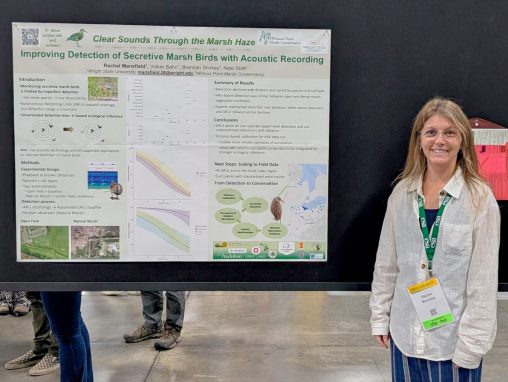
Rachel Mansfield is working to improve the process of gathering information about birds in the Great Lakes region.
Small but significant
Khong Lunaria, master’s student in biological sciences
Dipterists Society Field Meeting
Lake Itasca, Minnesota
Using data from the Thailand Inventory Group for Entomological Research project, Lunaria is looking to fill the knowledge gap on the occurrence and community composition of the Tachinidae family of flies, also known as “bristle flies,” in Thailand. Although often overlooked, these insects play an important ecological role. Because their larvae develop inside other arthropods, bristle flies are biological control agents and could serve as indicators of broader patterns of diversity and ecosystem health.
“This research would produce the first comprehensive baseline record of Thailand’s bristle flies that future studies can build upon and serve as a reference for conservation priorities in Thailand.”
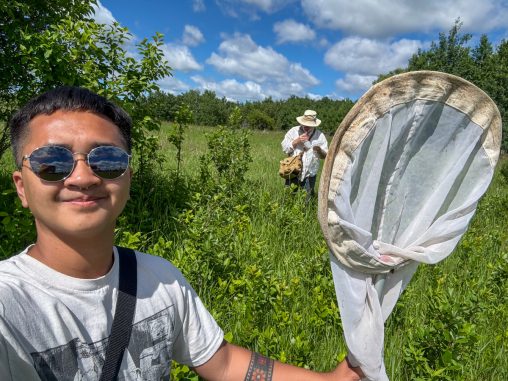
Khong Lunaria is hopeful that his research will produce the first comprehensive baseline record of Thailand’s bristle flies, serving as a reference for future studies and conservation priorities.
Modeling the mind
Jarean Carson, Ph.D. student in human factors and industrial/organizational psychology
Society for Mathematical Psychology and the International Conference on Cognitive Modeling
Montreal
How does the mind decide whether it recognizes something? Carson explored that question by creating a computer model that mimics how humans recognize and remember images. The model was designed to determine whether it had seen an image before, and Carson compared its speed and accuracy with the performance of people who completed the same task. The results showed that what one expects to see will affect both accuracy and response time.
The model helps people understand what cognitive mechanisms humans use in performing a memory task, and this research can be used in real-world applications, such as determining whether a tumor is present in the brain or whether an object found in luggage is dangerous.
“Attending conferences provides a growth experience unlike any other, augmenting the education and personal development that Wright State provides. I am deeply grateful to have this opportunity — as a nontraditional student, these kinds of opportunities are especially valuable.”
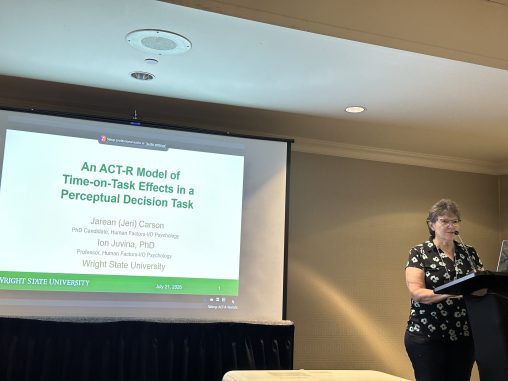
By creating a computer model that mimics how humans recognize and remember images, Carson’s research helps people understand what cognitive mechanisms are used in performing memory tasks.
Nature’s balancing act
Lindsay Rowland, master’s student in biological sciences
Ecological Society of America Annual Meeting
Salt Lake City
Amur honeysuckle typically outcompetes the native plants that it co-exists with; however, it can experience leaf blight — a fungal disease that causes its leaves to die. By studying how leaf blight alters the way the honeysuckle competes with other plants, Rowland hopes to improve the understanding of how this disease could influence ecosystems in our own backyards.
“I expect that this fungal disease is negatively impacting the honeysuckle’s competitive advantage and am so excited to take my research to the ESA annual meeting and discuss my preliminary findings with ecologists who work in different plant communities. Their fresh perspectives will be uniquely valuable.”
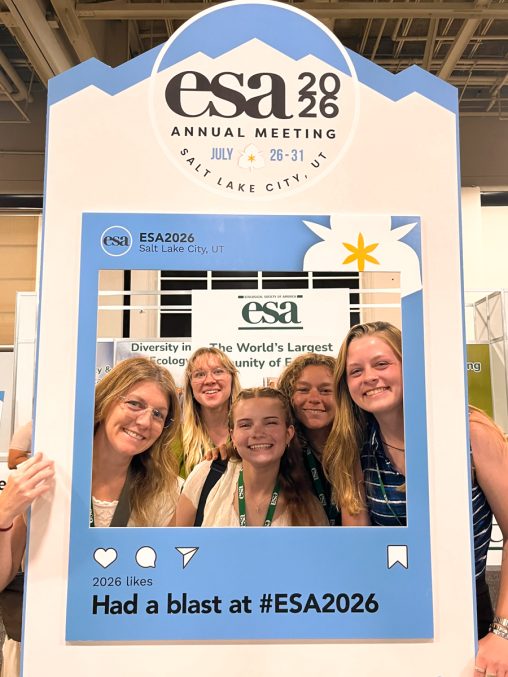
Over the summer, Wright State students presented their research at conferences across the United States and Canada.
Caterpillar clues
Dillynn Blevins, senior biological sciences major
Lepidoptera Society Annual Meeting
Pittsburgh
By studying the caterpillar communities on the shrub Autumn olive shrub (Elaeagnus umbellata) and comparing it to native plant species, Blevins is attempting to measure the ecological impact of this invasive plant. Very little is known about the ecological impacts of the shrub, but early findings suggest that in contrast to other invasives it may provide some ecosystem benefits.
“Being able to present my project to a room full of people who love moths and butterflies just as much as me was an amazing experience. I was even able to make some connections to help with my research in the future.”
Beauty or beast?
Mesa Grine ’26, master’s student in biological sciences
Ecological Society of America Annual Meeting
Salt Lake City
Originally from East Asia, Asian beautyberry was brought to Wright State’s campus as an ornamental plant. By conducting various experiments to evaluate if this non-native plant has traits consistent with other known invasive plants, Grine’s research will allow policymakers to be better educated on how to manage this plant and further conserve natural areas.
“Attending the conference allowed me to present my research to a diverse group of students and professionals from around the globe. I was able to network with my peers and industry professionals, gaining insight on future career pathways and research methods.”
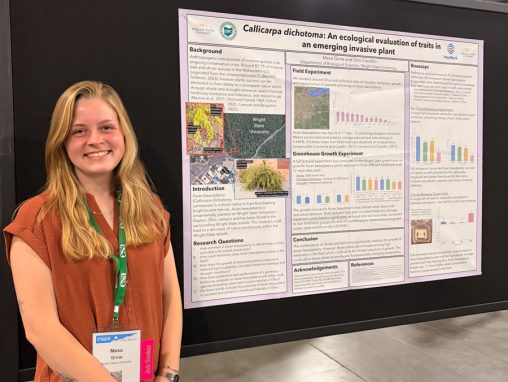
By studying the Asian beautyberry, Mesa Grines hopes to better educate policymakers on how to manage the plant and conserve natural areas.
 Wright State’s Family Weekend brings Raider families together
  International scholars
  A fresh start leads to finding his people
  Wright State alumna and faculty member Amy Faust receives Emerging Cinematographer Award
  Weeks of Welcome helps Wright State students find place on campus